
Dundalk blind tennis champ to represent Ireland at World Championship

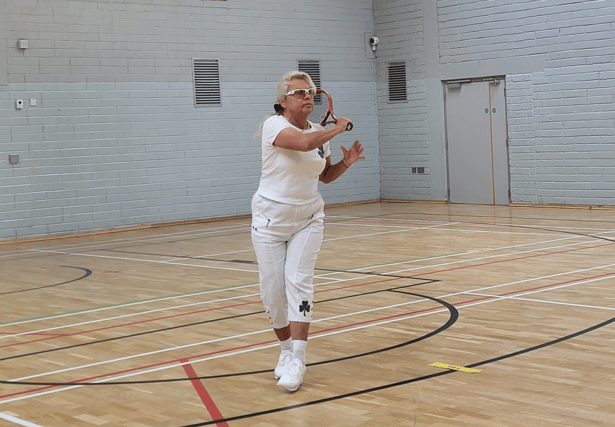

Blind/Visually Impaired (VI) Tennis
Babs Weiberg, had never played or had even heard of Blind/Visually Impaired (VI) Tennis before April 2018, but now, for the second time, is part of the Ireland team preparing to take part in the Blind Tennis World Championship taking place in Birmingham in August.
Babs has about 5% eyesight, and admits that when someone first asked her in April 2018 if she interested in playing blind tennis, she had never even heard of the sport, and asked “have you been on the Guinness?”
She had watched tennis but had never played it before, so deciding to give it a go, she went to her first session and the very next day she got her own racquet “and that's where the story started”.
Now, just over five years later, she has won the Irish Nationals, titles in Poland, Spain, numerous tournaments, was number four in the 2019 World Championships in Spain and is part of the team of eight players, two coaches and two guides, heading to the World Championship next month.
Ahead of one of her training sessions at the Dundalk Sports Centre in Muirhevnamore, Babs shares her story of how she got started, the sport and how it is played and the preparations for this year's World Championship.
Explaining how the game is played, Bab says that “depending on the severity of your sight loss, we get categorised and put into four different groups.
“Group B1 is completely blind people and they play in the service box of the tennis court and have up to three bounces with our sound ball.
“It's a foam ball, slightly bigger than an ordinary tennis ball, with an inner core like a table tennis ball with little plastic beads. So when that ball bounces we can orientate and hear it.
“So the next group, B2, that's where I play, because I have about 5% eyesight, I can roughly see your face but I would not recognise you when you walk by an hour later.”
The tennis balls are either yellow or black. “The two colours, yellow and black are because, like here in the centre, we have a bright wooden floor, so we use the black ball.
“On the outside court, we use the brighter yellow ball. Even though we are all visually impaired, some have a different way of seeing colours and some even like to play on the brighter court, with a yellow ball.
“For example when we are playing in a tournament, like it would be here, then the organisation says, “ok, black balls”. But if the players agree on playing with a yellow, they could use a yellow.
“So it depends on what they want. If one of the players say “no, I can't do that, I play with a black ball”, then it has to be the black ball.”
Babs was not always visually impaired. “I was born in Hamburg and I moved to Ireland in 2000. I was diagnosed in 2002 and by that time I had already lost 50% of my eyesight without knowing. I knew something wasn't right.
“One thing that I would like people to do – get your eyes checked twice a year, because if it's a slow deterioration, you don't realise. And the earlier it's detected, the better is the chance to repair or help you.”
Babs was always into sports. “I did all different kinds of sports. From school years, in summertime, athletics, in winter time, gymnastics. Then a lot of cycling – which I never really liked. Scuba diving and all these kind of things.”
Her diagnosis didn't put an end to that however. “I still did go to the gym. I did for a while a lot of water gymnastics. In 2012 I climbed with the Royal National Institute of Blind People (RNIB) group, Ben Nevis in Scotland. I even tried tandem cycling!”, she added.
Babs' positive outlook and determination is clear from first meeting her. “I try to be because everything I give up is taking away a little bit more independence and that's why I am very stubborn to give up things.
“Everybody is different. It's also that most of the people that see me walking around Dundalk would never realise that I have a visual impairment. Because I know the area so I have not a problem. If you send me to a place where I haven't been, that gets tricky because I can't read anything and a lot of things I can't see. So I did end up on the wrong bus [before]”, she adds, laughing.
The sport is getting bigger in Ireland, Babs reveals. “I think we have about 150 players all over Ireland and we play as one team in the World Championships, like they do in rugby.
“It's one team, that is very very good. That's why I can go sometimes to Belfast or to Shankill or down to Cork, so wherever I have a chance [to play].”
Everything at the moment is geared towards next month's World Championship. "The World Championship is integrated into the IBSA (International Blind Sports Federation) games in Birmingham and it is a very big competition, that was usually an athletic competition, and for the first time they integrated the blind tennis to make it known to a wider public, which is very important for the sport.
“The IBSA games is I think 1250 athletes coming, but about 20 countries from around the world playing tennis. So Australia will be there, Japan, South Korea, Colombia, Mexico, the European countries, and pretty new, two players from America, they joined last year.”
It will be expensive however for the team to go and compete, and any support that can be given would be greatly appreciated through a GoFundMe page that they have set up.
“The whole tournament”, Babs explains, “we are eight players going, two of the players are completely blind, so they need a guide. So the whole thing is almost €35,000.
“I do some fundraising here in town. Five years ago when we had to do it before going to Spain. Dundalk business people have been really supportive and I'm very grateful for that, they are so generous in giving whatever they can.
“I know that times are very difficult for everybody at the moment but without that we can't go anywhere.”
A donation to help the team fund their journey to Birmingham, can be made here: www.gofundme.com/f/g447n-
Babs has a message for anyone who is visually impaired and is interested in the sport. “Don't be afraid because the sport is really open to every age group, I'm not the youngest myself.
“We have equipment here that you can rent, so nobody has to buy anything. They can try it out and we will make it work that we may be able to set up a group again and I will work on that.
“It's also not just players. We really need coaches getting more involved. It's the same for coaches, don't be afraid. Like every other sighted player, there is no difference, just the ball. Come and give it a go!”
Her last words are to thank everyone at Dundalk Sports Centre in Muirhevnamore. Babs says they try to help her out whenever they can with the courts and speaks very highly of everyone at the centre. “It is really nice and so so supportive. They help me so much. It is really good.”