
Echoes of history at Louth's Anaverna House

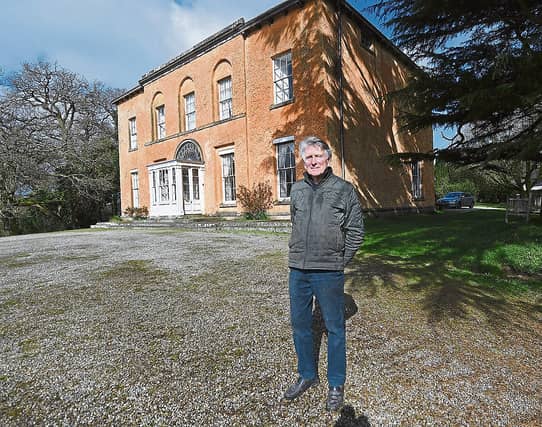

Delving into Anaverna House: Tracing centuries of stories and secrets on a journey through time
Aanaverna House, nestled amidst the tranquil foothills of the Cooley Mountains, stands as a silent witness to the ebb and flow of history.
Within its Georgian walls, a fascinating tapestry of narratives unfolds, linking together a diverse cast of characters spanning continents and centuries.
From its humble origins as the creation of Thaddeus Gallagher, a farmer and builder, to its current role as the cherished abode of Vere Lenox-Conyngham, Anaverna House has served as a stage for both local legends and international intrigue.
What do Daniel O’Connell, Virginia Woolf, a suspect for the Jack the Ripper murders and the founder of Singapore all have in common?
The answer is a connection to Ravensdale's Anaverna House which sits at the top of a steep avenue in the shadow of the mountain with which it shares its name near the Cooley Mountains.
Built at the turn of the eighteenth and nineteenth century by farmer/ builder Thaddeus Gallagher, the Georgian style manor house has seen many owners in its two hundred plus year history but for the past hundred or so years has been in the custodianship of the Lenox-Conyngham family.
Vere Lenox-Conyngham whose family were tea planters in Ceylon (now Sri Lanka), has called it home for fifty of those years, moving in permanently in 1974.
Affable and charming with a plummy accent, Vere has an almost encyclopaedic knowledge of the house’s history and a fair few anecdotes too, all retold with the warmth only someone with a personal connection to the place could possess.
“The house was originally built for a lawyer called McClelland,” he explains.
“Despite what people think it was never a landlord’s house, he was made Solicitor-General for supporting the act of Union but I don’t think his support was for any great patriotic reasons.
“The house is actually built off the plans from a patent book which had a copy of design drawings from a house in the south of England, now some of them weren’t great or well copied and you can see that in some of the features in the house.”
Indeed, the builder of Anaverna, Thaddeus Gallagher, was later surpassed in his architectural ability by his son, James Gallagher, who is famous for designing, among others, the building which was once used as New Orleans City Hall.
Judge James McClelland was quite notorious in his time and a story goes that he once saw Daniel O’Connell, with whom he had had disagreements with on more than one occasion, sitting in his court in a case he was not briefed in, in the apparent hope that a younger barrister would ask him to assist him in conducting the case.
McClelland told those present that he personally had never behaved in such a way as a barrister.
O’Connell is said to have sternly replied that McClelland had never been his model as a barrister, and he did not propose to take directions from him as a judge.
McClelland had no children of his own but raised his wife’s nephews at Anaverna, who were also the nephews of Stamford Raffles, a British colonial official and the man credited with founding modern day Singapore.
The house was passed onto one of the nephews, who soon found himself in considerable debt and was forced to rent out Anaverna for many years.
The next notable occupants of the house were the family of James Fitzjames Stephen, uncle of author Virginia Woolf and father to James Kenneth Stephen, tutor to the British royal family and controversially suspected by some writers to have been Jack the Ripper.
Used primarily as a holiday home by the Stephenses, they built wide paths through the forests to accommodate the wide dresses which were the style at the time, a mark which can still be seen around the grounds today.
The house was bought by Vere’s grandfather Edward Fraser Lenox-Conyngham in the run up to Easter week 1916, with Vere wryly remarking that “had he waited a few more weeks I suspect he would have gotten it considerably cheaper.”
The inside reveals a house that still retains many of its original features, although there have been modernisations over the years.
Traces of its illustrious past come alive in the form of ornate furnishings and faded portraits adorning the walls.
The grandeur of its Georgian architecture is a testament to the craftsmanship of its builders, while the subtle imperfections and quirks add an air of eccentricity.
Fireplaces are found in most rooms which back in the heyday of the house would have been fueled by enormous coal bunkers in the basement that were, as Vere explained, closed off many decades ago, adding with a smile, “I can honestly say I’ve yet to be in every room in the house.”
The gardens, like the house itself, have their own tales to tell. Belying the serenity suggested by a nearby croquet lawn, a damaged shed marks an incident in the 1950s when members of the IRA stashed explosives earmarked for the Newry canal within the outhouses only for them to go off during the night.
“A cousin was living in the house at the time and she rang up a neighbour to say the boiler had exploded and when the neighbour looked outside her window and saw it, there was an atomic-like mushroom cloud hovering over the place,” Vere laughs, adding, “the back windows were broken with the force.”
Vere’s enthusiasm for the place is evident as he moves from story to story weaving through the complete history of the house. Although he admits there’s always something to be repaired or a new disaster to avert, it's clear he relishes the challenge and is always ruminating on some new idea.
The aspect of the house’s history that is perhaps most well known locally is its function as a theatre and artists retreat, with the outbuildings hosting a range of musical and theatrical performances over the years as well as serving as a quiet place for writers to work.
The theatre and studio space forms part of a structure, which includes an old stables and school building with a courtyard in the middle.
Vere works with local artists and production companies to host events and although this tapered off during Covid, it is something he says he is interested in starting up again with a number of possible projects in the works.
Through Vere's efforts, Anaverna House has evolved from a historical landmark into a hub of artistic activity, its buildings finding new purpose and its grounds teeming with life.
The theatre and studio spaces will hopefully soon once again resonate with the sounds of music and laughter as local artists and production companies breathe new life.
Anaverna House stands as a symbol of rich local and international history, its walls echoing with the stories of years past.
Yet, it is not merely a relic of bygone days; it is a living, breathing testament to the enduring spirit of custodianship and stewardship.
Vere's unwavering dedication to preserving the house and its heritage ensures that it will continue to thrive for generations to come.