
Louth farmer addresses Oireachtas committee on issues facing dairying

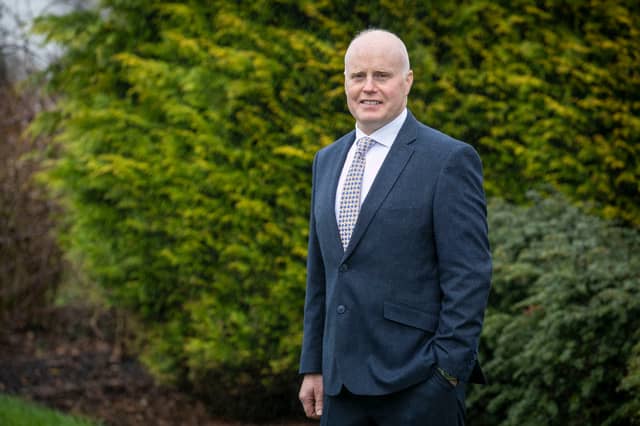

Niall Matthews is also Chairperson of Lakeland Dairies
Tully dairy farmer Niall Matthews addressed the Oireachtas Joint Committee on Agriculture this week, on key issues facing family farms and the agrifood sector amid concerns related to the future of the EU nitrates derogation for Ireland.
Mr Matthews is chair of the ICOS dairy committee (the Irish Co-operative Organisation Society) which represents the co-operative dairy processing sector. He is also Chairperson of Lakeland Dairies.
The Louth farmer, alongside ICOS President Edward Carr, told the Joint Oireachtas Committee that significant Government intervention is needed to ensure the future viability and environmental sustainability of the Irish dairy sector.
The ICOS delegation emphasised the dairy industry's unstinting commitment to environmental sustainability and stewardship, telling the committee that "Co-ops and farmers are deeply invested in advancing farm sustainability, with water quality as their foremost concern.”
ICOS is calling for the Government to form an inter-departmental taskforce led by the Department of the Taoiseach. This taskforce would be charged with thoroughly evaluating the economic and social implications of any further reduction to the Nitrates Derogation.
Additionally, ICOS says the Government should commission a comprehensive impact assessment to ‘fully and really’ understand the implications of a further reduction.
Analysis prepared by Professor Michael Wallace of University College Dublin, presented as part of ICOS's submission, reveals what ICOS says are stark economic challenges. This indicates that dairy farms in Derogation Band 3 could face a net margin reduction of -56% or €983/ha due to further derogation limits, thereby challenging their economic viability.
Mr Matthews and his ICOS colleagues also expressed concern a further reduction in the maximum stocking rate would severely compromise the competitive edge of Ireland's grass-based dairy system, highlighting the system's reliance on maximising grass utilisation.
ICOS warned that a further reduction to the derogation will drive farmers to a more global, indoor type of dairy production, with unfavourable economic, social and environmental consequences.
The delegation also cautioned that a reduction in farm profitability and changes to dairy production practices could have profound negative impacts on the downstream dairy processing industry, on sectoral cohesion due to milk supply shortages, and on the broader social and environmental landscape.
ICOS was forceful in calling on the Government to protect investments made by farmers, the processing sector, and the State in the Irish dairy industry by securing the Nitrates Derogation's future, also voicing concerns about the social effects of derogation reductions on family farms and the need for generational renewal.
ICOS President Edward Carr said, “A science-based approach indicates that the time lag between Nitrogen surplus losses and changes to water quality can vary between months to decades, due to groundwater pathways. The Government and European Commission must acknowledge that the range of new actions undertaken by farmers will require time to be implemented.
“We believe that the Government should prepare a strong science-based document, in advance of the next negotiations and with EPA input, similar to the MACC curve for Greenhouse Gas Emissions. This document, and a compelling case, is needed to map out the most effective mitigation measures on a catchment scale and provide realistic time horizons for the actions adopted by farmers.
“Further, ICOS calls on the Joint Committee to endorse the Ag Water Quality Working Group's proposals on slurry storage, including 70% grant aid for farmers. The Government must leverage the new Climate and Nature Fund, announced in Budget 2024, to provide funding for a national slurry storage project, in the context of climate adaptation.”
Strongly emphasising the importance of water quality, the ICOS team highlighted what it says is the need to prioritise resources for advisory services, including ASSAP, EIP and the Signpost Farm Programme, thereby it says, supporting compliance, awareness, and education regarding water quality issues.
Niall Matthews said, “Sustainability is our watchword and this must apply in equal measure to environmental priorities as well as the long-term sustainability of livelihoods in rural Ireland and the future sustainable progress of the dairy industry as a key pillar of the Irish economy.”