
Louth Motors: Hybrid technology, but at a price
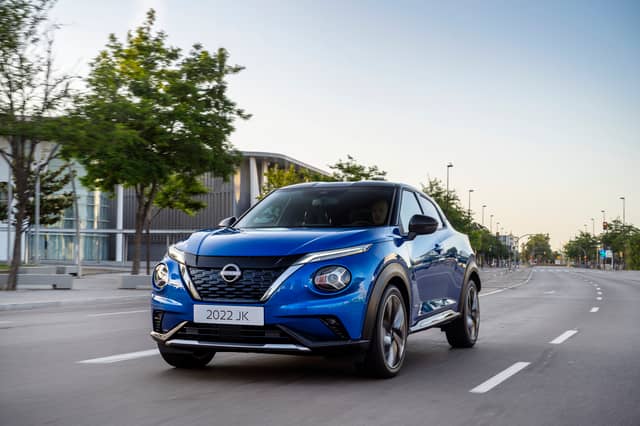

Nissan Juke Hybrid
In an era of it being hard to see any identifier for a new car where it could be a new model from any manufacturer, the Juke has a look that’s unique to it and Nissan have managed to keep it looking like a Juke from when it was first introduced in 2010.
I’m aware that the look, it could be claimed, is one that others will not be rushing to copy but the Juke has proved very popular saleswise and buyers are quite loyal.
Declaration of interest here. My dad, who is 88, has had his Mk1 2011 model from new and would never part with it.
It has a high seating position that helps with the obligatory bad back, gives a commanding view of the road and the high loading area makes the weekly shop that much easier for him and my mother.
The lifts to the bingo and the requirement to get in and out of the car at the drop off point are again made easier getting in and out for my mother who always travels Driving Miss Daisy style in the back.
The only criticism of the car my Dad will concede is the fuel economy. As most of his trips are city and urban ones 8.0l/100kms and above is regularly recorded and with fuel prices heading back to €2 a litre, it is expensive to fuel.
That all should be much better in this new hybrid version of the Mk2 model that’s available now. In terms of looks it’s the same as a normal Juke and whatever your opinions on the overall look of the car the front is a success. It’s like the Qashqai and the X-Trail, or are they like it? Either way it is a very good look.
I won’t make you wait until the end of the review to prove this and can tell you I managed a return of 5.7l/100kms for a mixed assortment of trips from town to motorway driving. The hybrid arrangement still uses a 1.6l petrol engine but the addition of the hybrid battery significantly reduces the fuel consumption. It has an all-electric EV mode that’s good for speeds up to 55km/h – Nissan don’t advise a range but with the battery at just 1.2kw/h it won’t be that far.
Nissan claims that this powertrain arrangement at 5.1l/100km reduces consumption by up to 40%, in and around town, and is marginally better than what I achieved so good that Nissan’s claim and my reality nearly align.
Nissan as a company is hedging their bets with electrification in cars with all-electric versions, their new e-Power engines that use a petrol engine to charge a battery which powers electric motors that drive the car.
This hybrid version, not a mild hybrid model, is another string to their bow and an electrification solution for markets where full-electric cars / driver circumstances may not be right at this time.
The drive in the Juke is quite quiet and comfortable with the only noticeable negative being its ability to absorb potholes – you really feel them if they are any way deep.
The Juke in hybrid format is a lovely car to take on the backroads and the feedback from the cars steering adequate.
Rally drivers and speed merchants won’t be buying a Juke unless it says Nismo somewhere on the bodywork. In town it is a cinch to drive & park which was always high on Juke appeal.
The e-Pedal drive arrangement makes stop-start driving, dare I say it, pleasurable and makes you more aware of using the car’s consumables wisely - be it brake pads or fuel.
In fact, driving any car with a battery element on board makes you consider how you drive to spare the energy you use, a welcome phenomenon.
The interior contains all the features we have come to expect in terms of comfort and safety with a wireless charger and a sizeable apple/android mirroring infotainment screen.
I quite like the way Nissan presents the drive selector as it is neat, compact and intuitive.
The synthetic leather seats in my “everything included” SVE model, for €38,350, were my takeaway star element of the car’s interior feeling very comfortable and plush.
In keeping the looks the same they maintained this theme on the inside as some of the designs in the original car still remain like the switches and air vents and are not so readily identifiable as Juke that they needed to be retained.
Which brings me nicely to the thorny issue of price. At the price level for the SVE model you are in and around Toyota Corolla Cross territory, again a hybrid, which I found surprising bordering on shocking.
I feel Nissan have overpriced the car with the price differential between the Yaris Cross and the cheapest Juke hybrid being €5k in the Yaris Cross favour.
The Yaris Cross is the runaway leader in this sector in terms of looks and sales (it is outselling the Juke by a factor of over 3:1) and Toyota have been in the hybrid space a lot longer and deliver a smoother drive.
The Juke Hybrid delivers its power smoothly too – just not as smooth. Of the Jukes sold 27% of them are hybrids so this form of power is finding traction and a significant number of buyers.
The Juke hybrid range starts at €35,350 for the SV Premium model which is €5k more than the equivalent manual petrol Juke model.
The Juke, in hybrid form, is a welcome addition to the range and will convert existing fans & owners to the powertrain but attracting significant numbers of new buyers will be hard work and a struggle.