
Louth swimmers conquer the infamous North Channel in grueling 13-hour relay

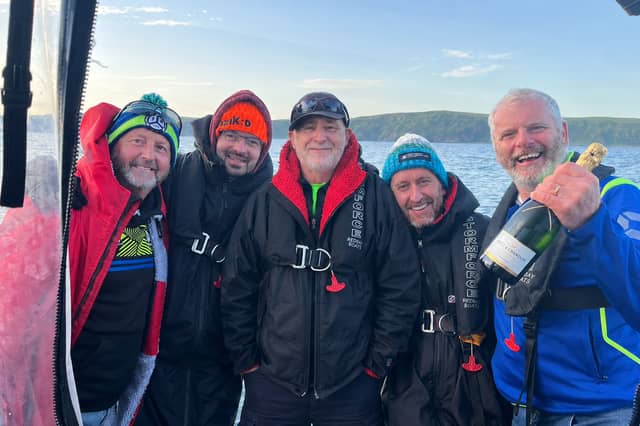

Months of sacrifice and training pay off for four Louth swimmers
Two years after testing their limits in the English Channel, a four-man relay team has successfully conquered what many open-water swimmers consider the ultimate Swimming Everest, The North Channel.
Local swimmers Paul Clinton, Blake Boland, Peter Farrelly, and Martin Gaynor officially completed the brutal 35-kilometre crossing on Monday, 24 June, landing on the Scottish coast after a grueling 13 hours and 27 minutes at sea. Because of the really strong currents, tides and wind they ended up swimming closer to 42 K.
Guided by the expert piloting crew at Infinity Channel Swimming led by pilot Jack and co pilot Jan, who were absolutely brilliant. The relay team of four swimmers took turns facing some of the most hostile swimming conditions on the planet. The stretch of water between Donaghadee in County Down and the Mull of Galloway is notorious for its strong currents, extreme cold, changeable winds and of course lions mane jellyfish.
The achievement is the culmination of a grueling, year-long training regime. The team spent twelve months splitting their time between relentless black-line pool training to build raw fitness and logging endless freezing miles in the open water at Clogherhead to acclimatise their bodies for the swim. Their training also included making sure that they ate the correct food and drink in preparation for the challenge.
To even be permitted onto the start line, each swimmer had to first pass a mandatory two hour continuous swim in sea temp of 14 C or lower. This is to prove that they could handle the cold water, and deal with the possible drop in core body temperature. The year of preparation proved vital, as water temperatures in the North Channel dropped below 12°C for portions of the swim, pushing their bodies to the edge of hypothermia.
The physical toll was magnified by the strict ILDSA channel swim rules governing the crossing. Under official channel swimming regulations, wetsuits or heat-retaining fabrics are completely banned.
The swimmer’s were permitted only standard swimming togs, a single cap, and goggles. Each swimmer entered the water to battle the elements for exactly one hour, immediately followed by the next swimmer in a continuous, unbroken chain.
The strategy required absolute precision and discipline. Furthermore, the rules dictate that this strict hourly rotation order cannot alter; if a single swimmer fails to complete their hour or touches the support boat, the entire team attempt is instantly disqualified. The North Channel is also infamous for its swarms of giant Lion’s Mane jellyfish.
Thankfully, luck was on the side of the Channel Chancers for this crossing, as the notorious stingers stayed deep down in the water. Allowing the swimmers to focus entirely on their swim pace.
Rather than navigating a minefield of tens of thousands of venomous jellyfish tentacles. Instead, the main battle was against the biting, at times sub-12°C water and shifting tidal currents and wind that constantly pushed the team off course. The flawless execution on the day proved that every single week of their year-long preparation was vital.
For Clinton and Boland, it marks a continuation of their open-water journey and with the addition of Farrelly and Gaynor to the team, not finishing wasn’t an option.
By the time the final swimmer, Paul Clinton, cleared the water and stood on the rugged Scottish shoreline—as required by rule to stop the clock—the time read 13 hours and 27 minutes. The feat cements their place in the exclusive club of athletes who have crossed one of the toughest channels in the world. More people have stood on top of Mount Everest than have swam the North Channel.
The channel chancers have now swam two of the Ocean 7s swims and with five remaining they are eager to continue their run.
The team said the achievement would not have been possible without the unwavering support of their families throughout the demanding year of training and preparation. They expressed their sincere gratitude for the encouragement and sacrifices made by their loved ones during the journey.
The seven swims are The English Channel, The North Channel, Catalina Channel (USA), Moloki Channel (Hawaii) , Cook Strait (New Zealand) , Tsugaru Strait (Japan), Strait of Gibraltar.