
Volunteers help save stranded dolphin in dramatic Louth rescue

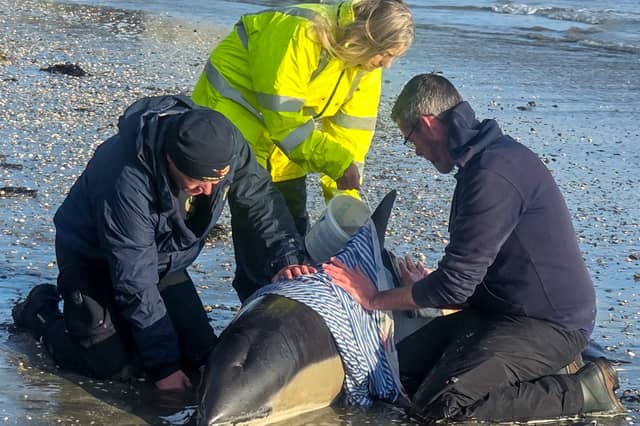

The rescue operation unfolded at Priest Beach in Blackrock yesterday morning
A rescue operation unfolded at Priest Beach in Blackrock yesterday morning after a common dolphin washed ashore, prompting a major effort by local volunteers and wildlife specialists to return the animal safely to the sea.
The animal had become stranded in the shallows. The dolphin appeared to be in good physical condition, with a normal breathing rate. However, it was being tossed around by the waves, prompting rescuers to carefully move it further up the beach to prevent water from washing over its blowhole. This allowed them to keep the animal safe and comfortable while they assessed its condition and awaited further assistance.
A team of rescuers worked together to keep the dolphin calm and comfortable while arrangements were made to transport it to deeper waters. A wet blanket was carefully placed over the dolphin, while buckets of seawater were regularly brought to keep its skin wet and prevent it from drying out.
According to the Louth Irish Whale and Dolphin Group: “Common dolphins are an open-water species. In the extensive shallows off Priest’s Beach, they can become disoriented and struggle to find their way back to deeper water, which can be several kilometres away. We decided to bring the dolphin to Greenore slipway, where it would have access to deep water and a route out to sea.”
A rescue sling was brought down to the beach to facilitate the animal's safe lifting and transportation to a van supplied by local charity Crosscause.
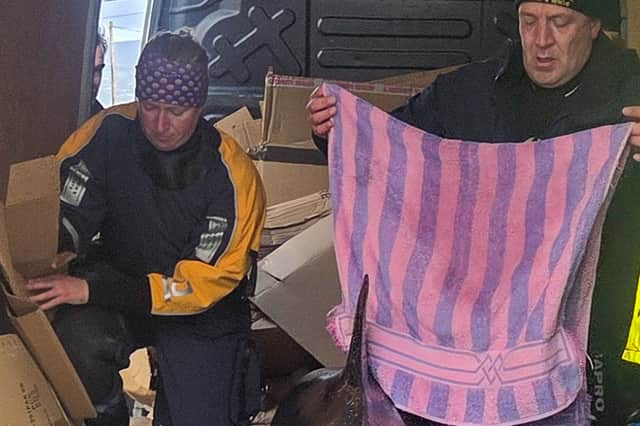
The operation was led by Conservation Ranger Jennifer Lynch, supported by members of Dundalk Sub Aqua Search and Rescue, a veterinary professional from Dublin Zoo and a number of other dedicated rescuers including IWDG responders, the National Parks and Wildlife Service (NPWS) and Louth County Council’s Biodiversity Office.
Local volunteers also played an important role, helping to direct traffic and ensure the transportation operation could proceed safely. The dolphin was kept wet throughout the journey, while its heart rate was monitored. Its sex was checked and measurements were also taken as part of the animal's assessment.
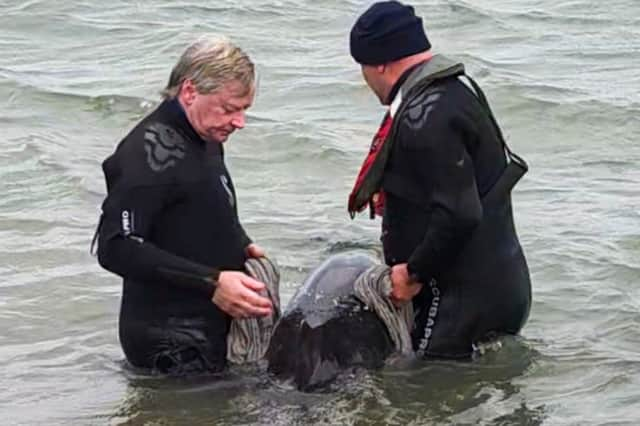
On arrival at Greenore, the dolphin was carefully removed from the van and brought towards the water. Rescuers then slowly and carefully placed it into the sea, where it was released and later spotted swimming strongly 2 km from the release site, still heading towards open water.
According to the Louth Irish Whale and Dolphin Group: “Live strandings can be very tough. When a dolphin is in good enough condition to refloat, it’s just wonderful to see it swimming strongly out to sea.
“Several volunteers who helped today took part in IWDG live stranding training in 2025, organised by Louth County Council with funding from the Local Biodiversity Action Fund (LBAF). That training has been put to use several times since, including in today’s rescue.”
The group also advised that: “If you see a dolphin in distress or in danger of beaching, call the IWDG Live Stranding Hotline immediately on 097 28118. Never drag or pull a dolphin by its tail or fins. This can cause serious injury and severe stress.”