
Apple Tree Yard creator Louise Doughty reveals shocking family secret
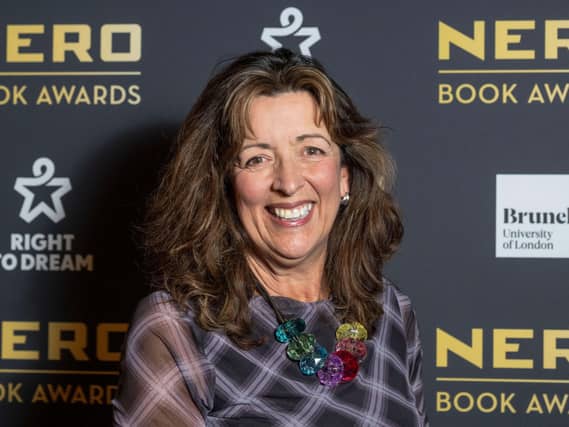

The thriller writer has penned her parents’ true love story – with an unexpected twist.
Best known for her gripping thrillers including Apple Tree Yard and Platform Seven, both made into TV adaptations, bestselling author Louise Doughty has now turned her attentions closer to home.
“As I like stabbing people and killing people in my novels, this is probably, as I’m saying to everyone, the only love story I’m ever going to write,” she says of her new book, On This Spot Fell One Tear Of Love, which charts her parents’ love affair and 60-year marriage which lasted despite her father’s battle with Alzheimer’s in the last few years.
It’s a beautifully written memoir of a working-class couple, Ken and Avis, finding their way in the Fifties amid all the social restrictions of the time, which touchingly explores love and loss, the grief of losing her parents and the lifelong secret they kept from their children.
Written in reverse, it begins with the end of their lives, moving on to the family dynamic, lifestyles and the surprise element which is how the love story began.
It was while clearing out the family home in Leicester that Doughty stumbled upon a battered black suitcase, the last item left in their bungalow before the sale of the house was completed, inside which was a treasure trove of letters that revealed the origins of her parents’ love affair.
Safe to say, it’s a bombshell which reveals three people in a love triangle and proves almost as surprising as some of the twists in her thrillers and upended all of Doughty’s preconceived ideas about her parents.
They weren’t always happy, she says of Ken and Avis, but they stuck together through thick and thin, even when her father became psychotic through Alzheimer’s.
When he was having psychotic rages, he imagined that his wife was trying to kill him and once threatening Doughty with a knife, believing she was his torturer. Avis told her that she’d been finding knives and scissors hidden all over the house.
“She loved him and she knew that it was the illness speaking,” Doughty says now. “This is the tragedy of Alzheimer’s and other forms of dementia because on one hand you have this person with dementia and on the other hand it’s also the person that you’ve loved all your life.”
One of her messages in the book, given that her mother cared for her father throughout those hellish dementia years, is how heroic carers are.
“We have five million unpaid carers in this country, mostly women. They save the public purse millions of pounds every year by caring for relatives. My mother was elderly herself and she was a very small woman, tiny and slight. My father was a big man, 6ft 2in, weighing 16 or 17 stone.”
There was hardly any help available in their little town. “What little help was available my mum would have turned down because she believed it was her duty.”
Ken lived for five years following his diagnosis. During his final stages in 2012, Doughty was writing the key chapters of Apple Tree Yard.
“Writing fiction is a refuge,” she reflects. “Memoir and non-fiction is not an escape in the same way. But writing fiction is an escape to a completely different invented world, where you can make things turn out the way you want. I think it was probably pretty much what saved my life.”
Her mother died two years after her father, of a sudden heart attack at the kitchen table.
“Dad took five years to die, Mum took five seconds. You swing between these two extremes on this strange pendulum of grief, the different grief you have after a parent has died after a very long and distressing illness, and someone who’s gone very suddenly and unexpectedly.”
Doughty, 63, fears that she may have her father’s Alzheimer’s gene. “It’s my top paranoia, my big terror. I’ve never had myself medically tested … I never want my children to go through the experience of nursing me in the way that I had to nurse my father.”
She hopes the book will open up a wider issue about the money invested in dementia compared with other illnesses.
“We are pouring money, rightly so, into treating cancer, heart disease and all these other diseases, and people are living longer and longer. More people are suffering from dementia. It’s a national emergency that I think is not being properly addressed.”
Doughty, who has two daughters with her partner, a radio producer, is not sure her memoir would be as ripe for screen adaptations as her novels.
“I’ve been extremely lucky with the wonderful world of television. It came calling with Apple Tree Yard which was my seventh novel and up until that point in my career I’d always done other part-time jobs to support my novel-writing,” she explains.
Her tenth novel A Bird In Winter, a thriller about a female government spy on the run, is currently being developed by the same company which produced Platform Seven and also made the BBC mini-series Crossfire starring Keeley Hawes, which Doughty created and wrote.
What advice would she give to authors who dream of having their work adapted for screen?
“I would say, don’t try to write it as if you’re writing something that will be adapted for television because I always really hate it when I read a book and there are lots of short intercutting scenes, lots of unexpected dramatic developments and you can tell this novelist had one eye on the option fee. It weakens the novel.”
“When I was writing Apple Tree Yard I had no idea it would take off in the way it did,” she continues, “and that it would be adapted as a thriller. Same with Platform Seven, which was adapted by ITV and is a book narrated by a ghost who is trapped on Peterborough Railway Station. Somehow they made a four-part drama out of it and they did it very well.”
Even if books are optioned, writers need to be patient as the whole process can take years.
“The thing about television at the moment is that it’s incredibly expensive to make. Costs have shot up since the pandemic. An hour of television costs millions to make.
“And if you ever do get the first day of principal photography, just be a cheerleader for the production. Let go of it. It’s not your novel anymore.
“You’re in a win-win situation. If the series is good, then obviously it’s going to really help the sales of your novel. I went back up in the bestseller lists when Apple Tree Yard came out.
“If the adaptation isn’t very good, people are just going to sway, ‘Well, it’s not as good as the novel’. So you’re in a win-win.”
She would love her love story memoir to be adapted for screen, she admits.
“I know it sounds impossible. It’s a book full of letters but I think it could adapt as a drama. I could even see a documentary version.
“It’s a universal story that I think resonates with a lot of people. Nearly all of us lose our parents at some stage and realise after they’ve gone the things that we never knew about them.”
On This Spot Fell One Tear Of Love by Louise Doughty is published by Phoenix Books, priced £20. Available now