
Team GB coach’s top tips for playing padel

Here’s everything you need to know to start playing the sport.
With the global Premier Padel P1 tournament heading to London for the first time this August, it may be the time to give the racket sport a go.
Featuring the sport’s biggest stars, the tournament will take place over six days at Olympia, continuing to put it further on the map.
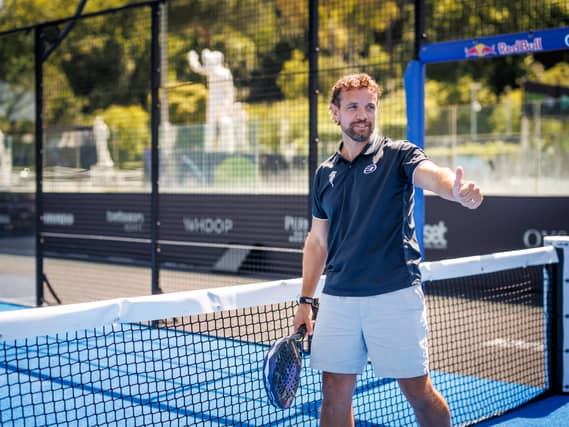
Sandy Farquharson, founder of The Padel School and former GB National Team padel player and coach, breaks down the sport and its rules just in time for the big event.
“Padel is often described as a combination between tennis and squash because the ball is similar to tennis and some of the techniques could be similar,” Farquharson explains.
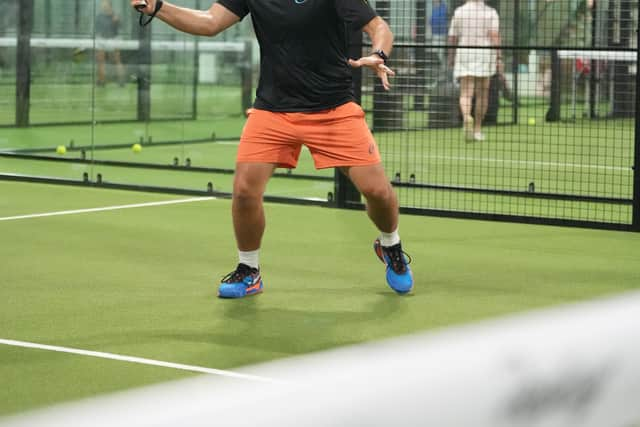
“However, it’s enclosed by glass and fence so the wall comes into play here.”
He explains that it’s a sociable racket sport that people can pick up early and quite quickly.
“After coaching tennis for years, the technique there to serve is difficult and acts as a barrier to entry for people to learn,” he says. “Whereas with padel, you start with an underarm serve and you can really have a fun game in your first session.”
What are the rules for padel?
Padel is always played in doubles, Farquharson says, explaining that you play two against two.
In padel, each game starts at 0-0 (love). “The scoring system is like tennis – points progress as 15, 30, 40,” Farquharson says.
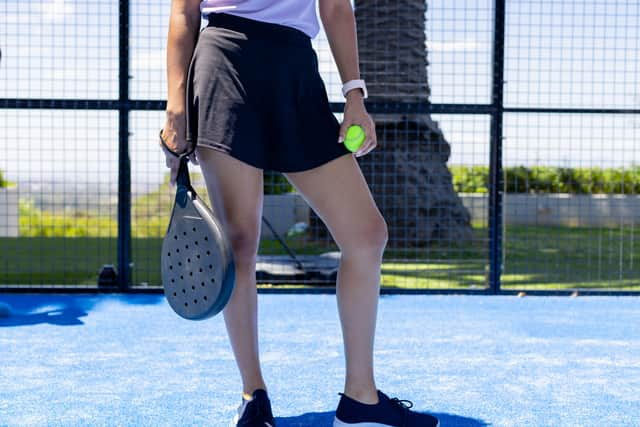
“You’ve got to put your hand through the loop of the racket – it’s part of the regulations and it’s also for safety,” he adds.
“Like tennis you’re allowed one bounce on the court. This means, if the ball bounces and hits the glass, it’s not allowed a second bounce on the court – it’s only allowed one bounce.

“You’re allowed to hit the ball against your own glass to go back to the other side but you can’t hit it against the fence.”
He explains that similar to tennis, you get two serves – if you miss the first, you can get a second.
“On that serve, you serve diagonally into the cross court box, like you would in tennis, but this time it’s underarm,” he says. “This means you’ve got to contact waist height or below on the serve.”
He adds: “If it bounces and hits the fence, that would be out on the serve. But after that, the point starts with that serve and you can bounce and hit the fence.”
If the court is calling out your name, Farquharson goes on to explain his top tips for beginners.
Appreciate it as its own sport
“Often ex-tennis players come and try to play tennis on a padel court or squash players come and they are firing the ball around the court,” Farquharson says.
“If you can learn the strategy, the control and the placement in padel, it’s really its own sport.
“My advice early on is to try and get lessons because people often play without having them,” he says.
“A lot of the players that come to my court have played for a year or two and they’ve never had a lesson. Therefore they’ve got a year or two of bad habits that you then have to try and change.
“It’s not so easy in padel to find qualified coaches and experienced coaches, but do the best you can.”
Try to improve and understand the game
“It’s a very tactical game – more tactical than tennis,” Farquharson says.
“Things like court position and shot selection are far more important than the the power and the speed at which you hit the ball. So learn those tactics as early as you can.”
Remember it’s a doubles game
“Be a good partner and treat your partner as you would want to be treated,” he says.
“That’s something we see at a recreational level – people getting annoyed or frustrated with their partner.
“They’re going to play worse if you get frustrated with them. Be sympathetic and supportive to your partner.
Communication is a big part of padel
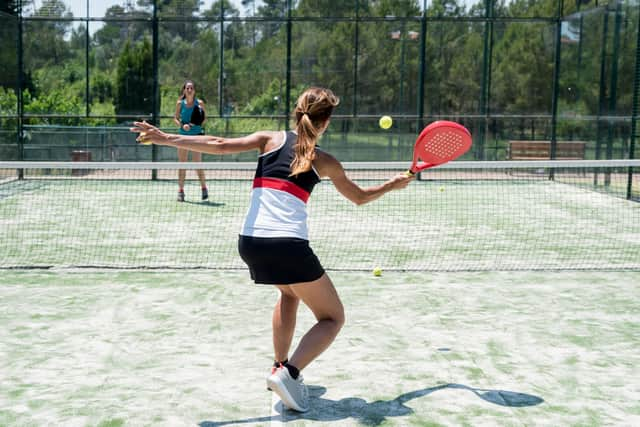
“When you come to padel, learn to communicate with your partner – not only within the point of what’s happening with your opponents, but also in between points and talk about tactics and what you’re going to do,” Farquharson says.
“So try and get used to good communication as early as you can.”
What are padel misconceptions?
“I think there’s a misconception that the sport is easy, like it is easy all the way up,” Farquharson says.
“It’s easy to start, but if you find that your hobby suddenly turns into a passion and you want to get better, the game gets more and more difficult, more and more physical, more and more mental and more and more tactical as you get better at it.
“And that’s part of the challenge. So if you don’t get help with technique and tactics in your journey early, then you will plateau and you will find it more difficult later on.”
The Padel School offers digital memberships, coach education, academy partnerships and player development programmes to help grow the sport through world-class coaching and education.