
‘When my vision went blurry I never thought it could be cancer – then I lost my left eye aged 29’
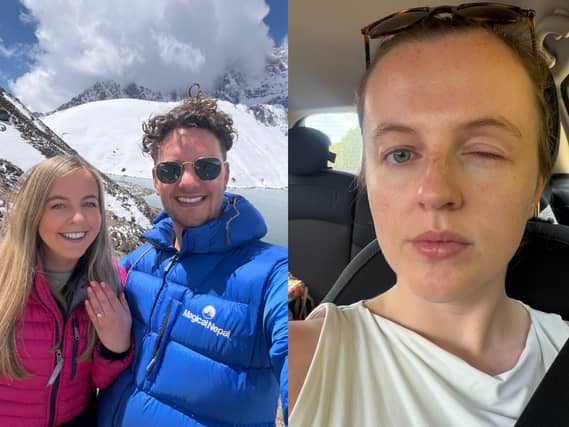

Amy was diagnosed was ocular melanoma in July this year.
A 29-year-old woman whose “little bit of blurry vision” turned out to be a sign of a tumour said losing her left eye made her realise that “cancer can happen to anyone at any age”.
Amy Cottingham said that when she got engaged to her fiance Finlay in April earlier this year during a trip to Nepal, she felt very happy and healthy.
However, in the months that followed she was diagnosed with ocular melanoma and required an enucleation (surgical removal of the eye) due to the large size of the tumour.
Only 750 people are diagnosed with this rare cancer in the UK every year, according to Ocular Melanoma UK.
Before this life-changing experience, Amy never imagined she would receive a cancer diagnosis at such a young age.
“Before my diagnosis, I had an idea in my mind of what cancer was. I would typically picture someone older, someone who is really unwell and looks sick, and but now I know that that’s not necessarily what cancer is,” Amy told PA Real Life.
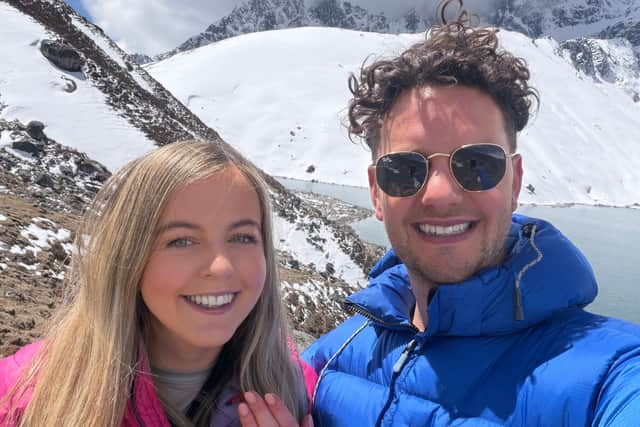
“There’s no way of knowing when the cancer first started in my eye, but I climbed Gokyo Ri, a 5,400 metre mountain, in April and felt very normal and healthy.
“In your 20s, you do think you’re untouchable to an extent, but cancer can happen to anyone at any age.”
She added that because of her age, her worries and fears are very different to older people in the same position.
“With it being such a rare cancer and being so young, particularly when the average age of diagnosis of this cancer is in the 60s, there’s an unfairness to it,” said Amy.
“When I look at people’s profiles on Ocular Melanoma UK Facebook group, everyone is so much older, and their worries and their fears are so different to mine.
“They’ve hopefully had children, lived a life and have been successful in their careers if they wanted to. So, I think that a cancer diagnosis is devastating at any age, but I do think it’s different for someone in their 20s to someone in their 60s.”

Amy first noticed a subtle shift in her eyesight when she was doing her make up for a wedding in May this year.
“I was doing false eyelashes on my right eye and noticed that with just my left eye open, my vision was slightly blurry. However, my vision felt completely normal and fine with both eyes open,” said Amy.
“I had no headaches, no tiredness, nothing else. Just a little bit of blurry vision with one eye closed.”
This prompted her to book an opticians appointment for July, and she remembers thinking that the worst news she would receive would be that she needed glasses.
“The optician noticed that I had macular thickening with intraretinal cysts and said it was unusual for someone of my age, as it’s typically associated with people aged 60/70 plus,” she recollected.
After the optician spoke to a colleague, they recommended that Amy should go to her GP to have a blood test, and referred her to the ophthalmology department at King’s Hospital, which she later received a mid-September appointment date for.
However, when what she described as a “crescent shadow” began to appear over her left eye in the following days, her partner’s mother, who is a nurse, urged Amy to attend eye casualty rather than wait two months for her scheduled appointment.
Amy said she initially suspected she might have diabetes, given her family history of the condition, so she was shocked when the doctor suggested there could be a tumour in her eye.
“The look of concern and pity and worry on the doctor’s face was like nothing I had ever seen before,” said Amy.
“When I rang my partner and said to him, ‘they think it’s cancer’, the emotion in his voice was awful, and still haunts me.”
She said cancer had never even crossed her mind as a possibility.
“I know bad things happen to your eyesight, but none of my family have ever fought cancer, so it was never even a worry. It was never an inkling for any of us,” she shared.
Amy’s ocular melanoma diagnosis was officially confirmed at Moorfields Eye Hospital in London on July 23, a date that Amy said will be “etched” in her mind forever.
“We had to wait in the waiting room to be called by the oncologist for around 40 minutes and I was almost having a panic attack. I felt like I couldn’t breathe and just kept rocking,” said Amy.
The oncologist revealed that the only treatment option was to remove the whole eye.
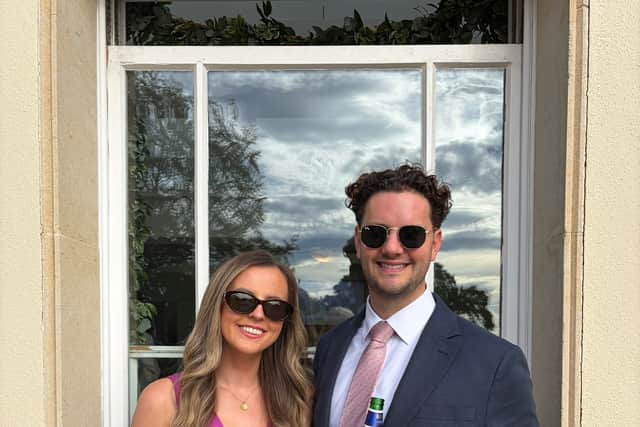
“Once I got the diagnosis, that was horrendous because I did have some hope before that it wasn’t cancer. Knowing that I had a tumour inside me was the worst part. I just wanted it gone,” said Amy.
She was originally scheduled for surgery on August 24, but after pushing for an earlier date, she had the enucleation 14 days earlier at Moorfields Eye Hospital.
“I remember going into the bathroom for the final time before my procedure and looking into a mirror and thinking, this is the last time I’m ever going to look like this,” shared Amy.
She said first thing she felt when she woke up from the 40-minute surgery was pain.
“Because eye muscles work together in pairs and I still have muscles in my eye that was removed, every time I moved my right eye, I was also moving the eye that was removed, so the stitches were being pulled. The pain was excruciating,” said Amy.
Since the tumour was contained to her eye, she didn’t need radiation treatment, and all follow-up scans have found no further evidence of the disease so far.
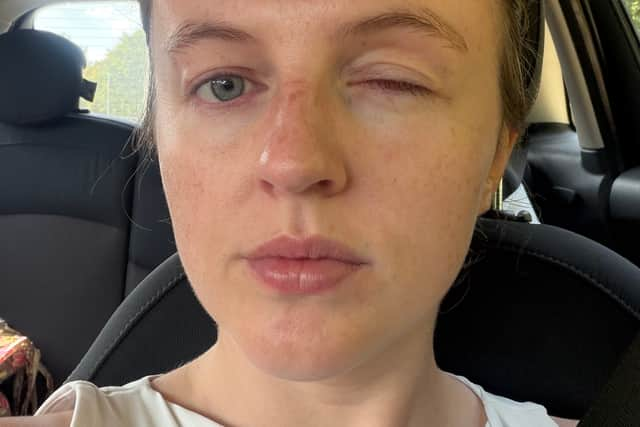
Six weeks after her surgery, Amy was given a prosthetic eye.
“Many people think that a prosthetic eye must be shaped like a whole eyeball, like a ping pong ball, but it looks more like a hard-fit contact lens,” she explained.
“Taking it in and out feels insane. I have a little suction tool, that looks like a little plunger, that sticks to it and then it makes a popping noise and it just pops out.”
She added that it has been difficult to get used to the difference in eyesight and perception since having her eye removed.
For example, with things like pouring liquid into a cup I need to concentrate much more and I can’t really tell how much food is in a bowl,” said Amy.
She has also recently started training for the Brighton Marathon, which takes place on April 4 next year.
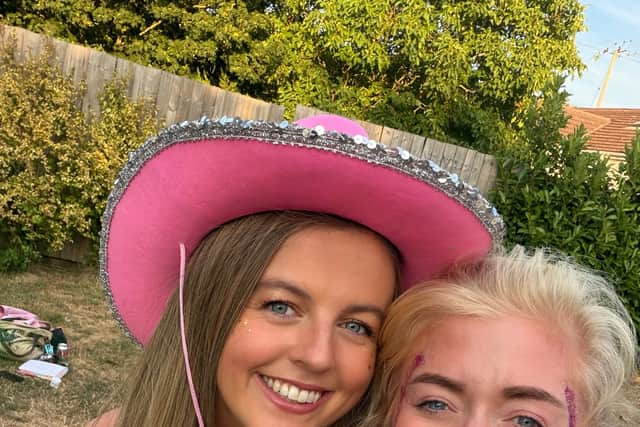
“I have been tripping up a little bit and have to be really mindful about picking up my feet because I can’t really see depth, and the ground always looks flat to me,” she explained.
“When I used to run a few years ago, running would be the one thing that could clear my mind. I’d go for a run, and I wouldn’t think of a single thing. So I’m really hoping that training for the marathon will do that for me now.”
She is taking on this challenge to raise money and increase awareness for Ocular Melanoma UK.
“I had never even heard about ocular melanoma before my diagnosis. I know that this type of cancer is very under-researched and underfunded because there’s less of us, but that doesn’t mean that our lives are any less important,” said Amy.
Ocular melanoma does not always cause symptoms, which is why it’s important to have an eye test every two years.
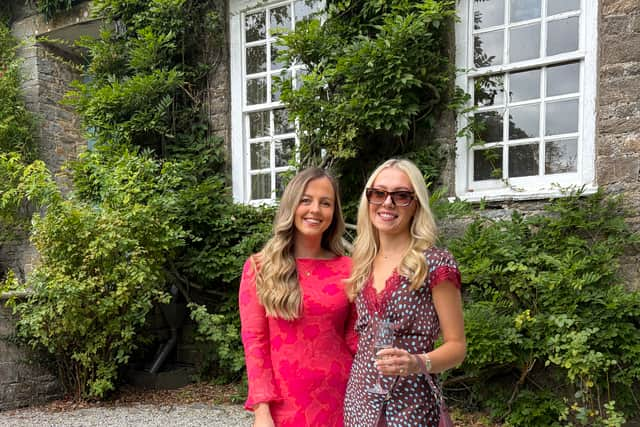
“It’s a silent disease, so when you do get symptoms, it’s often too late. So, going to the opticians is not just important for your eye health, it’s important for your overall health,” said Amy.
“You can’t get another pair of eyes, so you need to treat them so sacredly.”
She also emphasised the importance of advocating for yourself.
“If you feel like something’s wrong, keep on pushing,” urged Amy.
“If my partner’s mum hadn’t told me to go to eye casualty that day, I may have waited until September for my appointment. So, make sure that you advocate for yourself if you feel like something is wrong.”
To find out more about Ocular Melanoma UK, visit https://omuk.org/