
IF WALLS COULD TALK: Business, benevolence and the Quaker legacy

Columnist Dr Paul O’Brien reflects on a small but significant group that shaped life for generations
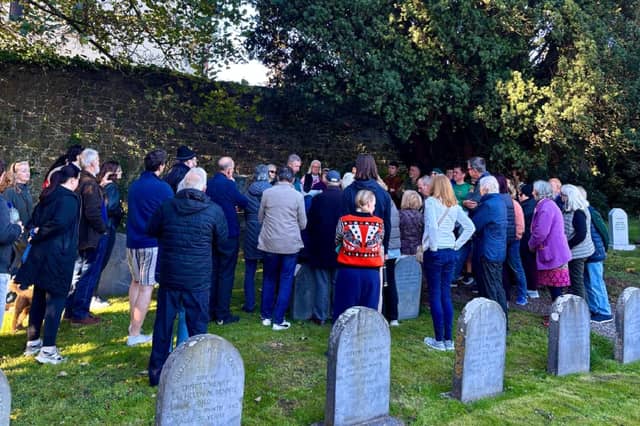
The Religious Society of Friends, better known as the Quakers, established a presence in Limerick by the late seventeenth century, drawn to a city whose commercial importance was growing rapidly. While their origins lie in England during the 1650s, it was their impact on Limerick’s business, philanthropy, industry and civic life that left the greatest mark locally. Their story survives not only in newspaper reports, family histories and business records, but also in the Friends’ Burial Ground at Ballinacurra, where generations of Limerick Quakers found their final resting place.
The charitable reputation of Limerick Friends appears repeatedly in the local press. During the severe distress in County Mayo in June 1831, the Limerick Evening Post reported that the Society of Friends in Limerick subscribed £55 13s. 9d. towards famine relief. The newspaper observed that it had often recorded ‘the charity, and real benevolence of heart’ shown by this ‘amiable society’, hoping that such generosity would be remembered long after the crisis had passed.
The first Quaker meeting house in Limerick stood on Creagh Lane East. Originally built in 1671 and rebuilt in 1735, it served the community until 1806, when worshippers moved to a newly constructed meeting house on Cecil Street South. That building remained associated with the Society of Friends throughout the nineteenth century before eventually passing into commercial use in the c.1950s.
Their earliest burial ground was located at the end of Pump Lane, now St Francis Place, beneath the present site of St Mary’s Girls’ Primary School. The surviving burial records offer a remarkable glimpse into the city’s Quaker community. The registers contain familiar Limerick Quaker surnames including Fisher, Harvey, Unthank, Mayne, Phillips, Newsom, Hill, Banks and Fitt. They also preserve details of occupations, among them George Alleyn, Master Cooper; John Newsom, ironmonger of Mungret Street; John Thomas Thacker, grocer; William Phillips, apothecary; William Hill, tanner; Thomas Kendal, woollen draper and Joshua Dudley, clerk.
By the early 1830s the Pump Lane burial ground had reached capacity. Its replacement came about through the intervention of Joseph Massey Harvey following the death of his wife, Rebecca Mark Harvey on Christmas Day 1831. Initially buried near Summerville House, Rebecca became the first person interred at the new Friends’ Burial Ground at Ballinacurra on 8 July 1833 after Harvey donated part of his land for the purpose. A notice in the Limerick Chronicle dated 1 February 1832 sought ‘a piece of land’ within one mile of the city for use as a Quaker burial ground, almost certainly placed at Harvey’s direction.
Among the most prominent Quaker families were the Fishers. Their name was closely associated with Richmond House, Ashbourne Avenue (the long avenue) and with Fisher’s Flour Mills on Francis Street. A newspaper notice recorded the marriage in 1805 of William McAllister to Miss Fisher, daughter of Joseph Fisher, both members of the Society of Friends. Through marriage, commerce and philanthropy, the Fishers became interconnected with other leading Quaker families, particularly the Harveys.
James Fisher’s business activities extended well beyond milling. An advertisement in the Limerick Chronicle in 1826 shows him operating from the Linen Hall, selling locally produced and imported linen, managing bleaching operations at Clareville Bleach Green, and arranging marine, fire and life insurance. As honorary secretary of the Linen Hall, he exemplified the entrepreneurial spirit of many Quaker merchants.
Joseph Massey Harvey (1764-1834) arrived in Limerick from Cork around 1784 to work in Fisher’s Flour Mills. He later built Summerville House and became one of the city’s most influential businessmen, serving as President of the Limerick Chamber of Commerce and acting as agent to the Marquis of Lansdowne. His descendants continued that influence. Reuben Harvey inherited interests in milling and developed Harvey’s Quay. His brother, William Henry Harvey (1811-1866), achieved international distinction as Professor of Botany at Trinity College and became one of the nineteenth century’s leading authorities on marine algae. William Henry Harvey maintained a long correspondence with Charles Darwin, supplied scientific observations that informed contemporary debates on evolution, and continued communicating with Darwin after the publication of On the Origin of Species in 1859.
The Unthank family also featured prominently in the life of the Society of Friends in Limerick. Their commercial interests later expanded into professional careers including medicine and accountancy. Newspaper references to the family stretch back to 1769. In 1842, Robert S. Unthank successfully defended the validity of the will of his uncle, Dr Unthank. The will included substantial charitable bequests, among them £1,000 for poor Quakers, funds for the House of Industry, improvements to the Friends’ Meeting House, agricultural schools for Quakers, and the construction of a porter’s lodge at the Friends’ Burial Ground.
Other Quakers interred at Ballinacurra included Alfred Davis of Barrington Street; Thomas Fitt, a successful wholesale tea merchant in London whose death was reported in the Munster News in 1901; John Scarr, grocer, spirit merchant and magistrate of Patrick Street; Samuel Alexander, respected grocer and wine merchant of George Street; and John McAdam, chemist and druggist of George Street. Their obituaries consistently emphasised qualities valued by the Society of Friends: integrity, charity, public service and good character.
By the twentieth century, families such as the Goodbodys had continued the Quaker connection with Summerville. Yet perhaps the greatest legacy of Limerick’s Quakers lies not in any single family or enterprise but in the values they brought to the city. Through commerce, philanthropy, education, reform and public service, they left an influence that still survives in the quiet burial ground at Ballinacurra and in the records of the city they helped shape.
Dr Paul O’Brien is a lecturer at Mary Immaculate College