
Limerick researcher makes ground-breaking discovery about Galileo's telescope

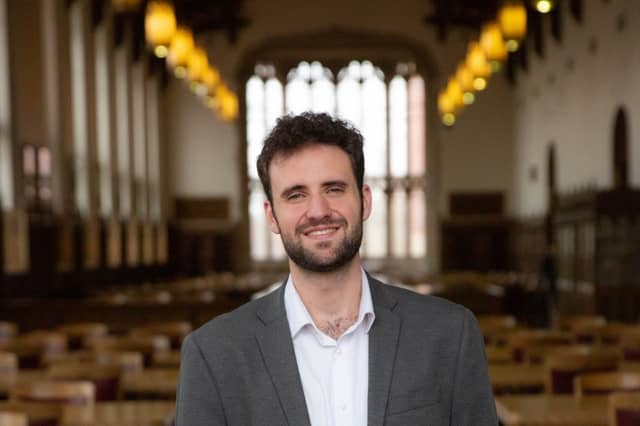

The paper discovered by the UL researcher Dr JoséMaría Morena Madrid is the most detailed analysis of the telescope by Galileo Galilei
A UNIVERSITY of Limerick researcher has made a groundbreaking discovery with the most detailed analysis of the telescope made by astronomer and scientist Galileo Galilei.
A previously unknown 17th century description of a four-lens terrestrial telescope attributed to Galileo was discovered by Dr José María Moreno Madrid, a researcher at UL’s School of History and Geography.
Dr Moreno Madrid made the fascinating discovery while studying a 1666 manuscript written by a Spanish Dominican friar named Ignacio Muñoz. In a document titled De Tellescopiis Stellarum, Muñoz provided a component-by-component description of a four-lens telescope described as ‘fabricatum a Galilaeo’, or ‘manufactured by Galileo’.
Existing historical records situate the first four-lens telescopes at around 1643-1645.
READ ALSO: 'Life moves cruelly onwards' - judge comments as Limerick student jailed for double fatality
Now Dr Moreno Madrid’s research provides evidence, which suggests that not only did experimentation with the four-lens telescope take place earlier than believed and documented, but it could be attributed to none other than Galileo himself.
“If, as the text claims, the telescope analysed was indeed manufactured by Galileo, then the earliest known experimentation with four-lens telescopes would have to be pushed back to 1630 at the latest and credited to him,” said Dr Moreno Madrid.
According to Muñoz’s manuscript, the telescope was presented to him by Antonio Sebastián de Toledo Molina y Salazar, then viceroy of New Spain and Marquis of Mancera, as part of a test of Muñoz’s scientific capabilities.
The UL researcher explained: “The viceroy of New Spain, suspicious of Muñoz’s scientific skills and concerned that he might be tricking the king into funding his travels, ordered him to meticulously analyse the instrument.
“He proceeded to give a detailed description of a reverse-tapered four-lens terrestrial telescope with an erecting eyepiece, with convex lenses separated by twice their focal lengths. Crucially, the manuscript entry also includes detailed diagrams and drawings of the instrument.”
According to historical accounts, Galileo presented one large and two smaller telescopes to Philip IV and his wife in a bid to curry favour at court and improve his chances of claiming the generous reward offered for solving the so-called ‘problem of longitude’.
Dr Moreno Madrid suggests that the four-lens telescope outlined in Muñoz’s manuscript, if indeed crafted by Galileo, may have come into the hands of the Marquis de Mancera as a gift from the Spanish royal family in recognition of his diplomatic and political successes for the court in Madrid.
With no further mention of the telescope in the Marquis de Mancera’s correspondences with the Spanish court, this sole document presents evidence that could shift our understanding of the history of early modern telescopes, and of Galileo’s in particular.
Dr Moreno Madrid said: “I believe that the unambiguous attribution of the telescope in the manuscript, together with the documentary evidence that three telescopes made by Galileo - whose optical configuration remain unspecified - may have been accessible to Mancera through his connections at the Spanish court, at the very least invites consideration of this possibility.”
Whether or not the telescope can be definitively attributed to Galileo, Dr Moreno Madrid says Muñoz’s manuscript holds significant importance in expanding the knowledge base for technical descriptions of seventeenth-century telescopes and underscoring these instruments as objects of prestige at the time.
Now, Dr Moreno Madrid hopes his research will form the basis of further exploration and discovery: “It is to be hoped that new documentary or material evidence will soon emerge to confirm the telescope’s attribution and further enhance our understanding of it.”