
MOTORING REVIEW: Yaris Cross ticks many boxes for Limerick families
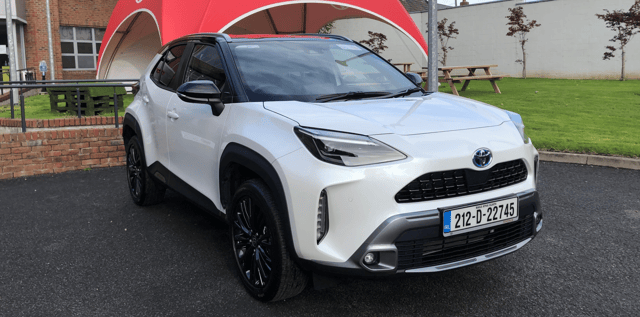

TOYOTA'S Yaris Cross is a compact crossover SUV that is exclusively sold as a self-charging hybrid. It is also the brand’s smallest crossover.
Adding the B-segment Cross to the line-up gave Toyota an SUV range that spans the B, C and D segments while keeping the Yaris name for this new variant ensured it was regarded, and accepted, as an extension to the popular Yaris hatchback range.
The brand claims that both cars appeal to different types of customers.

Grades are Luna, Luna Sport, Sol and Adventure. My car was in the top Adventure FWD grade with a Pearl Ice White exterior colour which would be my preferred choice as it showed off the car’s styling to perfection, and contrasting with the black gloss pillars, big wheel arches and 18-inch dark grey alloy wheels, the black protection mouldings on the side doors, roof bars, and rear privacy glass. Black and white is always a classy look.
The added height makes this motor easier to get in and out of - tall people won't have to duck their heads in the process - provides a higher driving position that many buyers look for as well as improved visibility.
The interior is nicely styled but I felt could do with a bit of brightening up. Granted there are touches of bright like the chrome surrounds to the air con buttons, the gear shift knob and some light blue ambient lighting on front doors and in the centre console which all add interest.
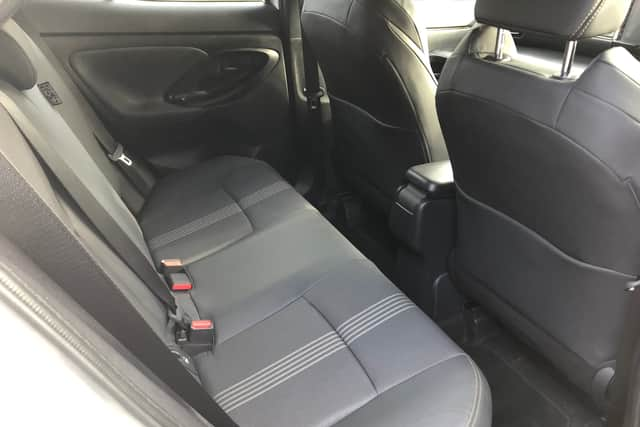
Seats are comfy and support you up along your back. Front ones can be heated. As with many compact SUVs, there’s not great rear legroom for an adult seated behind a six footer up front but the headroom here is absolutely fine. The felt door trim, however, looked a bit smudged in places and I wondered if it would wear well.
The dash features a new stand-alone 9-inch touchscreen infotainment display (on my top Adventure specced car) that is as good as most of its competition. All grades come with Apple CarPlay and Android Auto connectivity.
The 10-inch Head Up Display meant I didn’t have to take my eyes off the road to check my current speed, which is also displayed digitally on the instrument panel. To the left you see the PWR, Eco, and ‘state of charge’ screen. In EV mode, electric power is supplied by the hybrid battery and only the electric motor is used to drive the car. This mode allows you drive quietly in residential areas early in the morning or late at night. The Charge area shows the regeneration status. Regenerated energy, achieved mostly through slowing down and braking, is used to charge the hybrid battery. That’s why hybrids are very well suited to urban driving. Toyota claims you can drive in EV mode up to 62pc of the time and use up to 30pc less fuel than with an ICE vehicle.
Other items included voice recognition, USB connector, a rear view camera, front and rear parking sensors, automatic braking and front LED-type fog lights while Toyota’s Safety Sense system is one of the best available with many ADAS systems such as forward collision warning system, intelligent adaptive cruise control and Hill-start control.
Power is from a 3-cylinder 1.5 116hp hybrid system with 120Nm torque, developed directly from the bigger 2.0 and 2.5 powertrains used by Corolla, C-HR, RAV4 and Camry. The engine is matched to an e-CVT automatic transmission.
On the road, I found good feedback from the well-weighted steering wheel which helped my drive experience; the engine was nice and peppy with good acceleration. If pushed, it can achieve from 0-100km/h in 11.0 seconds. Toyota claim a combined fuel return of around 4.5 to 5.0 L/100kms, but I clocked up 5.4 L/100kms (52 mpg) at the end of my test drive week which included a few long journeys to the midlands and back.
The AWD version features an electric system that weighs less than mechanical AWD units and so helps lower fuel consumption and C02 emissions. In normal driving, the car operates with front-wheel drive which changes to all-wheel drive when low-trip conditions are detected, such as in heavy rain, on wet or packed snow or even on sand. Emissions for the FWD drive model start from below 90g/km C02, the AWD version from under 100g/km.
Toyota offers a standard 3-year/100,000km mechanical warranty on all its vehicles and up to 10 years’ extended hybrid battery care on its hybrids.
Yaris Cross is priced from €28,750; the Adventure grade from €36,030.