
BIG READ: No trees are harmed in the making of the art at Lúchta Studios in Tipperary
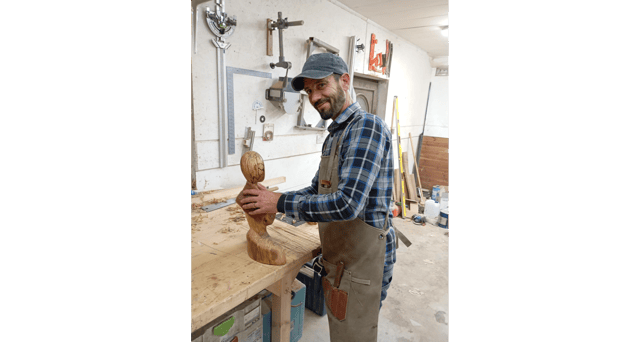

Paul Carew is an artist and furniture maker from Boherlahan
When it comes to sustainability, craftmanship and the beauty of nature, furniture-maker and artist Paul Carew can see the wood for the trees.
The husband and father-of-two from Peake, Boherlahan is a carpenter by trade but branched out into art and design in 2019 and started Lúchta Studios in July this year.
Using responsibly sourced storm-damaged wood, Paul designs unique pieces inspired by nature and his family.
“I believe it's an artist’s job to show people the beauty in nature.
“The wood is always the star of the show. I am simply guided by each piece to try and do justice by it.
“My other inspiration is my wife Jackie because that's how it started. I was initially inspired to create something unique for someone I love. For me, that is the essence of art. I immerse myself in the process like those who immerse themselves in the lyrics of a song. It’s not about getting to the end, it’s the journey that matters,” said Paul.
BACK TO LIFE
The ethos of Lúchta Studios, “no trees were harmed in the making of this art,” is about responsibility, sustainability and transformation.
Paul only works with surgeons and salvage companies in Ireland to make sure his materials are the least harmful and the best they can be.
Every piece is used with 100% native Irish wood, and Paul puts in the time, detail and care needed to transform the tree, into something new.
“We take our responsibility towards hardwoods very seriously and strive to create pieces that both honour the wood (in some cases, wood that came from an 800-year-old native oak) and produce pieces that can be passed on for generations to come.
“We know the history of each piece of wood we use. That is something we like to make available for our customers; it makes the process more personal.
“There is a huge sense of satisfaction when trees can be revived in the homes of people,” said Paul.
And the pieces Paul creates are not limited to furniture. Included in his portfolio of work are chopping boards, sculptures and even a set of speakers alongside a bar, cabinets and desks. It doesn’t matter what Paul is working on, he puts his whole self into every piece.
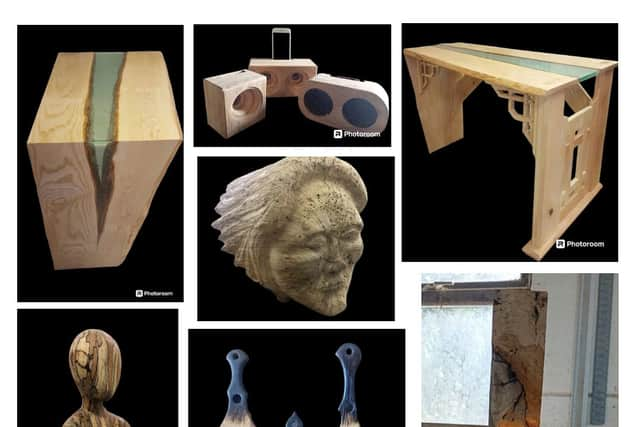
“If for example, I'm making a table, I have to assess the forces the table will be subjected to and because I use traditional techniques, I use the relevant joints required that have been tried and tested for centuries. The construction process is a complex and gradual one.
The wood I use is storm-damaged/salvaged and so there is a lot of preparation work involved.
It has to be ruff sawn, face planed, squared, straightened, thickness planed and the correct moisture content ensured and it is only then that I have a piece of stock to actually create something with.
“Due to the fact that I use these traditional woodworking techniques, marking and cutting each joint, sanding by hand, sealing and lacquering each piece is a meticulous process.
“A process I thoroughly enjoy. It’s a labour of love really.
BLOOD AND SWEAT
Paul’s passion for woodwork has been an almost lifelong pursuit.
Still in primary school, Paul made his first set of pieces- three corner shelves from scrap wood.
“The only problem was the lack of handsaws in my home place, which led me to make these with a bushman!
“This was evident then by the blood stains on my shelving and the scar tissue I’m left looking at today. Not ideal!” said Paul.
When he was 14, Paul began working with a local carpenter and, from there, learned “old-style techniques of woodwork.”
“It is almost a lost art these days, and I am privileged to be able to continue it. I’m inspired by the smell of the wood, the cut of a perfectly sharpened chisel to the satisfaction of the expulsion of glue from a perfectly cut joint,” said Paul.
After many years as a carpenter, Paul began exploring design and, last year, set up Lúchta Studios.
So, the trade carpenter became a consummate artist.
“The uniqueness of each piece, each varied. The grain hinting at its own history, its own beautiful summers and harsh winters visible.
“Working with something presumably passed life when the opposite is true. I’m inspired to bring it back to life,” said Paul.
The studio’s name comes from Paul’s love of ancient history and mythology.
Lúchta is the name of one of three brothers who were part of the Tuatha Dé Dannan and known as gods of craft in Celtic mythology.
“Lúchta was the carpenter of the three and it seemed like an apt name for my studio,” said Paul.
He says people ask him what the difference between a trade and art is.
According to Paul, jobs are systematic, defined by inputs to achieve a predetermined outcome.
“It differs for me as an artist because, for me, art is freedom. The entire artistic process is organic and unfolding. The nature of the materials dictates the process and outcome.
“The trinity of time, quality and money to achieve an end goal are tethers, nooses to the throat of creativity.
“I usually find myself completely lost in the process and am abruptly made aware of the outside world by my wife asking if I’d like her to move our bed into the studio altogether,” said Paul.
HAPPY CUSTOMERS
Since starting Lúchta Studios, Paul says the response has been positive.
“My clients seem to love the fact that my work is carried out using old-style woodworking techniques guaranteeing durability and pleasing aesthetics.
“I have clients return for second and third commissioned pieces, which is fantastic and very promising,” said Paul.
While Paul’s pieces are local, he hopes they will travel far and stand as monuments to the beauty of nature and Ireland.
“The ultimate goal would be to see my work, native Irish trees, crafted into beautiful pieces occupy prominent establishments whereby all that visit can see what Irish nature and Irish craftsmanship has to offer,” said Paul.
Paul is available to create commission works and a collection of ready- made pieces are available to view @luchtastudios on Instagram.
If you would like to know more about Lúchta Studios you can contact Paul Carew on 0873301400 or email [email protected].