
COLUMN: Stunning turquoise coast of Turkey awaits in 2024

Writes Fergal O'Keeffe
The blue-green hues of the sparkling sea of the Turkish Riviera has deservedly earned its moniker “the Turquoise Coast”. In fact, the word turquoise comes from the French word for Turkish.
My favourite day on my trip to southwestern Turkey last summer was spent sailing in an old Turkish wooden sailing boat called a gulet which traditionally served fishermen and sponge divers.
We spent the day sailing along the Lycian coast from Kas to Kekova island where we slowly glided over the sunken ruins of the ancient city of Dolikisthe.
Through the translucent water we peered into a magical classical world of submerged houses and streets, a Byzantine church and ornate half submerged sarcophagi.
This eerie sunken city was lost to the sea after an earthquake in the second century AD.
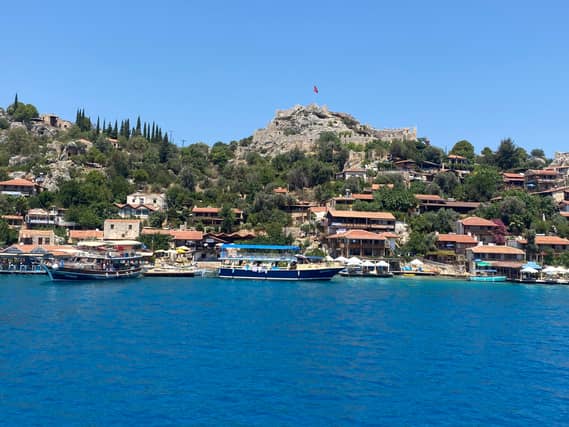
Across from Kekova island we moored at the idyllic village of Kalekoy, which is built up a pyramid shaped hill with narrow medieval streets leading to an imposing templar era castle.
It is quite something to be drinking a cold refreshing coke in the shade in a makeshift café with ancient Lycian tombs half submerged in the water just a few metres away.
We returned to Kas whilst taking regular detours to stunning secluded coves, only accessible from the sea to swim and snorkel in the crystal clear warm water, as if they were our own private pools.
I got chatting to a couple in their twenties from Russia who revealed they had fled Moscow to avoid conscription at the outbreak of the Ukrainian invasion.
He was a fund manager so he could work remotely and had settled in Kas but their lives were on hold and full of uncertainty.
It was jarring hearing how they had to put on hold plans to marry and buy a house juxtaposed to our view of the coast where the Taurus mountains tumbled down to the inviting Mediterranean Sea.
But it also reminded me why I loved travelling so much when you have the opportunity to see ancient ruins and natural wonders and meet people from other cultures to hear their stories firsthand.
As the sun was setting we returned to the town of Kas, whose little harbour is the centre of all activity. Kas has become a mecca for scuba diving fans and is considered to have the best dive sites off Turkey.
The habour is full of dive boats every morning getting ready and you can feel the excited, nervous energy of expectant divers all around town. It reminds me of the buzz you get in Cairns in Australia where I learned to dive.
As the oppressive heat of the day went down with the sun, it was magical to sit in the small square sipping the local Effes beer taking in the hustle and bustle of returning dive boasts and gulets, whilst watching old men playing backgammon, gossiping and drinking Turkish coffee that is so strong it oozes from the glass.
Kas is a laid back town with a history going back to Ottoman, Byzantine, Roman and Lycian rule including a well preserved 1st century BC amphitheatre.
But more recently the town was settled in the 19th century by Greek islanders, and it feels more like a Greek village with narrow cobbled streets and whitewashed houses with upper level ornate wooden balconies draped with beautiful pink bougainvillea flowers.
The Greeks had to leave 100 years ago when Turkey became a republic.
The Greco-Turkish War in the 1920’s led to a population exchange resulting in the displacement of over one million ethnic Greeks from Turkey to Greece.
I had spent the previous summer on holiday in the Halkidiki region of Greece where many of the displaced ended up.
I spent time in Ouranoupoli near Mount Athos and the town was festooned with banners celebrating the arrival of the refugees in 1922.
That area had a feel of Turkey, especially with its food so it was fascinating being in Turkey a year later in a town that felt Greek.
There is even the nearby Greek island of Kastellorizo just 20 minutes off the coast of Kas. Locals told me it takes longer to get through the passport check on either side than the boat trip due to over officious guards with love lost for the other country.
We drove back to our villa rental in Kalkan which is a 30 minute drive along the most spectacular road hugging the mountain with the sea often precariously close below you and reminiscent of an Amalfi coast drive.
Just outside Kalkan you pass Kaputas beach which is between two steep cliffs that you reach by descending over 200 steps.
This is said to be the most instagrammed beach in Turkey and even at 9am there are parked cars stretching along the coast reflecting its popularity.
We based ourselves for the holiday in Kalkan which is a one time fishing village which has morphed into one of the most stylish resorts in Turkey that became popular with well heels Turks in the 1980s and discerning Brits since the 1990s.
Kalkan is a beautiful town set in a wide bay surrounded by mountains. The old town is a labyrinth of narrow streets of whitewashed buildings reminiscent of a Cycladic Island town.
Most buildings have rooftop bars and restaurants with panoramic views out to sea to watch the fiery sun going into the sea for the night.
There are said to be over 200 restaurants in the old town and as you walk the streets at night the smell of barbecuing meat and freshly caught fish entices you in.
We were reminded of the deep connection of this area with Greece when the first restaurant we visited in Kalkan was called Solonika which is the Turkish name for the Greek city of Thessaloniki, where we had flown in to go to Halkidiki last year.
My kids had great fun walking the streets each night haggling with theatrical stall owners for premiership football jerseys that they euphemistically called “genuine brands for bargain prices”. My kids learned the art of walking away to get the deal.
Our days were spent lounging around the beach clubs perched on the rocks around the bay where you could dive into the sea to swim to pontoons.
Afternoons were spent visiting nearby attractions with many ancient, ruined Lycian cities nearby.
The pick of which was the old Lycian capital Patara where you could walk along paved roads through an arch built in 40AD and go into a fully preserved amphitheatre that could fit many thousands.
Patara is an ancient city built by the Lycians and taken over by the Romans where the original St Nicolas was born.
After a few hours walking in the sweltering heat where I kept pointing to ancient ruins and saying a version of “That was built when Christ was aged 10”.
I could see my kids’ patience and appreciation for history wavering, so I produced the trump card of a cooling swim at the famous protected Patata beach beside the ruins.
A much-needed respite for my family who were slowly melting in the unforgiving afternoon summer sun.
Patara is a protected beach because of loggerhead turtles who lay their eggs in the sand dunes of Turkey’s longest beach of 18kms.
The hills around Kalkan are surrounded by villas and this is a big reason for its popularity with Brits.
They offer stunning views of the bay and are a cheaper option than hotels or villas for families in most holiday destinations in Europe.
One tip is to always ask for a discount from the owner when booking on a site like Airbnb as you will often get it.
We flew with Ryanair from Dublin to Dalaman which is a great gateway to the turquoise coast.
Kalkan is around an hour and half away but there are also great resorts closer like the famous beach of Oludeniz near Fethiye, which is famous for paragliding from the mountains to the beach.
Olundeniz is a long beach with a lagoon at the end. It is surrounded by pine and cedar covered mountains and is so beautiful that it is often the beach used by the Turkish tourist board on adverts.
Turkey is growing in popularity every year and was the most popular European tourist destination in 2022 with more than 23 million visitors generating nearly €40bn in tourist revenues.
The country has some of the most beautiful natural scenery in the world including the Lycian Way which is Turkey’s most famous long-distance walking route of 540km that passes through the mountains above Kalkan, Kas and Fethiye.
It is possible to do day trips from these towns to the walk to see the amazing views of the Lycian coast below you in all its splendour.
There are also great hill towns to get away from the bustle of the coast and eat fresh river trout which is a speciality of the area.
Turkey offers unique attractions where east meets west and the ancient meets modern.
Everywhere you go along the Turquoise Coast you practically bump in ancient ruins and for me the highlight is the Turkish people themselves who have perfected the art of good hospitality.
If you combine the wit of someone from a tourist town in Kerry with the efficiency of an American waiter, then you get the picture. We will definitely be back.
There are five seasons of the Travel Tales with Fergal Podcast available on all podcast platforms now.