
Rory finds pure joy at work in Clonmel in the craft of silver and gold

Artisans of Clonmel
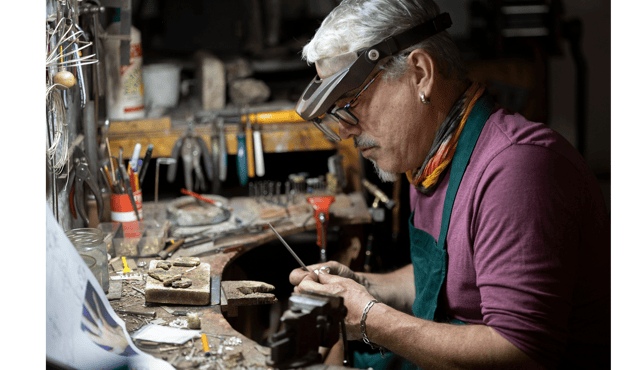
When I first walk into Rory Donohoe’s studio/workshop in 100 Irishtown, Clonmel on a cool summer’s morning, I am instantly reminded of how both messy and polished craftsmanship can be.
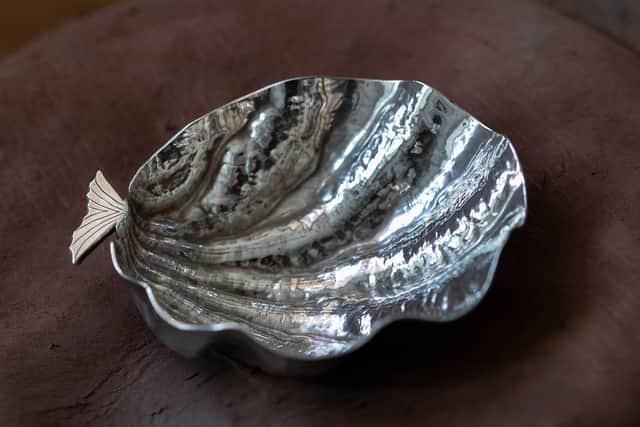
The front of the premises is tidy, spacious, and brightly coloured. Delicate silver pieces made in house and references to Ireland’s mythology adorn the walls.
However, as I approach the counter to greet the man I will be interviewing, I notice all the tools and raw materials scattered across the timber workstation. The lighting is dimmer and the layout more rustic.
Silver and gold smithing was considered art in the 18th century and still is to this day. The process mostly involves the cutting, shaping, and filing of sheets of silver or gold with precision to create jewellery and other items.
When it comes to both silver and gold smithing the techniques, training, history, and guilds are largely the same, but the end-product may vary greatly, as will the scale of objects created.
Rory uses precious metals to make jewellery, sculpture, and hollow/flatware. As I sit down and begin to chat to him, I realise how many of the few pieces of jewellery that I do own – whether it’s my diamond crucifix or pearl brooch – come from a lump of metal on someone’s desk and end up in a fancy box.
Rory puts me at ease with his big smile and friendly manner, he shows me one of the jobs he’s working on now. A silver chain and pendant inscribed with the name of a girl who is making her confirmation.
It’s not small, but it feels light. Everything is meticulous, down to the last, smallest detail. Rory informs me that there are personal stories behind every piece that he’s been commissioned to make. Everything from childhood trauma to lifelong commemoration gets poured into every artwork that he creates.
I ask him about his background.
“I’m from Dublin originally,” he says.
“I moved down to Clonmel in 1998. I opened this shop two years later in 2000 and have been here ever since.”
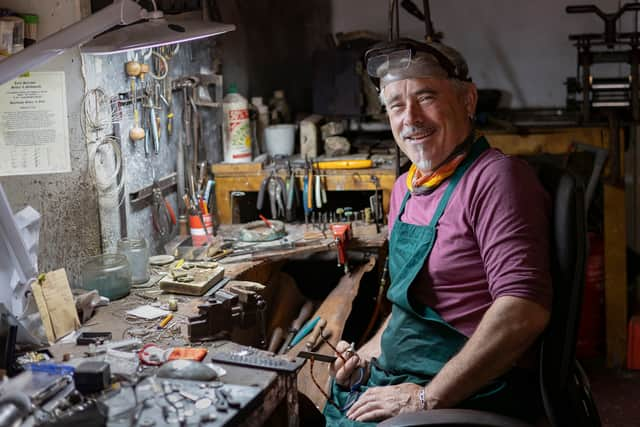
“I wanted to learn a handcraft,” he says. “I signed up to a one-year portfolio preparation course at Grennenmills crafts school in Thomastown, county Kilkenny. There were seven different crafts – including art metalwork, which I chose. My teacher was a goldsmith. Around the same time, my sister had just been ordained as a minister in the Church of Ireland. She asked me to make a chalice and paten for her. My teacher agreed to help me make it. He was the brains; I was the brawn. That was my baptism of fire!”
How did he become a silver and goldsmith? “Well, I’m self-taught so I didn’t go anywhere. You could go to art college, but I didn’t want to waste time studying other subjects as I knew what I wanted to do. In Dublin, I asked various silver/goldsmiths, could I observe their work to no avail sadly. However, one person put me on to a silversmith club set up by a few men who were retired. I went there for two years before I moved down to Clonmel. I gained knowledge any way I could, and I learned a lot from reading books on silversmithing and jewellery making.”
You can never stop learning how to be a silver and gold smith.
“It all comes down to perspective” says Rory. “I’m still learning even after over two decades in the trade. If you’re open to learning, you’ll go far. You could go down the college route as I’ve said at NCAD or LSAD. But there is a two-year jewellery making course again based in Kilkenny that’s seriously intensive but very good.”
Rory started the ball rolling while he was doing the course in Kilkenny around 1993/1994.
Rory got a lot of support when he was starting off.
“I contacted Clonmel Community Partnership who were extraordinarily helpful. They also linked in with the local Enterprise Board and the Department of Social Protection. I was extremely supported by the ‘Start Your Own Business’ courses they put on.”
PASSION
What does a typical day involve in his workshop? “There’s nothing typical about my day, and that’s the beauty of it. There’s something new and different every day. It’s made up of creating and repairing various pieces as well as designing. There’s a constant flow of work and it’s a battle to get it all done.”
With the resurgence of apprenticeships, I ask Rory if he thinks this is a positive turn of events. “Absolutely.” he says.
“The apprenticeship system is brilliant. Unfortunately, apprenticeships were ruined by the industry itself over the years. It was all about the bottom line. They just wanted people out there working and not learning for four years.”
Rory finds pure joy in making both jewellery and sculpture. He describes the feeling, saying, “The beauty is that any piece looks burned, blackened, and discoloured when you’re making it, it’s when I polish it up that I’m like ‘Wow!’ Because it comes to life. It’s just beautiful. However, it isn’t until the customer sees it and is happy with the work done, that you know the piece is complete.”
I ask him about the process of producing a piece.
“It depends on what you’re making,” he says.
“If I were making a wedding band, I would use sheet, silver, or gold, whatever metal the customer wanted. Or a pendant would require sheet, wire, or a part carved-in wax before being cast in silver or gold. It all depends on what you’re making. You buy the metal in different forms. Also, people bring in their old bits of gold – earrings, chains. I then melt it all down and make new pieces for them. I really enjoy that process – it’s very satisfying on many levels.”
Rory is clearly passionate about his work, and that, he tells me, is one of the traits that a silversmith needs. Rory has the following advice for anyone thinking of becoming a silver/goldsmith.
A GOOD EYE
“Along with passion, you need a good eye and a steady hand, commitment, and solid hand to eye co – ordination,” he says.
Rory doesn’t teach in any formal sense. But he is happy to provide work experience for students who are genuinely interested in learning about the craft.
As for his days off, “I love hillwalking and being out in nature,” he says.
“I’m at my happiest when my bum is sticking out and I’m looking at a flower. My love for flowers is only a part of my love of nature, for all of nature. There is so much beauty in even the smallest thing no matter what it is, the structure, the patterns, the colours, and the intricacies of the structure blow my mind in the most positive and humbling way.”
What Rory likes most about his work is that every day is different. He intends to keep tipping away, there’s no retirement for Rory, only death.