
Thirteenth Century head slab identified at cemetery in Tipperary
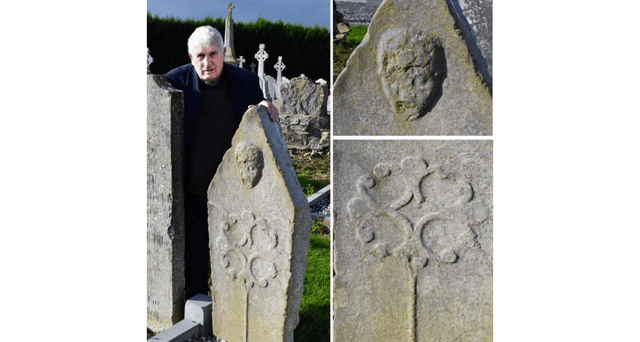

The work of the T.M.B. Old Cemetery Committee led to the discovery
Readers will remember we spoke, some weeks ago, of the remarkable restoration work being undertaken in the old section of Two-Mile-Borris Cemetery, by the T.M.B. Old Cemetery Committee.
Their work last year led to the identification of the burial place of the parents of a former Bishop of Limerick, Right Reverend John Ryan D.D. (1828-1864), enabling a memorial plaque to be unveiled at the grave site, on Tuesday, October 1, 2024 last.
Visitors visiting this memorial plaque within the old cemetery may have their attention drawn to a most unusual upright and indeed rare head slab located a short distance away also within the old Two-Mile-Borris cemetery section, south of the burial ground’s main central crucifix.
The head slab can be immediately and easily identified because of its pointed top.
While the back of the west-facing side of this limestone, flagstone (headstone) remains blank and undecorated; a most elegant, ornate Floriated Cross cross and human head can be found; both hand-hewn in relief, on the front east-facing side.
A Floriated Cross is a cross with arms terminating in representations of flower petals. The same represent faith, wisdom and chivalry when used in heraldry, and the Trinity when used as a Christian symbol.
This tombstone follows the classic head-slab style of such existing grave slabs, erected during the period between the thirteenth and fourteenth centuries.
The number of medieval slabs which feature a pointed top is very limited here in Ireland, with only three identified as having survived.
A second example can be located at St Canice’s Cathedral, Kilkenny City, county Kilkenny, while a third instance exists in the Cathedral of Newtown, Trim, county Meath.
In the United Kingdom, yet another example can be located on the site of St Peter’s churchyard in Lewes, East Sussex, UK.
The pointed top of the Two-Mile-Borris slab is a unique feature amongst the body of Irish head-slabs, however, it does occur on other medieval sepulchral (stone room) monuments, though again not extensively.
While little information is known about the history of this head slab’s initialraising; local folklore related by Mr Bowe, suggests that this pointed top, thirteenth/fourteenth- century slab, identifies the last resting place of anunknown Bishop, who it is said died, having fallen from a frightened horse, upon entering Two-Mile-Borris village, as he travelled westward towards Thurles Town, in Tipperary.
One fact, however, which may contradict this folklore is that the face of this slab looks eastward.
The practice of burying the dead so that their faces would reflect the rising sun originally began with the Greeks and ancient Egyptians, the latter who worshipped a sun god.
Their dead would therefore face the sun each morning, permitting them to greet each new day.
The practice of east-facing tombstones within the Christian community is of course traced back to the Bible.
New Testament scripture talks about the second coming of Christ, stating:
“For as the lightning cometh out of the east, and shineth even unto the west; so shall also the coming of the Son of man be (St Matthew’s Gospel, Chapter 24 : V. 27).
However, a notable and usual exception to this east-facing rule, are members of the Church clergy, who are buried facing west, (as indeed are often also senior army officers); based on the belief that, in the case of clergy at least, they too will rise, to face their congregation, and thus are positioned ready to lead same, yet again.
On the other hand, as Mr Bowe points out, local folklore may indeed becorrect, as from antiquity the Floriated Cross style has been identified as a symbol of purity.
The design at the ends of the arms of Fleury Crosses often represent lily bloom; lilies representing the Virgin Mary and/or Resurrection.
FULL CAPTION: Mr Gerry Bowe (Chairperson of the Two-Mile-Borris Old Cemetery Committee), pictured here explaining the little-known folklore, behind the long forgotten, pointed top, head-slab, latter located within Two-Mile-Borris Cemetery, Thurles, county Tipperary. Picture: G. Willoughby