
‘You just have to get back up and stay going,’ Tipperary man shares his battle with a brain tumour
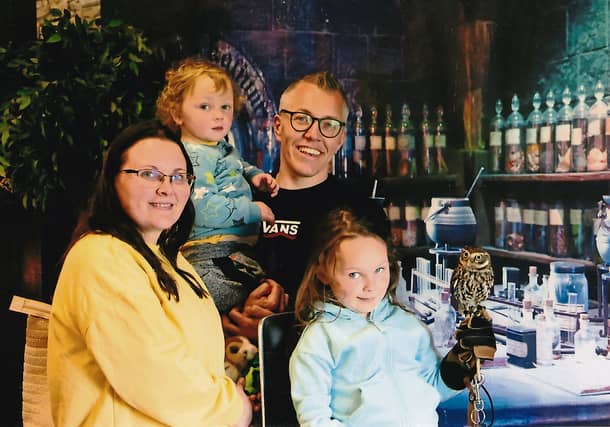

For International Brain Tumour Awareness Week: October 28- November 4
Thirty-five-year-old Joseph Ryan from Thurles lives with his wife Tasha, their two kids Penelope, six and Felix, three and their dog Hulk.
He works at the Thurles Leisure centre and loves music, watching rugby and walking.
And in 2006, at age of 18, Joseph was diagnosed with a Astrocytoma grade one on his prefrontal cortex.
With the help of his friends and family and Brain Tumour Ireland, Joseph has been able to recover and build a life.
“The love and support I received from my family and friends made it so much easier, as hard and all as it was.
“Don’t be afraid to ask for help. Brain Tumour Ireland is an amazing charity, and they do great things for people diagnosed with a brain tumour and their families,” said Joseph.
GROWING PAINS
Although Joseph’s last few years have been happy, his story began much earlier when he was still at school.
In third year of secondary school, Joseph’s hand began to seize when writing. He received treatment for a suspected muscle injury, assumed to be from playing rugby. But his condition didn’t improve, and neither did his academic performance.
By Sixth Year Joseph’s arm couldn’t be used, his balance was impaired and he had lost the ability to concentrate. Although he had received the aid of scribe, Joseph failed his Leaving Cert. After school, he went to work with his father as a plumber and then in Larry’s Pub. But things just became more difficult.
“It got so bad that when I was in Larry's serving pints, I’d grab a glass and my arm would be so seized up, I’d have to release it myself, so I’d actually have to take my fingers off it,” said Joseph.
On a particularly frustrating day, one of Joseph’s coworkers recommended he see a local private physiotherapist, Andy O’Connor.
That physio suspected that Joseph’s problem was neurological not muscular. Joseph went back to his GP, who in turn, referred him to Limerick for an MRI.
“So, I went for my MRI, and by the time I got my train back to Thurles, I was on the train I got a phone call saying: ‘Joe, can you return to the hospital immediately’. At that point I was young, I was 18, and I was like, not at all. I’m on the train now, and I’m not going to lose my ticket. It was already stamped.
“So they said look, you have to come back the day after, so my Dad drove me down, and they told me bring my Dad in with me, and they told me there that I had a brain tumour,” said Joseph.
Joseph was diagnosed with a grade one Astrocytoma.
Astrocytomas are tumours made from astrocytes, brain cells that support the functioning of neurons. Astrocytomas are the most common form of brain tumours and affect more men than women and are graded from one to four, according to the American Association of Neurological Surgeons. They can grow slowly or fast.
From there, Joseph was referred to Cork for neurosurgery. The tumour was damaging nerves on the right side of his body and leaking fluid.
The doctor told him that if they didn’t operate, he may have a stroke.
“The tumour had formed a shell because it was there so long. They reckon it had been there since early childhood,” said Joseph.
Joseph said he was young, and as scary as this all sounded, he wasn’t initially worried .
“I didn’t know what to expect. A friend of mine, James, rang me Tuesday morning and said you know, best of luck, and I said ‘sure I’ll meet you in the pub on Thursday for a pint.’ That is how naive I was with it all. It wasn’t until the day of my surgery when I woke up and thought, Jesus, what’s happening,” said Joseph.
The day after the tumour was removed Joseph woke up with over 40 staples in his head. He was, for a time, paralysed and had difficulty expressing himself.
“It was frustrating because I knew what I wanted to say in my head, but it wasn’t coming out.”
“I remember lying in the bed at one time and thinking Jesus, is this what it’s going to be like for the rest of my life, but then I thought look on the bright side of life.”
A LONG RECOVERY
Speaking to the Tipperary Star this week, Joseph seemed like an incredibly positive person. And it was that determination and positivity that got him through an incredibly difficult and long recovery.
After leaving the hospital, Joseph needed physio and speech and language therapy.
He had frequent headaches, difficulty sleeping and would ‘explode’ when he became overwhelmed. Joseph struggled but didn’t yet know his limits and was determined to go back to work.
“I was constantly doing one step forward and two steps back.”
In 2007, Joseph started seeing his now wife Tasha. But his condition took its toll on their relationship.
“It was a lot for her, and we ended up splitting up.
“It took two years before It was like, okay, I can do this type of work.

Joseph and Tasha
Joseph moved to Cork, and in 2013, he and Tasha got back together. The following year, they moved back to Thurles and adopted the first member of their family.
“So in 2014, then my dog Hulk came into my life. We still have him today and he is the most gorgeous dog you have ever seen. Such a friendly dog and lovable.”
Joseph found work he thought he could do, but within a month, he was experiencing blackouts. Undeterred, he decided to go to college and study Tourism with Business, and things started to turn around.
“So the second year of it I was up in Dublin in Ballyfermot. I was so proud of myself at this point because I was travelling up and down everyday on the train to Dublin. I was gone everyday at five o’clock. I got all the distinctions in Templemore,” said Joseph.
2017 was a special year for Joseph because not only did he graduate from college, but his daughter Penelope was born.
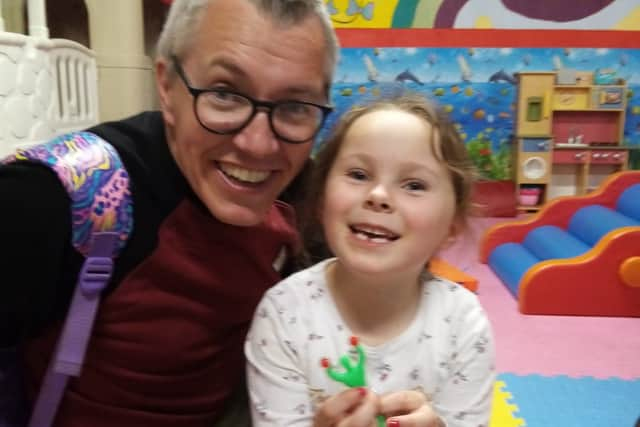
Joseph with his daughter Penelope
“It was the best six months because I had all that time to spend with my little newborn son and my daughter and my dog and my wife.
“In some ways Covid was a disaster for some people, but in other ways the first stint for me was brilliant because I got all that time with my family,” said Joseph.
SUPPORT
On one of his follow up appointments, Joseph was given information about a brain tumour support group- now Brain Tumour Ireland.
But he didn’t initially ask for support. It was his wife Tasha who encouraged him to reach out.
Joseph said it can be difficult to ask for support from friends, family or even support groups, but that is exactly what you need.
Joseph said he would bottle up his feelings until they overwhelmed him.
“If you are having issues, speak to people because, that’s what three quarters of my problems were,” said Joseph. But once Joseph started to talk to people with similar experiences, things started to look up.
“To this day I still get pains. I still get headaches, but I kind of know where to stop. I still push myself sometimes, but I know where to stop and a lot of that is from the support group because when you’re in the support group and you are sitting in a room with ten other people who have gone through the same issues you have.
“You might not be all the same. You might have different tumours or different grades of tumour and all different symptoms.
“We all have similar stories, so the support groups are amazing, and what brain tumour Ireland are doing is amazing,” said Joseph.
Joseph advises anyone who finds themselves diagnosed with brain tumour, not to look up their symptoms on the internet.
He said there are around 150 different kinds of brain tumour, and depending on the location, they affect people in different ways.
BRAIN TUMOUR AWARENESS WEEK
But you will need information, which is where Brain Tumour Ireland comes in. International Brain Tumour Awareness Week takes place from October 28 to November 4.
Brain Tumour Ireland are hosting a free webinar Brain Wise: Living Well with a Brain Tumour, on Tuesday October 31, at 6:30pm, with special guest Wild Youth’s Conor O’Donohoe. There will also be presentations from a dietitian on eating well following treatment for a brain tumour, and jointly from a senior social worker and occupational therapist on navigating relationships at a time of great emotional trauma.
Registration for the webinar, which is free, is now open at braintumourireland. com.
Having access to support and information is very important when navigating diagnosis and treatment.
But so is staying positive.
“That’s the main thing is that you are going to get knocked back no matter what it is. Even if it’s a brain tumour you are suffering with or anxiety or stress you are going to get knocked back, but you have to get back up and stay going. If you don’t, it will take you over,” said Joseph.