
Birds of prey at Cabragh Wetlands
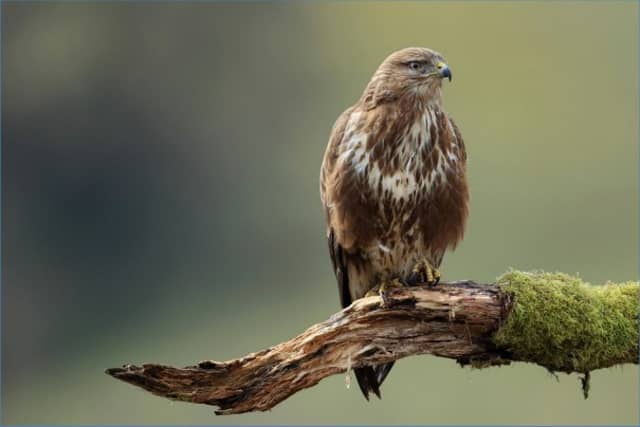

People now realise that birds are prey are vital to the local ecosystem
Cabragh is a special place for birds. In winter, for example, the area supports up to a thousand ducks and waders. Wherever this many birds gather, predators are never far away. It is one of the rules of ecology that the numbers of prey dictates the number of predators, and not the other way round.
A visit to Cabragh Wetlands at almost any time of the year will yield a sighting of a Buzzard. The Common Buzzard (Buteo buteo) is a large brown bird of prey—vital statistics are; length, about 0.55m, wing span 1.3-1.5m, weight 500g-1.4kg. The upper parts are dark brown and the belly is whitish.
However, Buzzards show a great variety of markings or barrings on the chest and belly. Some birds are very pale while others are boldly streaked with brown. The underside of the wing has a white splash near the elbow contrasting with the black wing tips of the primary flight feathers. The talons (legs) and cere (part of the bill) are bright yellow.
In winter, if you see all the ducks and waders fly up into the air together, there is probably a Peregrine Falcon in the area. The Peregrine is our largest falcon and is built for power and speed. The bird is steel grey on the back, has barring on the breast and has a black hood and moustache. In flight it appears deep-chested with pointed wings and a shortish tail. The female is larger than the male. It was the species favoured by falconers. It builds its nest or eyrie on coastal cliffs or on inland crags or in quarries.
If you see a small falcon hovering over rough grassland, it is a Kestrel. This is the only bird of prey in Ireland which hunts by hovering in the air, searching the ground below for food.
The male has a grey head and a grey tail and has a rich chestnut colour on the back. The female lacks the grey on the head and tail, and is rusty coloured with dark flecks.
During the spring migration, a Marsh Harrier often turns up at Cabragh. These birds are very rare breeders in Ireland, but birds from Britain and the continent wander over from time to time. These are bigger than our Hen Harrier and we usually see the juvenile type, which is all dark brown with a creamy patch on the head.
If you see a small hawk flying low and fast, it’s a Sparrowhawk. These are ambush predators and everything from a Wren to a Woodpigeon is on the menu. These are present at Cabragh throughout the year.
At night the owls have the countryside to themselves. There is a resident pair of Barn Owls at Cabragh. They nest in a nest-box. There are also Long-eared owls in the area. These birds nest in trees, often using and old crow’s nest.
There is something exciting about birds of prey.
Maybe they appeal to our predatory instincts. In the past they were persecuted by gamekeepers from the big estates. These days people are more educated and realise these birds are an important part of the ecosystem as top predators.
The Tipperary Star - supporting the protection of our local environment in Cabragh Wetlands