
Cabragh Wetlands is a photograph at this time of the year
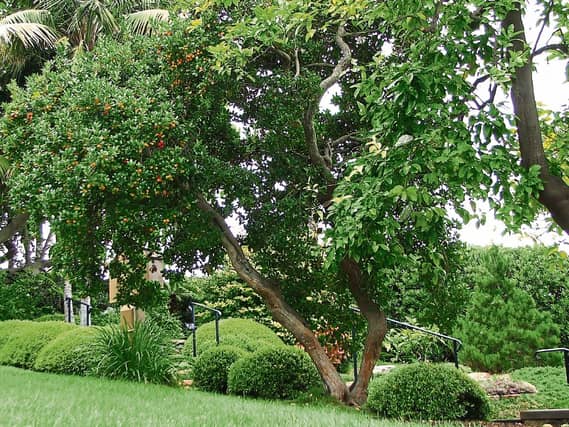

The tree you need by rivers and fens is the alder-one of our oldest trees found in the peat of Irish bogs in a two hundred year period about 4,300 years ago.
We all need a lift! Personally, a good nature photograph is my fix.
On last week’s edition, Julie Butler keenly observed a bracket type fungus which she identified as merculiaceae growing on an old stump and accompanied by a hundred word paragraph on the theme of biodiversity, scooped a major award.
In this week’s edition, Carmel Sammon draws our eye along the river path at Cabragh on a frosty morning leading us on to the fence posts of the Cosmic Walk.
Over sixty years ago, Martin Duggan hammered in a row of willow fence posts along the left bank of the river which grew into tall trees which have since fallen. But on the right bank you will see fine specimens of one of our native wetland trees – the alder which grows particularly well in that area. Incidentallly, the beautiful cut stone bridge near which the photograph was taken was built in the early 1840’s.
Trees and rivers are a great combination. These riparian woodlands in the upper catchments reduce the speed of run-off while on floodplains they slow down waterflow and reduce the incidence of flooding downstream. In the lowlands, they can to a certain extent, filter surface and sub-surface nutrient-rich waters flowing from farmland extracting phosphorus and nitrogen.
In Estonia, it has been found that woodland buffer strips on stream banks in association with sedge fens or wet meadows remove more than 90% of phosphorus originating from farmland. Trees along river banks reduce bank erosion , provide shade, cover and habitat for fish and invertebrates. Shade is also important for young salmon and trout which can suffer from lack of oxygen if water temperature is too high.
The reduction of sediment clogging the spawning beds is another plus. However, trees such as rhododendron, dogwood and sycamore are unsuitable and of course the invasive Himalayan Balsam is expanding its range along river banks. Two such sites are beside the Suir at Turtulla and Beakstown. You must engage experts to deal with them.
The tree you need by rivers and fens is the alder-one of our oldest trees found in the peat of Irish bogs in a two hundred year period about 4,300 years ago. Of the same family as birch, the wood when cut turns from white to red and was considered a tree of war and death, fire and water.
In Irish, An Fhearnóg, it is the source of many placenames including Farney, Borrisfarney and Rathfarnham. It is easily recognized by its dark green foliage and dark brown bark although this time of the year the dark brown remains of the seed cones are the giveaway.
Alder is the only deciduous Irish tree with cones. Through the summer, the fertilized female catkins enlarge to form solid oval cones about a half inch long. In winter these gradually become wooden and finally open out to release the seeds. Any seed not taken by birds is shaken free by the wind before spring.
Two birds in particular have learnt to exploit alder seeds and are largely dependent on them for their survival-the redpoll and the siskin-both finches that breed mainly in northern forests but move southwards in winter. To cope with their depredation the tree produces enormous quantities of seeds. The water resistant seeds float on rivers and lakes and when they wash up on shorelines they are eaten by small mammals and wildfowl.
The few remaining seeds grow rapidly to produce new trees. This vigorous growth is made possible by bacteria in small nodules on the roots. These are nitrogen fixing-the only higher plant that can do so. Both bacteria and tree benefit from the exchange of nutrients. That area of the wetlands has never developed into an alder woodland although it may in time but the trees that are there form a complex living community of moths, aphids fungi etc.
If you are looking for something to fill in the time why not take part in the Irish Garden Bird Survey hosted by Birdwatch Ireland, an excellent opportunity to become a citizen scientist and add to our knowledge of the natural world.
Our sincere gratitude to all who purchased our Christmas DVD-it was a huge boost and there are still some remaining -phone 0504 43879.
We extend our sympathy to the Corbett family on their loss of Breda Corbett and particularly to her brother Rev. Larry Wren who has been a great supporter of Cabragh Wetlands over a long period of time.
Suaimhneas síoraí di.
Stay at home, wear a mask, stay safe.
Slán go fóill.