
EXPLAINED: The sexual abuse report that named 15 Tipperary schools


Here is what the inquiry found and what will happen next
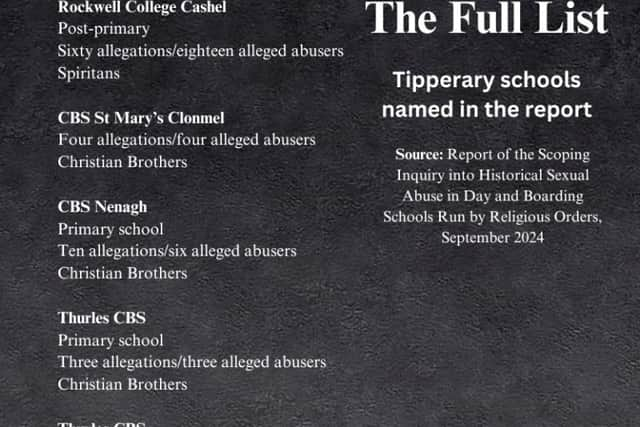
Fifteen Tipperary schools have been named in a scoping inquiry into sexual abuse in schools run by religious orders.
The report was published this week and lists 2,395 allegations in 308 schools nationally.
Ninety-seven of those were in Tipperary and relate to up to 46 alleged abusers.
Rockwell College in Cashel had the most allegations, with 60 and 18 alleged abusers, followed by Nenagh CBS, with 10 allegations and six alleged abusers.
CBS Carrick-on-Suir secondary school, Scoil Mhuire na nAingeal, Templemore CBS secondary school and St Joseph’s primary school in Tipperary Town all had the lowest with one accusation each.
CBS St Mary’s Clonmel, Thurles CBS (primary and secondary), CBS Carrick-on-Suir (primary) CBS Tipperary Town (primary), CBS St Peters and St Paul’s CBS Clonmel Junior School, Mount St Joseph’s Cistercian College Roscrea (post-primary) and Presentation Secondary School Ballingarry were also named in the report.
St Joseph’s Primary School in Tipperary Town was named under submissions from the Survivor Engagement Questionnaire with one allegation.
SCOPING INQUIRY
The inquiry was limited to day and boarding schools run in part or whole by religious orders.
It did not include industrial or reformatory schools as they were state care facilities.
This and data from the CSO suggest the level of historic abuse in schools is likely to be much higher.
It is a non-statutory committee with no power to investigate individual claims.
The inquiry’s job was to collect information that would give the Government an idea of how widespread the problem was and what that problem looked like.
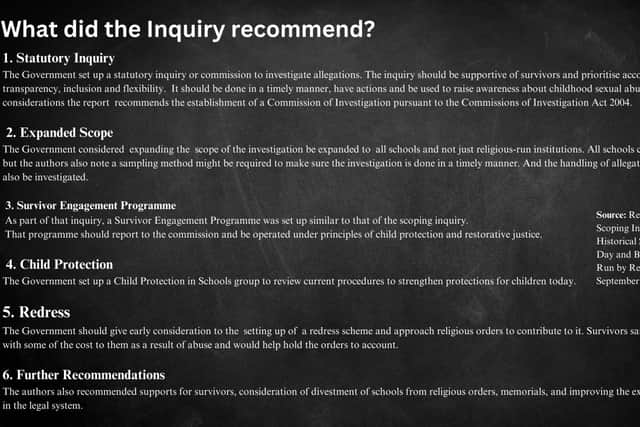
In their report, the team made recommendations for how the Government should respond in terms of further investigation, redress and examination of current child protection procedures.
The Scoping Inquiry team used two approaches to collect information.
In the first instance, they created a Survivor Engagement Process where, in phase one, people were asked to come forward and fill in a short questionnaire about the abuse they had suffered.
This was to find the incidents that fell within the remit of the inquiry. 205 people filled in the questionnaire, with 182 falling under the remit of the inquiry.
In stage two, survivors were invited to interview with a trauma-informed facilitator or provide a written submission to give more detail and say what it is they would like to see the Government do.
142 survivors went on to stage two, with 137 completing an interview and 12 providing written submissions.
The second method of collecting information was to request the records from the religious orders.
But, they had no power to compel cooperation.
The author of the report, senior counsel Mary O’Toole said that while most orders were cooperative, others declined to provide information like breakdowns by schools of allegations.
Of the 73 religious orders questioned, 42 said they had received allegations that fell within the scope of the inquiry.
Religious Orders named in the report under Tipperary schools were the Christian Brothers, Patrician Brothers, Congregation of the Presentation Sisters, Religious Sisters of Charity and Spiritans.
ABUSE
The Scoping Inquiry report was over 700 pages over five volumes.
Details of systemic abuse are contained within its pages.
Survivors describe horrific incidents of sexual abuse, molestation and rape accompanied in many cases, by physical violence, emotional abuse and grooming. Survivors were mostly between 11 and 15-years-old, with some but less below the age of 10 and older than 16.
The majority had been abused in the 1960s and 1970s, with the peak between 1970 and 1975.
Most said they had been abused by a member of teaching staff but some said lay people, clergy and others had also abused them.
Abuse ranged from single incidents to ongoing abuse over years.
The report called the abuse in these schools “pervasive, unpredictable, painful and normalised”.
Survivors described a “culture of violence and humiliation,” and “sadism and cruelty.”
Survivors said abuse had a life-long impact on mental and physical health, relationships with family and intimate partners, employment, substance abuse and stigma. They described feelings of isolation, fear, loneliness, shame and guilt.
Some survivors were estranged from their families, while others chose not to have children as a result of the abuse they suffered in school.
And, some said other authorities like the gardaí and health care professionals had failed to protect them, even when abuse was reported or signs noticed.
Most survivors believe that the abuse in their schools was so pervasive that authorities could not have known, and efforts were made to cover up the abuse.
They said it was an “open secret” in their schools.
Many survivors described being abused in front of other children in classrooms and dormitories.
Other people came forward to say that while they themselves had not been abused, they had witnessed incidents involving other children.
Some survivors said that following engagement with the orders, they did receive an apology.
Some found it helpful to their healing while others said apologies were formal and cold.
Others who did not receive an apology said their engagement with order lacked “empathy and compassion.”
Survivors told the inquiry team they wanted to see a full investigation of what happened to them and a redress scheme set up by the Government but contributed by the religious orders.
COMMISSION
Following the publishing of the report this week, Minister for Education Norma Foley announced she is to set up a Commission of Investigation to examine allegations made during the scoping inquiry.
“I am announcing today that the Government has accepted the principal recommendation of the report of the scoping inquiry, which is for the establishment of a Commission of Investigation.
“Historical sexual abuse is a profoundly serious matter and needs to be examined in detail.
“One of the most compelling aspects of the report is that older participants provided devastating accounts of how sexual abuse in childhood has affected their entire lives, from their schooldays through adolescence, early adulthood through to later years,” said Minister Foley.
Minister Foley commissioned the scoping inquiry in response to a 2022 RTE Radio 1 documentary, On One: Blackrock Boys.
The inquiry team was established in March last year to inform the Government’s response and make recommendations for a future framework for addressing historic abuse.
Some survivors credited the documentary as giving them the courage to come forward because they felt less alone.
Commission vs Tribunal
The establishment of a Commission of Investigation was in line with a recommendation made by the scoping inquiry team that addressed most of the requirements of survivors.
Survivors wanted a full investigation held in public to ensure transparency and accountability.
Survivors wanted it to be the least adversarial and be done promptly to allow older survivors the time to tell their stories and contribute to the investigation.
However, the inquiry team noted meeting all of those requirements would not be possible.
They said that while a bespoke statutory inquiry could be created, it would require new legislation and that would take time.
Under current legislation, there are two types of statutory inquiry, and both are different from the scoping inquiry that wrote the recommendations.
TRIBUNAL OF INQUIRY
Tribunals of Investigation have powers to investigate specific matters but not impose penalties.
They are usually chaired by judges or senior lawyers, and they submit a report to the Oireachtas, which may contain recommendations.
They sit in public, which is what survivors wanted, but have some downsides.
They are not courts but are court-like and so often combative, affording full procedural rights to the accused parties.
The scoping inquiry report noted they were likely to re-traumatise survivors and may discourage people from coming forward.
COMMISSION OF INVESTIGATION
The Government has opted for a Commission of Investigation, in line with the report’s recommendation. Commissions of
Investigations are set up under the Commissions of Investigation Act 2004 and are established to investigate matters of public concern.
They are not held in public, but they do issue a report.
Survivors have the option to give evidence by video link and won’t be cross-examined.
According to the scoping inquiry report, they are more flexible and can consider the needs of survivors.
They are also much faster.
SCOPING INQUIRY
A scoping inquiry is exactly what it sounds like. It is an inquiry to scope out an issue.
The aim is to collect information and make recommendations.
In this case, it also allowed survivors to tell their stories, where they may not have had the opportunity before.
But it is non-statutory, which means it has no powers to compel and relies on voluntary cooperation.
It is also limited in scope, which means it has clear terms of reference and remit.
In this case, the inquiry only looked at historic sexual abuse in schools run by religious orders or community schools with religious orders on the board.
It didn’t look at unrecognised, industrial or reformatory schools.
The inquiry can and did recommend a future tribunal or commission to expand the scope.
APPEAL
An Garda Síochána is appealing to anyone who wishes to report a crime relating to the report to do so.
Those who wish to make a complaint can do so by emailing [email protected], phoning the confidential Garda Child Sexual Abuse Reporting Line on 1800 555 222 or by calling your local garda station.

Detective Chief Superintendent Colm Noonan of the Garda National Protective Services Bureau said they are there for all victims of abuse.
“An Garda Síochána is here to support any person who wishes to report any crime of Sexual Abuse not just in Day and Boarding Schools Run by Religious Orders but also in any other institution or organisation.
“These crimes are insidious and have a lifelong effect on those who are subject to this abuse.
“An Garda Síochána will support each individual who makes a report to us; An Garda Síochána will listen and will assist in progressing their complaint at the pace and to the extent that the person wants.
“Any person contacting An Garda Síochána can be assured that their interaction will be treated in complete confidence,” said Chief Supt Noonan.
He continued: “To any person who has not spoken about being the victim of sexual abuse, I would say the evidence in the Scoping Inquiry and the, so far, over 160 contacts made to An Garda Síochána show that you are not alone, you did nothing wrong and that if you want to speak your voice will be heard.
“I once again appeal to any person who believes they are the victim of a criminal act relating to Historical Sexual Abuse in Day and Boarding Schools run by Religious Orders, to please come forward and report this to An Garda Síochána.”
CHILD PROTECTION
The authors of the report said that current child protection procedures in schools today are “robust”.
As part of the inquiry, the team commissioned two reports, one of them an analysis of current child protection measures and the other an analysis of the response of religious orders to allegations by way of Restorative Justice.
While the inquiry found that child protection measures were adequate, they did believe procedures could be strengthened and recommended a group be established to review the current measures.