
Innovative High School students showcase their impressive projects
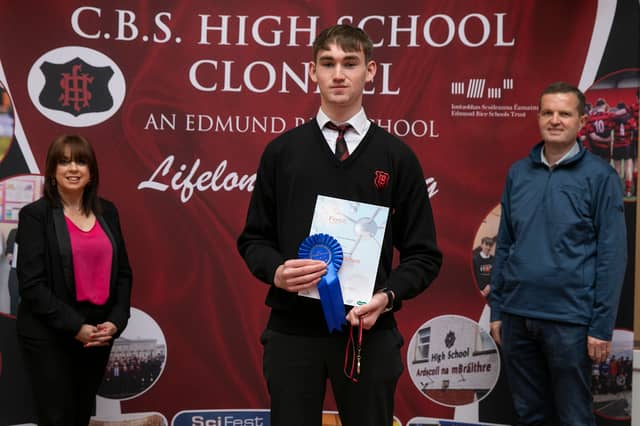

S.T.E.M. has always been to the fore in the High School Clonmel and the recent Scifest@School science fair has shown that the area is stronger than ever, proving that the future is bright
45 students from 1st, 4th and 6th year exhibited their projects in the first High School Scifest@school science fair, kindly sponsored by Boston Scientific, Clonmel.
SciFest is a series of one day science fairs, funded at college level primarily by Science Foundation Ireland, Intel and Boston Scientific. SciFest@School is a smaller branch of SciFest where a second-level school hosts their own in-house SciFest science fair. SciFest@School was introduced in 2011 and there has been strong demand from schools to participate.
Traditionally, the High School would enter students at SciFest@College competitions in L.I.T. Thurles or W.I.T. This has proved to be a most productive and enjoyable experience for the students. They are provided with the opportunity to present their projects to judges and other schools, learn about project areas chosen by other schools and also gain valuable insight into S.T.E.M. careers and the latest S.T.E.M. technology. For example, at the last Scifest@College first and second years got to experience Virtual Reality Headsets whilst at the L.I.T. Thurles SciFest T.Y. students received inspiring S.T.E.M. career talks from a variety of speakers including lecturers from the University of Limerick and Engineers who have worked in Ireland as well as the U.S. and Canada.
This year the students have worked hard since January preparing for SciFest. They are to be commended for their focus and determination as much of this research was done during a phase of online schooling. Topics of particular interest included Covid-19 and its effects on the environment and mental health, comparative studies on vaccines and also agricultural sustainability.
It was difficult to envisage initially what SciFest would look like at the High School this year due to health and safety restrictions but T.J. Kinsella, Jonathan Howley, Valerie Moloney and Emma Mullane from Boston Scientific provided fantastic support. Jonathan is a Manufacturing Engineer, Emma an R&D Process Development Engineer and Valerie is a Test Engineer. They are all part of the Boston S.T.E.M. team. As well as sponsoring the event, Valerie and Emma also agreed to judge and give a S.T.E.M. related career talk on the day. Sheila Porter from SciFest itself also sponsored prizes and certificates to all participants.
BOSTON SCIENTIFIC
Judging on the day was not an easy task but the judges whittled it down to two winning groups in the first year (junior) category. Patrick Keating and Kevin Wojtowicz were the overall winners with their project on the Advantages and Disadvantages of Covid-19. The boys discovered that one positive aspect of Covid-19 was reduced air pollution due to fewer vehicles on the road and a smaller number of industrial factories working at full capacity. Disadvantages meanwhile, included loss of lives, job losses and the effects on mental health. Runners up Paddy Spellman and Brian Morrison let their passion for sport lead their project efforts and researched which sport is ‘the hardest.’ They carried out multiple experiments in the months prior, trying different sports whilst wearing smart watches to track their B.P.M. and calories burned. In the end boxing resulted in the highest B.P.M. and burned the most calories. The judges were blown away by the passion the two boys had for their chosen project.
AIR POLLUTION
The overall winner for the Transition Year (intermediate) category was Robbie Buckley who based his project on the effects Covid-19 has had on air pollution.
Robbie discovered that some countries have seen air pollution levels drop by 60% since the start of the Covid-19 crisis. Robbie also uncovered that people in India can see the Himalayas for the first time in their lifetime due to reduced pollution levels. He hopes to build on his project by looking into how we can learn from the Covid-19 crisis and keep reducing air pollution levels and possibly enter Young Scientist in September. The Transition Year runner up was Donal 4Quinn who researched what physical attributes contribute to making a person a good swimmer. Donal put his knowledge of swimming and physics to good use in the project, investigating forces, equilibrium and applying Newton's 3rd Law.
Judging then moved onto 6th years and there were three very strong projects all based around agricultural sustainability. Runner up Rian O’ Connor investigated the benefits of water harvesting on a local beef farm. Cathal Ryan, a second runner up, built a water wheel to generate electricity for his farm. David Broderick won the overall prize however and his project compared grass growth on his farm when using different fertilisers and the effects of each on sustainability. The judges remarked that it could have been a Teagasc research project.
The day was finished off with an inspiring S.T.E.M. talk from Valerie, a Test Engineer. She captured the students’ attention from the offset by sharing her love of gaming and how she let her passion for the area lead her into her college course and onto her career path. The boys could not believe the strong links between maths, physics and gaming. She definitely inspired our resident gamers to put down the controller and focus on their Science homework!
The High School places a significant emphasis on S.T.E.M. subjects and related projects and it is an incredible opportunity which serves to highlight the area for students, show its importance in their everyday lives and more importantly, to help pave the way for potential future careers. We can’t wait for our 2nd annual Scifest@School science fair next year!!