
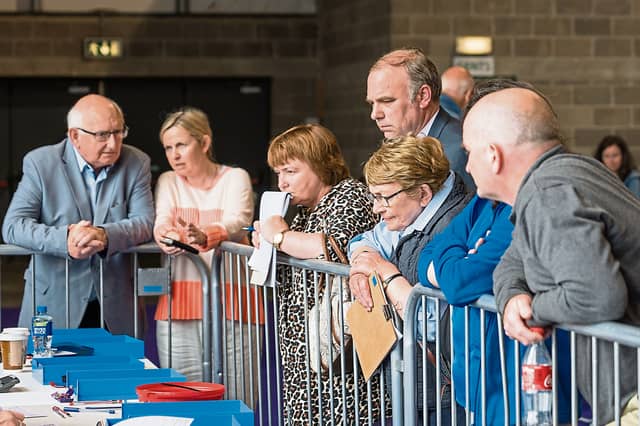
Jotting up the stats and figures at the election count


Kildare politics
Maths is crucial on count day. Even the cheapest campaign costs money and involves the help of friends and supporters.
Whatever we think of elected politicians, the only other option to managing our affairs is to give non-elected people the reigns.
But who will select them for us? Their friends, the corrupt, the economically powerful?
Those elected to Kildare County Council on June 8/9, following the vote on June 7, will find their powers and desires are limited by (1) budgets, both national and local (and increasingly European Union), (2) the laws of the land (as agreed by those elected to the Dail, for the most part) and (3) a multitude of rules, and practices.
But before they start to think about the above, they must get elected. And that is not easy.
In the 2019 local elections, under half the electorate in Co. Kildare turned out to vote, with 57% voting for one or other of the current government parties, Fianna Fail, Fine Gael or the Green party.
The Proportional Representation (PR) voting system works, in essence, by electing those who reach what is known as the quota, although in some instances you can get elected without reaching the quota.
The quota is calculated by dividing the number of valid votes by the number of seats to be filled plus one, and adding one to that result.
Quota
In the 2019 result in the Naas area, for example, the quota was 1522 with 12,436 valid voters for seven seats.
Of the eight highest vote getters, the candidate with the lowest number of first preference votes of those who got elected received 917.
That is a lot of votes to get from one’s community, a lot of people who put them at number one.
One candidate received 1,004 votes, but was not elected.
Two other candidates each got over 800 first preference votes. There was a gap then with the remaining candidates polling between 436 and 275 votes.
In Naas, with one exception, the top vote getters on the first count were the ones which won the seats available.
Of those elected in the various areas in Kildare in 2019, the lowest first preference vote on the first count recorded by a candidate was 544.
Those figures will change this time depending on the numbers entitled to vote and the % of those entitled to vote, who come out to do so.
Whatever our politics, we should respect both those who go forward and don’t get elected, and those who get elected, provided they respect us, the voter and those who opt not to vote.
- Henry Bauress