
Kildare historian has penned new book about an Irish revolutionary
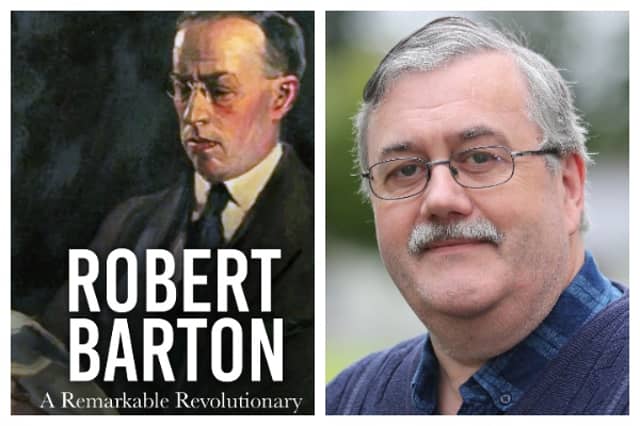

The new book is entitled Robert Barton: a Remarkable Revolutionary
Chris Lawlor, former head of the history department in Naas CBS, has written another book, which will go on sale in bookshops and online during the first week of December.
Chris was the inaugural winner of the County Kildare Archaeological Society’s prize for history, and he has authored a history of Naas CBS (2002) and The Little Book of Kildare (2015 and reprinted earlier this year).
The new book is entitled Robert Barton: a Remarkable Revolutionary. Barton has a unique place in Irish history because he was a signatory of the Anglo-Irish treaty, but subsequently took the anti-treaty side in the Civil War.
Chris has written the first ever study of the enigmatic signatory, which focuses on his role during the Irish Revolution, charting his political journey from a staunchly Unionist background, through Home Rule to Republicanism and his later anti-treaty stance. Using multiple sources, including extensive archival material, this book traces the life, times and legacy of a truly remarkable revolutionary.
The Barton family of Glendalough House, Annamoe, County Wicklow were pillars of the local Church of Ireland community. They were related to the Bartons of Straffan House (now part of the K Club). Their Unionist credentials were underlined when Robert’s father, Charles, fell out with his famous neighbour, Charles Stewart Parnell, over the question of Home Rule for Ireland. The young Robert received a classic Anglo-Irish education, attending Rugby School, the Royal Agricultural College, Cirencester, and Oxford University. His educational journey was parallelled by a political one, in which he was converted to the idea of Home Rule. While he was at Oxford, he espoused the cause of the Home Rule (Irish Parliamentary) Party. One of Robert’s classmates later remembered that Barton ‘first set me thinking of the English treatment of the Irish and aroused in me a sense of disgust at our barbaric tyranny and of sympathy with the movement to free Ireland from English rule’.
Barton fully supported the Nationalist cause during the Home Rule Crisis of 1912-14, but World War One intervened and Home Rule was put on hold.
Robert Barton joined the Royal Dublin Fusiliers in October 1915. He was gazetted as a second lieutenant, but Fate decreed that he would be sent, not to France, but to Dublin because of the Easter Rising. In the aftermath of the rebellion, Barton was stationed at Richmond Barracks and was involved in looking after Republican prisoners. As Officer in charge of Prisoners’ Effects, Barton was in daily contact with the incarcerated men, some of whom he already knew from his Home Rule involvement. Barton remained in the British Army until 1918, but he underwent a political conversion during this time. One inmate claimed that Barton’s later ‘very national outlook’ was directly attributable to contact with Republican prisoners during this period. Barton joined Sinn Féin and stood as a candidate in the 1918 general election, comfortably winning the seat for West Wicklow.
During the War of Independence, Barton was given the position of Director of Agriculture, but he was arrested for making seditious speeches. He was imprisoned in Mountjoy Jail, but became the first person to escape from there on the night of 16-17 March 1919. Before he left his cell, Barton coolly left an effigy of himself in his bed and a note for the prison governor,
stating that he felt that he had to leave due to ‘the discomfort of his present surroundings’. He remained on the run for some time, but was recaptured and sent to England, serving time in Portland Prison and Portsmouth Gaol. He was elected for the constituency of Kildare-Wicklow in 1921 and was released from Portsmouth at the behest of de Valera, who wanted
him to help negotiate a truce to end the ongoing Anglo-Irish War.
Robert Barton was integral in initiating and implementing the truce which ended hostilities on 11 July 1921. As de Valera’s right-hand man, he travelled to London with the fruitless first Irish delegation (headed by de Valera) of that year. He was also chosen as a member of the second delegation (from which de Valera was conspicuously absent) to go to London later in
the year. Having been promoted from Director of Agriculture to Minister for Economic Affairs, Barton’s principal objective was the attainment of full fiscal autonomy for Ireland.
He was also perhaps the most doctrinaire republican within the delegation, but he found himself excluded from nearly all the sub-conferences (attended mainly by Arthur Griffith and Michael Collins from the Irish side).
Robert Barton became increasingly worried about the negotiations, but he cut an isolated figure. His only ally among the delegates was Gavan Duffy, but they were constantly outvoted. After many intricate twists and turns, with numerous moments of high drama involving Barton in both London and Dublin, matters came to a head late in 1921. On 5 December, Lloyd George presented the Irish delegates with an ultimatum – sign the treaty or break off negotiations and resume hostilities. Griffith, Collins and Duggan made it known that they would accept the terms now on offer. Gavan Duffy said that he would follow
Barton’s lead. Thus, in effect, Barton had the casting vote among the Irish delegates, for they all had to sign the document in order for it to be accepted.
The hours that followed were agonising for Barton. This was one of the most dramatic and
significant nights in Irish history, and one in which Barton was to be a pivotal figure with a
principal role. Lloyd George’s ultimatum may have been a bluff, but could Barton take that
gamble? During a night of high tension and even higher drama in which Barton was the
central figure, pressure was piled on him, and he nearly reached breaking point on a number
of occasions. He eventually agreed to sign the document, later stating in the treaty debate that
‘for myself, I preferred war… but for the nation, without consultation, I dared not accept
responsibility.’ He stated that signing ‘seemed to me the lesser outrage’. Having signed the
document, Barton voted for it in Cabinet, where it passed by a single vote. Hence, Barton’s
vote in Cabinet gave the Dáil the opportunity to debate the issue.
The treaty did not deliver a republic, but it gained support from enough TDs to narrowly pass
in the Dáil. Unlike Griffith, who commended the treaty to the House on the basis of merit, the
dutiful Barton commended it on the basis of signature. Having done the honourable thing and
voted for the document which he had signed, intriguingly, in a move demonstrative of his
deep soul searching, Barton then joined the anti-treaty side in the Civil War that followed. He
was among the group of anti-treatyites who occupied the Hammam Hotel in Dublin. He
managed to escape from the building, but was soon captured and incarcerated in Portobello
Barracks, from where he escaped. While on the run, Barton was chosen as Minister for
Economic Affairs in De Valera’s council of state, a shadow body set up in opposition to the
government. Barton was arrested again and imprisoned in the Curragh Camp, but he survived
the Civil War. He lost his Kildare-Wicklow seat in the general election of August 1923 and
retired from politics.
Robert Barton returned to public life when De Valera’s Fianna Fáil party came to power in 1932. He had always been a confidant of De Valera, who made him a director of the Irish Press. Sean MacEntee also appointed him to the board of the Agricultural Credit Corporation.
He became chairman of the board of the ACC in 1933, a position he retained until 1959. In 1934 Barton also became chairman of the Turf Board, and remained in this post after the board had been altered and renamed Bórd na Móna in 1946. As chairman of Bórd na Móna, Barton did much to develop the bogs, especially in the Irish midlands, until his retirement in 1960.
Barton died on 10 August 1975 at the age of ninety-four. Ironically, some of his best work was done in his later life, but it was overshadowed by his part in the Irish Revolution, and particularly his role in the treaty saga.
Robert Barton: a Remarkable Revolutionary by Chris Lawlor will be available from the first week of December. (ISBN: 978 1 80399 816 9, published by The History Press, 222 pages, Price €20).