
KILDARE WILDLIFE COLUMN: Heather for honey, brooms and baskets

With Nuala Madigan from the Bog of Allen Nature Centre
Visiting a local bogland here in the midlands, both Ling Heather and Crossleaved Heath are familiar.
Both are native and bring a flush of purple and pink colour across our peatland landscapes at this time of year.
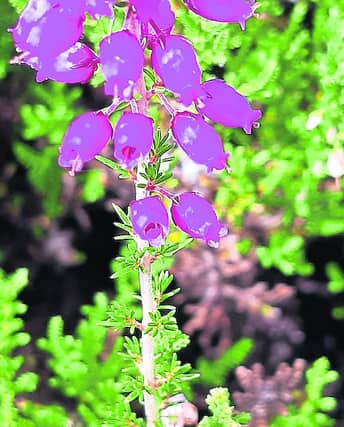
However did you know that Cross-leaved Heath can be often mistaken for a third type of heather native to Ireland, Bell Heather (Fraoch Cloigíneach as Gaeilge).
Bell Heather and Cross-leaved Heath are both evergreen and both have fused petals that create a distinctive bell shape.
While Cross-leaved Heath grows well in wet peaty soil, Bell Heather prefers drier peatland areas typical of upland bogs and can also grow in woodland and coastal habitats. The leaves on both wildflowers are green, narrow and small.
While neither the leaf of flower colour and shape will help you identify the difference between these two wildflowers, the leaf arrangement will.
Looking at the leaves I presume Cross-leaved Heath gets its name from the arrangement of four leaves in a whorl (several leaves radiating from the same point on a stem) on the stem creating what looks like a cross.
Bell Heather only has three leaves which also grow in a whorl along the stem. The values of Bell Heather are similar to those of all heathers.
Its nectar is an important food source for pollinators in autumn and heather honey is said to be dark and fragrant. Heather was also used to make traditional sweeping brushes, you may know this type of broom referred to as a besom.
For upland farmers heather is a valuable source of food for life stock while closer to home it was used for basket making and thatching.
On another note have you noticed the rich crop of berries in your local area this week, bramble, blackthorn, hawthorn and wild rose, to name a few, seem to be ladened with berries this year.
Stop and take a moment this week to observe the colours of heather and wild berries in your community.
Don’t forget if you come across a wildlife species that you would like help identifying I would be happy to help, cont
act me at [email protected].