
KILDARE WILDLIFE WATCH: Mysterious bog hoverfly found in Lullymore
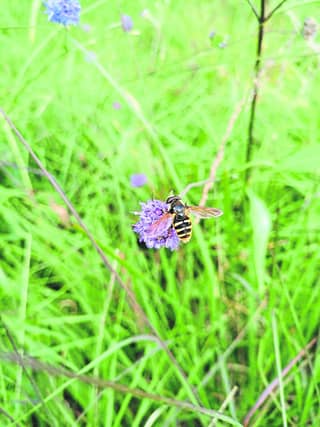

My colleague encountered a hoverfly she was not familiar with on Lullymore West Bog recently.
I recommended if this was to happen you, photograph your wildlife encounter and identify it on your return home, never take wildlife from its natural habitat.
In this case using the photograph taken, on return to the centre and with help from the National Biodiversity Data Centre we identified the unknown hoverfly as Sericomyia silentis. You are probably thinking the name is so unusual, but this is actually the scientific name of this particular hoverfly.
All species have two names, a common name that we use in everyday discussion when talking about biodiversity, and a scientific name.
The scientific name is always in latin or greek and has two parts, a genus and a species. The genus name refers to a particular taxonomix category that is the grouping of species developed on the basis of their fundamental characteristics, similarities and dissimilarities.
The species name simply details the specific species. There are rules when using scientific names, for example the genus, can stand alone and is meaningful to scientists while using the species name alone is meaningless!
You might now be thinking why did I not just write the common name of this hoverfly like I usually do. In Ireland there is no common name reference for this hoverfly on the National Biodiversity Data Centre.
However looking across the Irish Sea it is referred to as the Bog Hoverfly. This hoverfly has reddish legs, and three yellow bands on its abdomen. Like all hoverflies they have one pair of wings on their thorax.
As its common name suggests this is a hoverfly typical of boglands, fens and woodlands clearings. The National Biodiversity Data Centre has 1297 of this hoverfly in Ireland so a relatively common hoverfly to observe. It flies between May and November each year so you only have a few weeks to try and identify this weeks wildlife species in your community before you have a wait until next May.
If you come across a wildlife species that you would like help identifying contact me at [email protected].