
KILDARE WILDLIFE WATCH: Native bluebell is full of fragrance

Nuala Madigan from the Bog of Allen Nature Centre
On the last weekend of April the Irish Peatland Conservation Council hosted a butterfly and bumblebee information stand at Monasterevin Tidy Towns Bluebell Festival in Moore Abbey Wood.
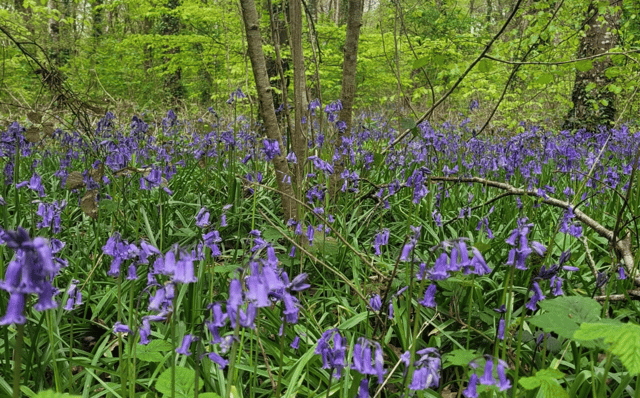
At this time of year a woodland walk is highly recommended because all of the woodland wildflowers are now in bloom.
Woodland wildflowers are always early to bloom as they take advantage of the sunlight seeping through the open tree canopy, growing through photosynthesis, before the tree canopy becomes filled with leaves limiting light reaching the woodland floor.
For this reason, woodland wildflowers are an important source of nectar for early butterflies and bumblebees in our community. You can expect to find lesser celandine, primroses, wild garlic and the most striking of all bluebells (coinnle corra as Gaeilge) now in bloom.
Bluebells are native to Ireland but you should also know that a none native Spanish variety of bluebell has been introduced.
At first glance they look very similar but there are important features to identify between the two varieties.
The native Irish bluebell will always hold its drooping, tubular, purplish-blue flowers on one side of the stem, each of the flowers will also have white anthers (an anther is part of the male reproductive part of the flower located on top of the stamen within the flower).
The Spanish variety will have the flowers on both sides of the stem and will have blue anthers. The leaves are fleshy, longer than wide and come from the root.
The Spanish variety has broader leaves than the Irish native bluebell but this feature may be difficult to use to identify between the two varieties unless you have both growing in the same area, similarly there is a difference in colour between the flowers with the Spanish variety being paler than the Irish native bluebell.
You can also use your sense of smell to identify between these two species, the native bluebell has a strong fragrant smell while the Spanish variety will have no smell.
If you would like help identifying a wildlife observation in your community you can contact me on [email protected].