
Liam Kenny: The day the Minister for Transport was left behind by a new train at Newbridge Train Station
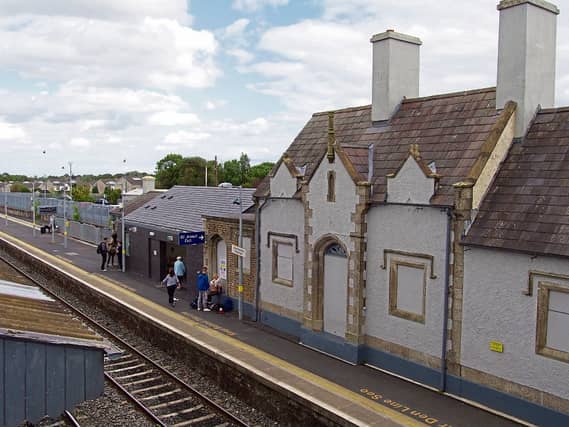

Did you hear the one about the Minister for Transport who was left behind by his own train? Sounds a too-good-to-be-true kind of story? Well, it happened – in Newbridge on 16 May – thirty years ago.
In a “you couldn’t make it up’ moment the hapless Brian Cowen, T.D., Minister for Transport was left stranded when a public relations exercise to launch the new rail commuter service went wrong. Minister Cowen had stepped out of the new train at Newbridge on the morning of the launch where he was to cut a ribbon on the platform in front of top transport officials and local dignitaries.
Moments into the ceremony, there was a sound of sliding doors in the background and the revving of an engine as the train set off east in the direction of Sallins, the driver apparently having got a signal to move onwards even though the Ministerial party was still on the platform.
There was consternation as the Minister’s officials whipped out their new-fangled mobile phones - which in those days were the size of a brick- in an attempt to recall the vanishing train.
Confusion reigned until a local garage owner who had been invited to the Newbridge ceremony offered the Minister a lift in a Nissan Micra and set off in pursuit of the train making for Sallins.
There a marquee had been erected to facilitate a lunch for the guests with local TDs and Senators included in the party.
Fortunately, the Minister arrived before the soup went cold.
Such mortifying mishaps aside, the day in May 1994 marked a transformative chapter in the life of the county with – for the first time – a dedicated commuter service on the Kildare to Dublin Heuston route. As the likes of Newbridge and Naas
grew with suburban-type housing estates traffic on the dual-carriageway had congealed into stop-start queues which tried the patience of both car and of bus passengers. Rail was seen as a way of taking the load off the road links between Kildare and capital.
From 1992 Irish Rail began a programme of upgrading the stations at Kildare and
Newbridge, and even more noticeably, refurbishing and reopening the closed stations at Sallins and Hazelhatch which had not seen timetabled passenger
services since the early 1960s. In parallel, the marketing messages began to flow with the new service branded as “the Arrow” and the name of Naas being added to the official signboards for Sallins, and similarly Celbridge added to Hazelhatch, so as to attract custom from the burgeoning towns not directly served by the railway but near enough to be afforded a viable commuting option.
Plans for the new service also demanded new carriages and Irish Rail went to far off Japan for innovative diesel railcars which – painted in an orange-and-black livery – were marked with the Arrow logo.
The new service proved a hit for commuters with the frequency of trains on the line opening up options for travel from early morning to late evening. In fact, so many began using the service that growing pains appeared.
The access roads to the station at Sallins had been built for 19th century horse drawn carriages and forced drivers into making awkward hairpin turns to get on to the main road.
There were also perennial complaints that passengers from Newbridge had to pay higher ticket prices than those at Sallins because of where the “hop” zone boundaries were drawn – an issue at last being resolved this year.
However, despite such teething problems, the new rail service transformed life for many in mid-Kildare.
For years after the opening of the Arrow service auctioneers’ brochures for new estates in Newbridge, Naas, and Celbridge featured images of the distinctive rail cars and thus communicated to young couples the attractions of living in a county setting while maintaining careers in the metropolis.
Nowhere was this more evident than in Sallins which in the years after the opening of the Arrow service grew from the status of a village to being an urban community with one of the highest proportions of commuting residents to be found anywhere in the country.
The rail service met the demand to the extent that today seventy-two trains stop in the Kildare stations each weekday and as well as conveying commuters directly to the Dublin stations also make it possible, with just one change, to travel to points as
distant as Tralee, Galway and Belfast.
Irish Rail wouls derive satisfaction from its engineering choices with the early Arrow railcars proving to be highl reliable conveyances over the following decades to the extent that, although replaced by more modern kit on the Kildare route, are still going strong on the Cork to Cobh commuter link.
Indeed, the original pair of railcars which served Sallins, Newbridge and Kildare has been repainted as a commemorative gesture in its 1993 colour scheme of orange-and-black and may be spotted passing through its old Kildare haunts on rail enthusiasts’ special runs this month.
And on this occasion, if the Minister of Transport does turn up, he might be best advised to stay put on the train and not risk the embarrassment of his predecessor of thirty years ago.