
Ó Cearúil tops the poll, Hamilton loses Green Party seat in Maynooth

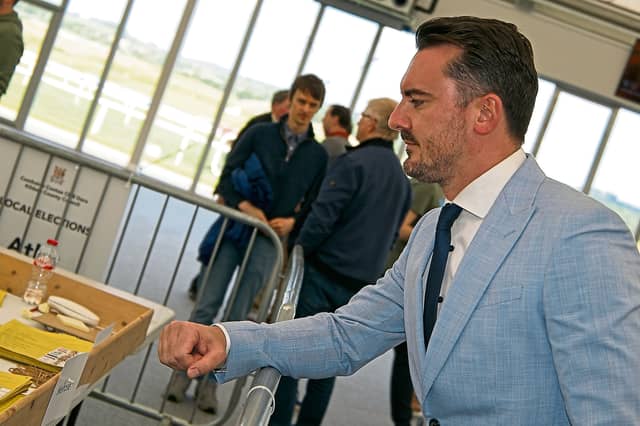

Maynooth LEA threw up a few surprises with GP's Peter Hamilton first out of the race
Fianna Fáil’s Naoise Ó Cearúil topped the poll in Maynooth, exceeding the quota of 1,566.
The former Mayor of Kildare was the only candidate elected on the first count in Maynooth, with a surplus of 314 votes, and was also the first person elected in the Kildare Local Election 2024.
Elected alongside him were Fine Gael’s Tim Durkan, Social Democrats’ Peter Melrose, Labour’s Angela Feeney and Fianna Fáil’s Paul Ward.
No candidate was elected on the second count following the distribution of Naoise Ó Cearúil’s surplus. Labour’s Angela Feeney was the biggest winner of the round receiving 104 votes. However, Fine Gael’s Tim Durkan remained the closest to the quota following the second count with 1,494 votes, just 72 shy of the required mark.
Ahead of the third count, outgoing Green Party councillor Peter Hamilton was eliminated with the lowest number of votes to that point and his 514 votes were distributed next.
The four candidates closest to the quota following the second count were Tim Durkan, Angela Feeney and Social Democrats’ Peter Melrose.
Fine Gael’s Tim Durkan was elected following the third count having received 92 of Peter Hamilton’s re-distributed votes, with Angela Feeney (1,478), Peter Melrose (1,429) and Paul Ward (1,197) all still short of the 1,566 quota.
During his tenure, Cllr Durkan voiced his concerns surrounding issues in Maynooth such as housing, roads, footpaths, public lighting, planning and the completion of unfinished housing estates during his election campaign.
Following the fourth count and the distribution of the 20 surplus votes of Tim Durkan, no candidate was elected.
The fifth count followed the division of the lowest score to that point, which was Independent Ireland’s Liam Meade and his 552 votes. No candidate was elected in the fifth count either, but the distribution put both Labour’s Angela Feeney and Social Democrats’ Peter Melrose very close with 15 and 49 votes to go to meet the quota respectively. Melrose was the biggest winner of the fifth count receiving 84 counts.
The end of the fifth count brought about the end of Sinn Féin’s Evelyn Gaynor's participation, who’s 605 votes were the lowest after that round and were to be distributed ahead of the sixth count.
The sixth and final count saw Melrose (1,771), Feeney (1,678) and Ward elected.
Speaking to the Leinster Leader, Cllr Ó Cearúil said, “It is (a great vote of confidence). It is humbling to get the vote that I did here today to be honest. It is very hard to predict anything in politics. It has been an increase in my vote since 2019 and an increase on that vote in 2014, but the main thing is that people have placed their trust in me once again and it is now incumbent on me to deliver on that trust.”
“I have done a decade now as a county councillor now, starting out at 24 and I am now 35. The important thing is that I focus on what I committed to the people of the area when running for election.
“Naturally the question is potentially running for the Dáil, that is something I am going to have to discuss with my wife and my family first of all and then we need to discuss it with the Fianna Fáil party. It is something that has been coming up in the doors a lot, it is something that I have been asked a lot and something I am going to have to seriously consider.”
Cllr Ó Cearúil concluded by discussing the pressing issues surrounding his local area.
He explained: “The key issues in Maynooth are also across all of North Kildare and Kildare in general. Childcare and school places. This area of North Kildare is one of the fastest growing areas in the entire country and we need to ensure that services keep up with that.
“If we look at healthcare, we need to ensure there are primary healthcare centres. If we look at education, we need to ensure we have adequate schools, primary and secondary. And what is coming up time and time again is childcare, we need to ensure there are proper childcare facilities in place and in all of the towns that every child has a place pre-school and post-school.”