
Kildare sculptor creates intricate pieces from bog oak
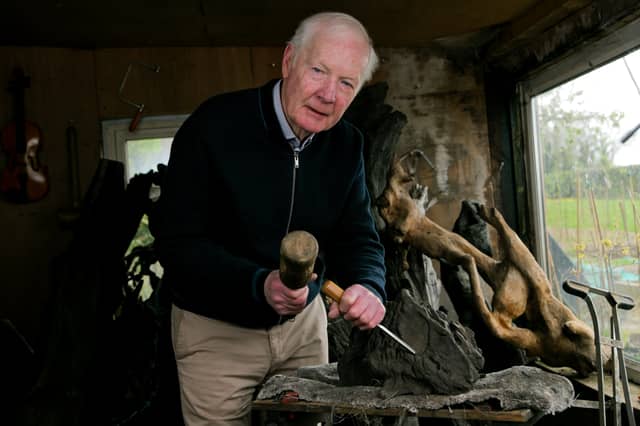

In a quiet corner of County Kildare, inside a studio in Clane run by father and son Larry and Lorcan Harney, ancient history is carefully brought back to life.
The Bog Oak Sculptures business is rooted in a shared passion for a material older than the pyramids – dark, dense bog oak, preserved beneath Irish soil for thousands of years.
A retired public servant originally from Wexford, Larry has spent more than three decades working with this remarkable wood. He settled in Kildare over 35 years ago, bringing with him a strong love of hurling – a passion he still holds, along with a hope for success in his adopted county. His son Lorcan has inherited both his appreciation for bog oak and his belief that hurling itself is a kind of art form, shaped by skill, rhythm and instinct.
READ THE LATEST KILDARE NEWS HERE.
Larry’s connection to nature began in childhood. “I can remember collecting cows for my father and being fascinated by what I saw on the hedgerows and ditches,” he says. “The way ivy twisted and hugged the trees – it stayed with me.” That early wonder deepened during his school years in the 1960s, where encouragement from art teacher Paul Funge inspired him to pursue creativity, even at a time when such interests were not always encouraged.
His journey with bog oak began unexpectedly in Co. Galway, when land was being reclaimed and ancient timber surfaced from the earth. “When I realised it had been hidden and preserved for thousands of years, I was immediately hooked,” he recalls. From that moment, he immersed himself in understanding the material – how it formed, how it endured – and how he might work with it.
Bog oak originates from forests that fell thousands of years ago and became buried beneath peat. Over time, the unique acidic conditions of the bog preserved the wood, turning it almost black and incredibly dense. For Larry, each piece carries a story, shaped by time, landscape and chance.
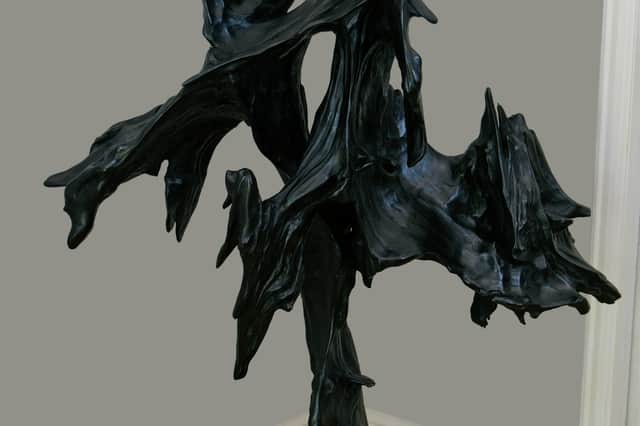
Working with it is a slow and demanding process. The timber must dry for years before it can be shaped. Even then, it resists easy handling, requiring patience, experimentation and specialised tools. “It’s about being led by the wood,” he explains. “You reveal what’s hidden, and the form begins to emerge.”
Each sculpture is painstakingly refined by hand, sanded to a smooth finish that invites touch. Larry’s approach is deliberately restrained. “I try to intrude as little as possible,” he says. “I respect the integrity of the wood. It still holds the essence of a living tree.”
His work often draws on Irish mythology, landscape and memory, blending natural forms with deeper cultural meaning. In one recent commission, inspired by a family tragedy from 1937, he created a piece titled Deora – the Irish word for tears – linking personal history with a wider sense of heritage.
“This wood speaks to me,” he says. “I can feel its presence, its spirit. I’m just helping it tell its story.”
In a fast-moving world, their work offers something enduring – a quiet, tactile connection to Ireland’s deep past, shaped with care in the present and preserved for the future.