
KILDARE TV COLUMN: She-Hulk aims to highlight post MeToo society

Kevin Dowling
As the days get shorter and our famous Irish weather returns to something like its normal self, you might find yourself looking for some ‘filler’ to see you through the gloomy days ahead.
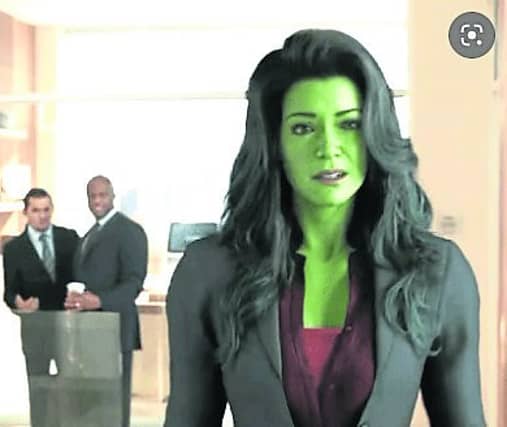
She-Hulk: Attorney at Law, just released on Disney+, is a series that will more than likely find its way onto your watchlist.
Starring Tatiana Maslany as the eponymous hero, and with cameo appearances from Mark Ruffalo, Megan Thee Stallion and Tim Roth, amongst others, this is a mostly light hearted Marvel mash-up that rarely strays from the confines of its family friendly12+ rating.
The action revolves around Maslany’s character Jennifer Walters who, as the show starts out, is an ambitious but slightly diminutive lawyer.
Her cousin just happens to be Bruce Banner (The Hulk). In episode 1, the two go on a road trip and, after a very Marvel-esque run in with a space ship, they have a huge road accident. The fallout from this is that Walters comes into contact with Banner’s blood and, as tends to happen in all things Marvel, she becomes a member of the Hulk race herself.
From then on, the crux of the plot rests on Walters’ dilemma. Refusing to rest on her green hued laurels, she insists on pursuing her career as an attorney. And just like that, deus ex machina, with her creation story out of the way, the show’s creators really begin to set out their stall.
From the outset, it’s made quite obvious that the world that She-Hulk inhabits is peopled with toxic masculinity and social media age misogyny. The foil to her newfound superpowers isn’t Kriptonite.
The creators of this show have found an alternative, it’s the Toxic White Male.
For the show’s heroine to navigate her way through life as her ‘human’ self, she unfortunately has to co-exist with people like her slimy workmate Dennis Bukowski, the very caricature of toxicity. He’d much rather rate his female colleagues by their looks than their professional abilities.
And, contrary to what you might expect, when Walters morphs into her Hulk alter-ego, things do not get any easier. Both online and in real life, her credentials are constantly called into question. A zoomed-in social media screen grab has one of her detractors complaining: ‘So we have a MeToo movement, and now all the male heroes are gone?’
The fact that MeToo is obliquely mentioned is a nod to what creator Jessica Gao is trying to say. It’s obvious that this series aspires to carry a punch, but blink and you’ll miss it.
This is a cosmetic attempt by those at Marvel HQ to reckon with where we are as a society post MeToo.
If the daily travails that Walters experiences are anything to go by, then the answer must be — ‘not in a very good place’.
For anyone in denial about the cultural and economic impact of the Marvel juggernaut, I highly recommend having a look at the closing credits at the end of any episode of She-Hulk.
The sheer amount of artistic, financial and legal talent that must go into producing a series like this is a testament to the impact Marvel has had on the film industry. It also shows the financial clout that it wields.
Whether you think this is a good thing or not is another question. In another era, film legend Michael Caine was posed with such a question.
After starring in Jaws 4, he was asked about the merits of the film. He hadn’t seen it. But he did helpfully add: ‘I’ve seen the house it bought my mum. It’s fantastic.’