
The 12 new rules to know before the Kildare ladies' league campaign starts this weekend

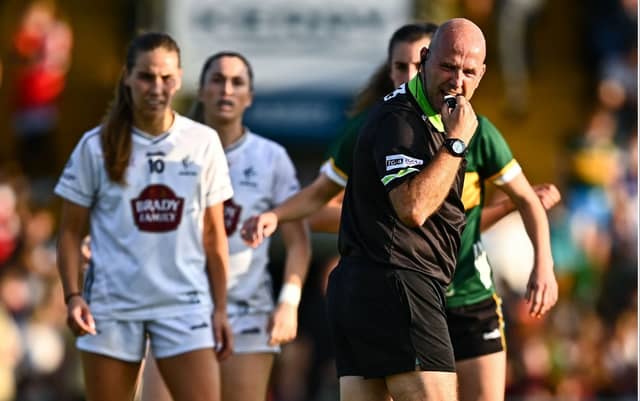

The Ladies Gaelic Football Association will trial 12 new playing rules this year’s National League and Higher Education colleges competitions before a review after Round 3
The Kildare ladies get their Lidl National Football League Division 1 campaign under way this weekend when they travel to the Munster Technological University Arena in Cork to take on the home side, a game that throws-in at 2pm.
Ahead of that clash, Lilies fans will need to keep an eye on 12 new playing rules that are being trialled in the first three rounds of the league. A review after Round 3 of the National League will inform decisions for a Special Congress, where permanent adoption will be voted on.
Half of the 12 new rules proposed by the Playing Rules Review Workgroup (PRRW), headed by former LGFA President Mícheál Naughton, will mirror the 'rule enhancements' introduced to the men’s game by the GAA’s Football Review Committee last year. The PRRW to their credit have listened to calls for increased physicality and tackling in the ladies game, which is reflected in their ladies football specific rules that are outlined below.
The 12 rules to be trialled:
THE TACKLE
A player can tackle the ball even if it is in the body but they still must use an open hand and the initial contact must be with the ball. The tackling player may make incidental contact with their opponent at the same time once the initial contact is with the ball and they cannot leave their hand in on the ball. Previously, a player could only tackle when the ball was out from the body.
PREVENTING A COLLISION
A player may now use one or both hands to legally delay an opponent’s forward movement provided the opponent is in possession of the ball and that the contact is made below shoulder height and is not a push backwards.
PERSISTENT FOULING
Three non-technical fouls by a player will result in a yellow card for persistent fouling.
CONTROLLED CONTACT
Previously there was a rule stating no deliberate body contact was permitted. This trial rule will allow a player to use their body to fairly contest for possession of the ball provided the challenge does not involve excessive force. A shoulder charge is still not permitted, though.
45m KICK MUST GO FORWARD
Rules around the 45m kick remain the same except the ball cannot be played backwards or a throw-in will be awarded.
SQUARE BALL FROM PLAY
Rules around the square ball from a set play remain the same in that a player cannot enter the small rectangle before the ball. However, during play an attacking player can now legally enter the small rectangle after the final play of the ball – kick or handpass into the small rectangle.
KICKOUT MARK
Awarded to a player, from either team, who catches the ball cleanly from a kickout on or past the 40m arc. Player may alternatively play on immediately and cannot be tackled for 4m.
3v3 STRUCTURE
During play a team must have at least four players (which may include the goalkeeper) in their half of the pitch and at least three outfield players in the opposition half.
40m ARC
Two points are awarded when the ball is played over the crossbar and between the posts having been kicked by a player who has at least one foot on or outside the 40m arc.
SOLO AND GO
A player who is fouled can toe-tap immediately within 4m of where the foul occurred and play on. The player cannot be challenged for 4m and any player from that team can solo and go, it is not confined to the fouled player.
DELAYING PLAY
Where a foul is committed for the purpose of delaying play, the offending player will be noted or carded where appropriate, and a free awarded to the opposing team 50m more advantageous.
DISSENT BY A TEAM OFFICIAL
Misconduct by a team official(s) that warrants a yellow or red card will also result in a free on the offending team’s 13m line.