
Concrete shed demolition scrapped for historic Portlaoise fort

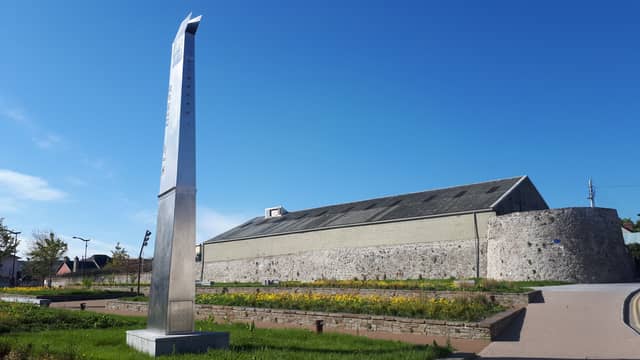

An eyesore granary shed built on the historically important Portlaoise fort is no longer up for demolition.
The huge shed that was built by Odlums in the 1940s cannot be removed, experts have advised, because that could damage the fort.
Conservation Architect Richard McLaughlin from Ballybrittas has led the conservation plan for the Fort Protector in Portlaoise, in association with archaeologist Eoin Sullivan and Historian Diarmuid Wheeler.
"The unfortunate thing is that the granary was so robustly built, to demolish it would nearly demolish the wall. So now it is nearly part of it. It was made of solid mass concrete on top of the wall. It's now part of the history of the town. It's a matter of finding a way forward for it," he said.
He recommends instead repurposing the concrete building for amenity, cultural or commercial use, and opening access to it from inside the fort.
However the reconstruction of a Tudor 'king's house' has been suggested, along with excavations in businesses along the Main Street, where a huge castle once stood on the corner of the fort.
The experts also believe it is "only a matter of time" before they find a tunnel from the fort to the convent, built so the British settlers could flee into the fort when the Irish attacked.
The round bastion tower is recommended to get a viewing stand inside for visitors, while they suggest the courthouse as a county museum.
The conservation plan for the Fort Protector was launched last Thursday night, June 23 in the Midlands Park Hotel, just as the festival based on it kicked off in the town.
Prepared for Laois Heritage Society and full of ancient maps of the town and new photographs of the fort, the book will guide future development of the fort to enhance Portlaoise, while protecting the archeologically significant listed building.
The report is the culmination of eight years of painstaking research which found that the huge military fort, the first of its kind to be built in Ireland by invading English forces in the 1540s, was "hidden in plain view" and is astonishingly well preserved.
"It is never going to be the Rock of Cashel, but the way it lives with the town is its strong point," Mr McLaughlin said.
He said that finding the tunnel was likely.
"We are keep our eyes open. People are fascinated and want to know. There probably is one. It is a matter of time before it is uncovered," he said.
The plan was launched by Laois County Council Cathaoirleach Cllr Conor Bergin who said that the council was delighted to source funding and offer expertise for both the conservation plan, and other works underway around the fort to make old Portlaoise town centre a hub for heritage and arts. Those works include Fitzmaurice Place garden, Old St Peter's Graveyard, a new county library and new paths and lighting.
CEO John Mulholland has his eye on the future for the fort and Portlaoise.
"The history we have is there for future generations as well as the past. It is not about fossilising things, but to use it for the benefit of society. We are lucky that most of it is intact and if not, we now have a plan to deal with that. The grainstore was what was demanded in the new Ireland of the 1930s. We are at the beginning of a new phase now. There is a huge amount to do yet but a pleasant journey lies ahead," he said.
Information on projects undertaken to date is available at https://laois.ie/departments/ heritage/archaeology/fort- protector/.
The Fort Protector Conservation Plan can be downloaded at the link above, and hard copies are available for purchase from Laois Heritage Society and to view in the Portlaoise Library.
The Fort Protector Conservation Plan is a Partnership Project of Laois Heritage Society and Laois County Council, supported by the Heritage Council.