
Laois representatives seek action over planned ‘savage’ school bus fee hikes

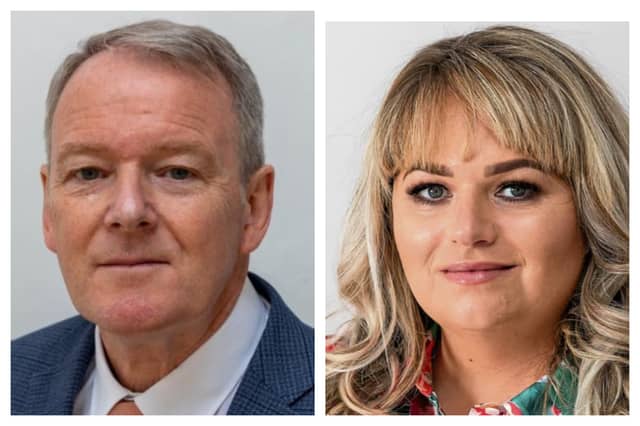

Laois TD Brian Stanley and Senator Maria McCormack are both objecting to the planned 250% school bus fare increase
Increasing school bus fares from €100 per year to €350 has been branded as ‘shameful’ by a Laois Senator while a Laois TD called on the Taoiseach to review the ‘savage’ price hike in the Dáil.
Senator Maria McCormack has urged local TDs to support a Sinn Féin’s Dáil motion to reverse the Government’s planned school transport fare hikes.
She described the government’s decision to increase school transport fees from €100 to €350, with the family cap rising to €650 from September 2027, as “shameful”. She warned that these fare hikes will place an unbearable financial burden on families already struggling in the midst of a cost-of-living crisis.
The Sinn Féin motion aimed at reversing the fee hikes will be debated in the Dáil next Tuesday, December 1.
“Every child has a right to access education, regardless of their family’s income or where they live. The cost of travelling to school should never become a barrier to education.
“The School Transport Scheme is a vital public service for families across Laois, particularly in rural communities where there are few or no public transport alternatives. Instead of strengthening that service, the Government is forcing parents to pay more for less,” said Sen McCormack.
“Families are already under enormous financial pressure. Recent surveys show many parents are worried about meeting back-to-school costs, while more than one in four are taking on debt simply to cover essential school expenses,” she said.
“Against that backdrop, Fianna Fáil, Fine Gael and the Regional Independent’s decision in Budget 2027 to increase post-primary school transport fares from €100 to €350 per child for the 2027/28 school year, while the maximum family contribution will rise from €220 to €650, is scandalous. These are staggering increases that many families simply cannot absorb.”
She said parents were being asked to pay substantially more for a scheme that continues to suffer from capacity shortages, restrictive eligibility rules and uncertainty around concessionary places. She said the Government’s failure to adequately plan and expand the scheme was evidence. She said far too many children are still unable to secure a seat on a school bus.
“The School Transport 2030 Review identified the potential to accommodate an additional 100,000 pupils by 2030. That ambition can only be achieved through proper investment and planning, not by increasing fares and pricing families out of the service.
“In our motion, to be debated in the Dáil next Tuesday, Sinn Féin is calling on the Government to reverse these increases, fully implement the recommendations of the School Transport 2030 Review, and ensure that school transport remains accessible, reliable and affordable for every child who needs it.
“School transport is not a luxury. It is an essential service that supports educational access, rural communities, social inclusion and climate objectives,” said Sen McCormack.
“Parents deserve a school transport system that works. Children deserve a reliable way to get to school. The Government must stop penalising families and instead invest in delivering the school transport service that communities in Laois and across the State need,” said Sen McCormack.
Meanwhile, Independent TD Brian Stanley asked Taoiseach Micheál Martin to review the 250% hike in School bus fares during leader’s questions in the Dáil.
He said “it will put another huge burden on parents and households in rural areas and working families, who will be hit again. Middle and low-income workers are hit again.”
“I am thinking of rural areas in County Laois where people depend on the school bus service. The local Society of St. Vincent de Paul, talking about the general situation for families this week in Laois, said that it is worse this year than ever and everyday people are being hit.”
He noted the move came ‘hot on the heels’ of a 15 % hike in public transport fares.
“The people most affected by this hike are those who commute by train to work from stations such as Ballybrophy, Portlaoise and Portarlington. The majority of these are middle and low-income workers. They already pay €81.50 per week for a weekly ticket. If they do it monthly, it is €290 per month, and an annual one is €2,900. The increase will mean an extra cost of €435 annually on their ticket. Surely the Taoiseach must see that there is something wrong with this,” he said.
Dep Stanley asked: “Will the Taoiseach order a review of the savage increase that is being proposed on school bus fares for next September? Will he also put a halt to the double-digit hikes planned for January of 15% in train and bus fares and not heap more pain and hardship on commuters and working families?”
Following questions raised by Dep Stanley, the Taoiseach acknowledged the critical role of school transport and stated that: “The investment in school transport has grown exponentially, with very significant increases in the level of State support for school transport. I think 92% of the costs are borne by the State.”
He said the fees were reduced substantially during the Covid and “cost-of-living period” and there was a balance between services, fares and cost across the general transport fare increases.
“The Deputy referenced the general bus fare increases, etc., earlier. On the other hand, because of resources that will be released, the Minister will be in a position to announce very significant new routes - for example, for both buses and other forms of public transport which many people in the House were calling for all last year,” said Mr Martin.
“The school transport scheme supports approximately 181,000 children. It costs €3 million every day. It is not an insignificant allocation. The funding, as I said, has gone up from €219 million in 2019 to €687 million for 2027. That is massive,” the Taoisach said.
He said there were approximately 51,000 mainstream and over 6,400 special needs applications processed by the end of September alone. Approximately 25,000 children with special education needs are accommodated each day.
“While this cohort represents 13% of passengers, specialised transport accounts for almost 60% of the scheme's total costs. The State, as I said, bears the overwhelming majority of the cost,” the Taoiseach said.
Mr Martin said the decision to reinstate the school fares followed a review of the scheme in 2024 which found that a family contribution would reduce the number of unused seats and ensure resources are used efficiently.
Dep Stanley reiterated his concerns regarding the planned increases and indicated that he was not satisfied that the response adequately addressed the concerns he had raised.
“The Taoiseach sidestepped what I was asking him. This is a 250% increase in one go for school transport, no matter what way the Taoiseach dresses this up. there was a lot of talk here coming up to the budget about those who get up early in the morning. I meet people who are up at 5 am catching trains from some of those stations in County Laois. Those people feel really aggrieved by what is happening. I told the Taoiseach what the local Society of St. Vincent de Paul said. It is not talking about people who are unemployed. It is talking about people who we think are doing okay. They are struggling,” he concluded.