
‘Didn’t get a fair shot at life’: Galway man calls for mental health ED’s after brother’s suicide
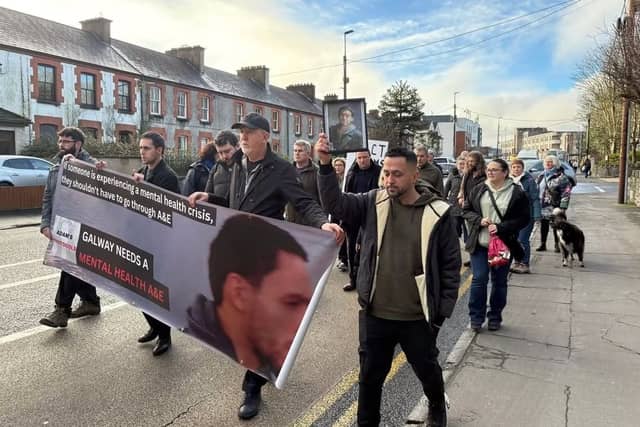

The family of a Galway man, Adam Loughnane, are fighting for better mental health care after he died by suicide just 30 minutes after presenting at Galway University Hospital’s emergency department
The brother of a Galway man who died by suicide after not receiving adequate help in the emergency department of Galway University Hospital is calling for better protocols to be put in place.
Adam Loughnane, who was 34 years old when he took his life, presented to the Emergency Department in February of last year.
He had been struggling with his mental health and told the triage nurse he had a suicide plan, which involved him ending his life in the River Corrib.
After being triaged, Adam was deemed a patient requiring “urgent attention,” but was sent back to the waiting room of the ED.
Two hours passed without him being seen or helped, and Adam carried out the plan he had told the nurse.
Now, almost two years on, his brother Joe is fighting for better care for people suffering with their mental health.
“One of the biggest reasons why Adam was failed was that he was sent to the emergency department. The more we investigated, we realised there isn't any other venue to go to for somebody who's looking for emergency care when they're in suicidal distress or experiencing a mental health crisis. There is only the emergency department,” he said.
Joe is the Chairperson of the Adam’s Protocol petition, which was set up shortly after Adam passed away.
The group is demanding that there is a separate, dedicated space for people who present to hospitals in a mental health crisis.
The petition has almost 30,000 signatures so far, and Joe has presented to the Oireachtas Committee on Public Petitions.
He received “widespread support,” including from TD’s and Senators, who have not shot the idea of a mental health emergency department down.
Joe says the idea hasn’t been “pulled from thin air,” as over the past year, the UK has been working to roll out departments of this kind.
In America, they have EmPATH or Emergency Psychiatry Assessment, Treatment, and Healing units, which are specialised mental health crisis stabilisation units that are typically located within a hospital emergency department.
“I just kind of felt that there was a need for that here in Ireland, and there has been support. The problem with a lot of these things is that they will tell you that they support it, but that they won't put the money where their mouth is and allocate funding for it in a budget or vote for it to be legislated,” Joe explained.
“That's almost a second battle,” he continued.
The day before speaking with Joe, the Coroner’s Inquest into Adam’s death had been released.
The coroner said Galway University Hospital needed to do more for mental health patients when they present.
It was advised that they fill the roles they said they’d fill and put proper protocols in place to deal with people who are sitting in the emergency department and waiting ot be referred to a psychiatrist.
“He said that this kind of understaffing and underfunding is costing lives, and he apologised in theory to us and the hospital apologised as well,” Joe said.
Galway University Hospital is one of many overcrowded hospitals across the country, with a waiting room filled with bright lights, loud noises, and too many people; all of which will “aggravate” the conditions of someone in a mental crisis.
The inquest also discovered that on the day Adam presented, the hospital had issued press releases saying their emergency department was overcrowded and that there was a norovirus outbreak.
Various news sites covered the story, but the hospital still advised people to present themselves to the emergency department should they need to.
“For us, there wasn't really any closure there. It was more just understanding the care that Adam received and didn't receive on the day he died,” Joe said.
“He was triaged. He told the triage nurse that he was suicidal. He told them he had a plan. He explicitly stated that he wanted to jump into the River Corrib. They categorised him as requiring urgent attention, but unfortunately, he was just led back to the waiting room, where he sat for about two hours until eventually he got up and walked out… He wasn't seen, and he walked out, and he died by suicide,” Joe continued.
The day Adam died wasn’t the first time he had gone to Galway University Hospital for help with his mental health.
Joe and his family analysed Adam’s medical records and found that he had been struggling with his mental health over 10 years.
“It's just a copy of a young man presenting to an emergency department over and over again. He's being passed on to the community mental health system, and then after a while, they think he's OK; they let him go again. Then after a few months or a year, he's back presenting with suicidal ideation to the emergency department. It's just this kind of never-ending cycle where the person ultimately isn't really getting any help at all,” Joe explained.
One of the main issues Joe and his family have discovered is that these mental health services are only available from nine to five.
For those who present to the hospital in the evening, there is likely just one liaison psychiatrist working across the whole hospital.
Another issue they found is “deliberate” underfunding.
“When you look at our budget, I think we spend less than five or six per cent of our overall health budget on mental health, while the EU and the WHO and various other organisations recommend countries to be spending a minimum of 10, 12, 15 per cent,” Joe shared.
“There isn't any actual thought put into the journeys that people in the mental health crisis have to go through and the various systems they have to navigate. It's complex. It's all over the place. That's where we came to our conclusion that people in that position need their own front door for emergency care. They need some space in the hospital that isn't the emergency department, but that is a clinical setting where they can get access to psychologists, psychiatrists, social workers or whatever else is necessary in that moment of suicidal distress,” he added.
Adam’s birthday is coming up in a couple of weeks, allowing time for his family to look back on the life he lived.
According to his brother, he “didn’t really get a fair shot at life.”
It’s hoped that through the Adam’s Protocols petition, others in a similar boat to him will.
If you would like to find out more or support the petition, you can do so here.