
Movie magic relived at Laois talk on Portlaoise Electric Cinema

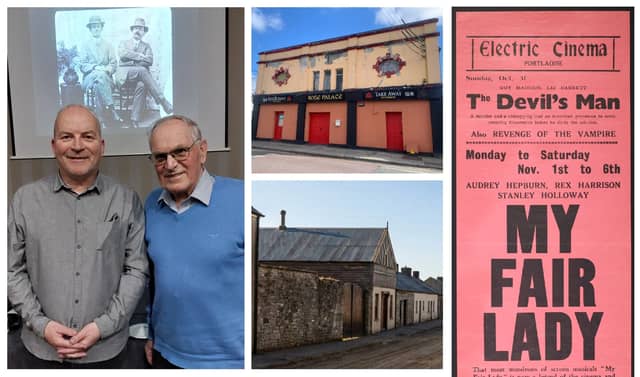

Heritage Society member shares incredible cinematic family story
The former Electric Cinema in Laois briefly flickered back to life this week, thanks to a fascinating talk by the grandson of its co-founder, Paul Delany.
The Portlaoise building now in need of a lick of paint, and home to a Chinese restaurant business, was once the epicentre of social life, with queues down the street of people eager to go to “the pictures”.
Last Thursday, April 16 that history was brought alive by the grandson of the man who co-founded the Electric Cinema in 1914 on Well Road.
Portlaoise man and society member Paul Delany gave an engaging Laois Heritage Society talk to a full room in the Midlands Park Hotel.
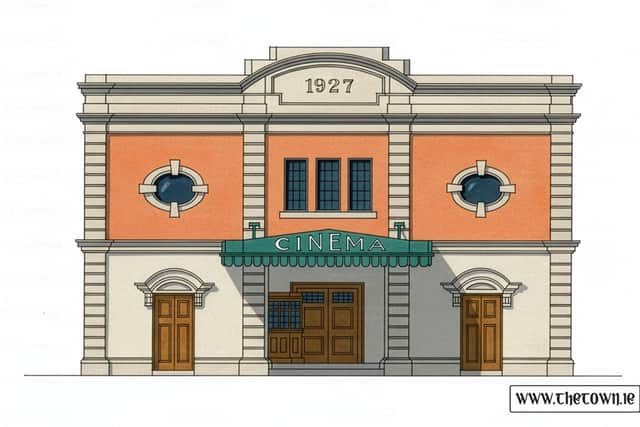
Architectural drawing of the Electric Cinema in Portlaoise.
Paul explained that his grandad was a Portlaoise tailor also called Paul Delany who grew up in what is now Square coffee shop.
He co-founded Maryborough Electric Cinema with his relative Patrick J Delany also from Portlaoise. Local builder William Carroll built it on the site of a former coach builder’s yard, on Well Road.
It opened in 1914, described in newspapers as “well ventilated and heated, seating arrangements quite up to date, being equal in every respect to metropolitan picture houses”.

The first facade of the Electric Cinema in the 1900s, next to what is now the Leinster Express office carpark. Photo: Portlaoise Pictures.
They rented reels that were sent by train and then horse and cart from Dublin.
The first film was Joan of Arc, shown in 1914 along with three short comedies.
"The place was jammed. It must have been unbelieveable for a small community, most of whom would never have even left the parish,” Paul said.
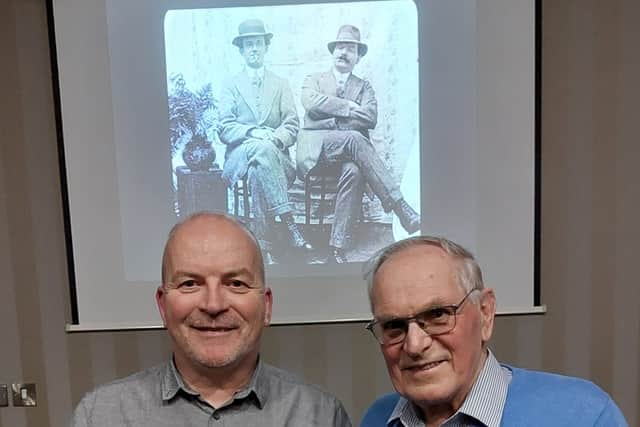
Paul Delany with Teddy Fennelly at the Spring talk by Laois Heritage Society in the Midlands Park Hotel. Behind them is an image of the two founders of the Portlaoise Electric Cinema, Paul's grandfather Paul Delany and his relative Patrick Delany. Photo: Lynda Kiernan
His grandfather married London pianist Mary Webb and reared five children in Kellyville Park. Patrick married and opened a furniture and hardware shop on 78 Main Street.
In 1927 they redesigned it with architect Thomas McNamara in line with fire regulations to the facade still largely in place today.
In 1931 the “talkies” arrived, starting with All Quiet on the Western Front.
Paul noted the strong grip of the Catholic church with only Sunday openings during lent, and the screening of the 31st International Eucharistic Congress. Films like Charlie Chaplin’s satirical The Great Dictator and Casablanca were banned because they did not align with Ireland’s neutral status.

A poster for the cinema, now in the national archives.
His son took over but by the late 60s with the arrival of television and dance halls, numbers were declining. It was sold in 1968 to a group of local men, and again in 1973 to the Irish Theatre Company Limited who also owned the Coliseum in Portlaoise.
Paul said that their plan was to turn it into a luxury boutique cinema ‘The Oscar’ but six months on it was back on the market. It was bought by local printer Pat Doorley and became International Screen Print.

Full house for Paul Delany's talk on the Portlaoise Electric Cinema for Laois Heritage Society. Photo: Lynda Kiernan
The building is on Laois County Council’s Record of Protected Structures.
"I’d love to see it restored to its former glory. It would be great to use it for the town,” Paul Delany said.
Teddy Fennelly, chair of Laois Heritage Society thanked him for his talk, describing the cinema as “part of my growing up, and such an important part of the town for over 50 years”.
The society welcomes new members, see laoisheritagesociety.ie