
'The cost of disability comes to work too': Longford activist challenges exclusion from disability payment

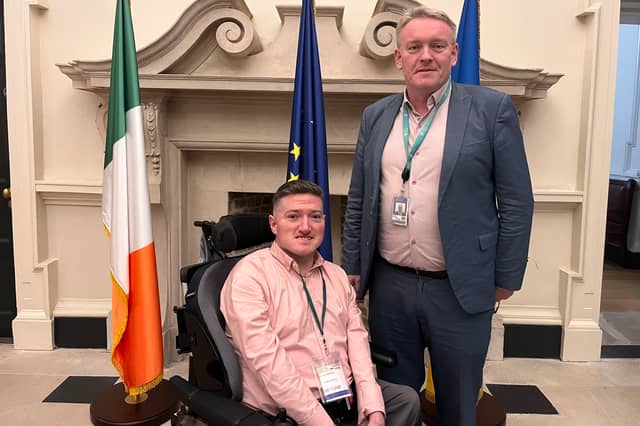

It was agreed that the National Collective would be included in the co-design of the Cost of Disability and other related policy issues
The National Collective of Working Disabled People representatives including Longford activist James Cawley challenged the exclusion of working Disabled People from the €500 Cost of Disability payment at a meeting with Ministers Dara Calleary, Jack Chambers and Seán Canney.
Ann Marie Flanagan, James Cawley and Brian Dalton presented the case for a refundable €500 tax credit for 2027 on Wednesday, a standalone Cost of Disability entitlement and meaningful participation in the co-design of future policy.
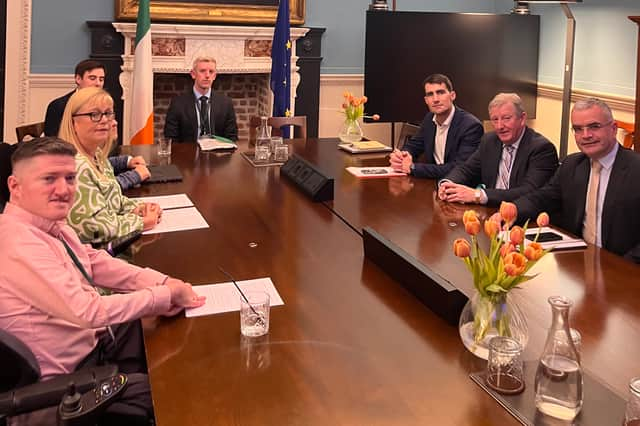
The meeting opened by remembering Avril Greham, a member of the National Collective and a constituent of Minister Calleary, following her sad passing. The representatives acknowledged her commitment to equality and the deep loss felt by those who knew and worked alongside her.
The representatives welcomed the introduction of the payment as a starting point but expressed disappointment that working Disabled People had been excluded. They stressed that the Cost of Disability continues regardless of employment, income or a partner’s circumstances.
James Cawley commented:
“The Cost of Disability comes to work too. We explained that earning a salary does not remove the Cost of Disability, including expenditure on assistive technology, accessible transport, additional heating and assistance needed to participate equally. We put forward a refundable €500 tax credit for 2027 as a fair way to include working Disabled People, ensuring that those on low incomes would also receive the full amount.”
The representatives highlighted how fear of losing secondary benefits, including a medical card and travel pass, leads some Disabled People to remain on partial Disability Allowance rather than increase their earnings.
Brian Dalton added:
“Some Disabled People who could work full-time are choosing to remain on partial Disability Allowance because they fear losing essential secondary benefits. Attaching the Cost of Disability payment to disability payments reinforces that pressure and keeps Disabled People poor. This is not good government policy. The Cost of Disability needs to be recognised separately from social welfare entitlement.”
The representatives challenged the framing of Disabled People primarily through disability services and social welfare expenditure. They asked Ministers to recognise Disabled People as citizens with full lives, including their roles as parents, workers, taxpayers and community volunteers.
The representatives also highlighted the injustice of working Disabled People having to use a disproportionate share of their income to meet the Cost of Disability. This leaves less money available for their children, family needs and everyday life.
Ann Marie Flanagan said:
“We reminded Ministers that we are citizens, parents, workers, taxpayers and community volunteers. It is deeply unfair that a disproportionate amount of our income goes towards meeting the exorbitant Cost of Disability. We asked Government to give us back a small amount of our own money by allowing us to pay a little less tax.
“Ministers need assistance, advisers and other supports to do their jobs effectively. We need support to be equally effective in our working lives. Why are we expected to go without, or our children and families to lose out, because we must redirect family income towards meeting the Cost of Disability? We asked for that injustice to be recognised and addressed.”
Ministers described the €500 payment as an initial step towards a more comprehensive approach. Minister Calleary referred to the commitment made by Tánaiste and Minister for Finance Simon Harris in his Budget 2027 speech.
In that speech, the Tánaiste committed to work across Government over the following year to “examine what further measures we can take to recognise the contribution of those who are already working.”
It was agreed that the National Collective would be included in the co-design of the Cost of Disability and other related policy issues. Department officials will liaise with them arrangements for its participation in co-design and a meeting with the Department of Finance to present its request to be included in the cost of disability payment via a tax credit directly.
The representatives welcomed these next steps. However, were disappointed with the indication of no immediate inclusion in the €500 payment in 2027.
All three representatives agreed that sitting down directly with Ministers who hold decision-making power enabled a deeper understanding of the true impact of the Cost of Disability on working Disabled People and their families.