
Two Longford men have a hundred years of counting between them

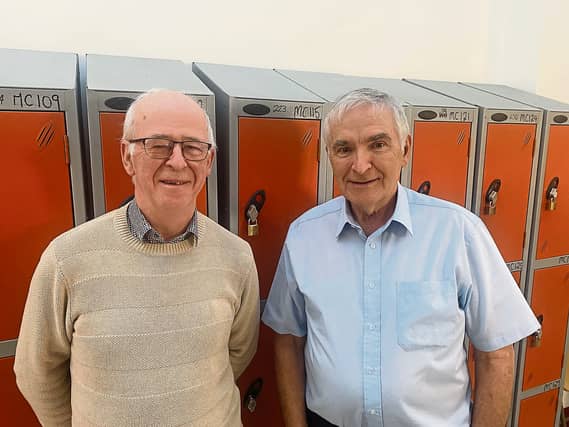

Colm and Tom have been part of the democratic process for over five decades each
Counting votes in the Longford Westmeath constituency to elect the TDs to be sent forward for the 34th Dáil concluded in the early hours of Monday morning.
A dedicated team of counters sorted, counted, redistributed and weighed the ballot papers from 9am on Saturday to just after 4am on Monday.
It's an arduous task presided over by returning officer Bridin Concannon, with attention to detail the byword for the staff who sifted through the papers over the two long shifts.
Among Ms Concannon's team were two Longford men, Colm Harte and Tom Farrell, who between them have over a century of experience of the democratic process.
Colm and Tom were first drafted into the vote counting process back in the 1970s. Fresh faced youths at the time, they have participated in a process that, though augmented by technology, is essentially the same since the foundation of the State.
The Irish system, Proportional Representation with a single transferable vote, ensures that public representation reflects the complexities of the Irish political palate.
Traditionally the count has been a hive of activity. A throng of political enthusiasts eager to be part of the action, eager to be ringside of a somewhat satanised blood sport.
The gathering in the John Count McCormack Centre in TUS Athlone for counting of votes for Longford Westmeath was not the frenetic bustle of previous years. On Saturday morning there were a good number of tallymen, but once the initial figures were gauged the spectators in the hall dwindled to the hardcore.
As the counting approached an end in the wee hours of Monday morning the hall started to fill up. Count 15 saw the completion of the election process, and count staff were free to return to normal life.
For Colm Harte the last five decades have seen significant changes in the counts: “The big change I have seen over that time is the amount of people that are around, particularly on polling day, vis-a-vis now, because I work as presiding officer as well as on the count.
“There has been a big change in that regard. Nowadays, it's much quieter. In the earlier times, there were a lot of people around polling stations and indeed around count centres, although there's still the buzz in the count centre, it's not to the same extent as it used to be.”
This observation is backed up by Tom Farrell. “I agree with Colm. The big change for me is the level of interest seems to have dropped. Because years ago, people just couldn't get a pass to get into the centre.
“People would be outside the count begging you to loan them your pass to get in for a few minutes, but that's all seems to be gone. There's still a tremendous interest in the count itself. I suppose social media means they don't have to be there. They're well informed. They can be informed at home without coming in.”
Tom says in his 50 years of counting there have been mammoth counts. “The biggest one was a very recent one, in Kenagh (2016 Siege of Kenagh). We were literally the whole week, we ended up going home at seven o'clock in the morning. Staggered home, I suppose. That was probably the longest count I was ever on.”
The counting of votes requires a tremendous amount of concentration. The workers shift from periods of inactivity to intense busyness, and at all times have to be conscious of the importance of the task: “There is a huge amount of attention to detail,” Colm tells, “there's massive transparency in all that. Our system is a marvellous system.
“When you see what goes on in other countries it makes you really appreciate the transparency of this and the fairness of it. With proportional representation, everybody's vote counts. We're going down through the elimination process at the moment and you'll have people's voice being heard down to maybe the ninth, tenth, eleventh, twelfth count, where the voice is being heard.
“With the first past the post system, which you have in other jurisdictions, it's done and dusted in a very quick time, but it's not reflective of the people to the same extent as it is here.”
The complexity of the transfers is about making sure every vote counts. Tom says the nuances are not that difficult to follow: “The distribution of excluded candidates' votes is not a problem. The only complicated bit is where there's a surplus. That takes a little bit longer and it has to be done very carefully.
“If you have somebody who reaches the quota on the first count, we have to go through all those papers again, because that's the last parcel. That delays the thing quite considerably. It's a very fair system and I agree with what Colm said, it's a great system, it's really representative.”
Spectators in the Count John McCormack Centre in Athlone will have seen the count staff putting bundles on scales to ensure accuracy.
Colm has 54 years experience, primarly as presiding officer in polling stations in Longford.
He has also participted in numerous counts: “A recent addition is the weighing of the ballot papers, it makes sure it is fair in every respect” he explains, “The total weight has to match the weight of the total valid poll. All votes are calculated and we have to go through the system of count after count.
“That's all tabulated vis-à-vis the weight of the original to make sure that everything is absolutely accurate.”
Tom harks back to his initial involvement. “I just wanted to name one person who started me off on all this thing 50 years ago, the late Dylan Gray.
“He was that Staff Officer with Longford County Councillor. Anything I know about the PR system, Dylan taught me. He was just a genius.”
Colm has returned to the count centre decade after decade as he values its role in our democracy. “I first got involved in counting and working as Presiding Officer back when Leo Brannigan was County Registrar in Longford and he asked me to get involved in 1974. There was a local election and I've been involved since.
“I'm intrigued with the whole system and how it works and the fairness of it. It's a fantastic system and I don't think maybe we appreciate it to the extent that we should for the value that's there.”
Although the 2024 election in the Longford Westmeath constituency may not be regarded as the most exciting count in the last 50 years, it's accuracy, thanks to the meticulous work of counters and presiding officer Bridin Concannon, is incontrovertible.