
Birr service hears harrowing stories from four victims of The Troubles


‘it was in fact terrorism and the purveyors of violence who had no business being there’
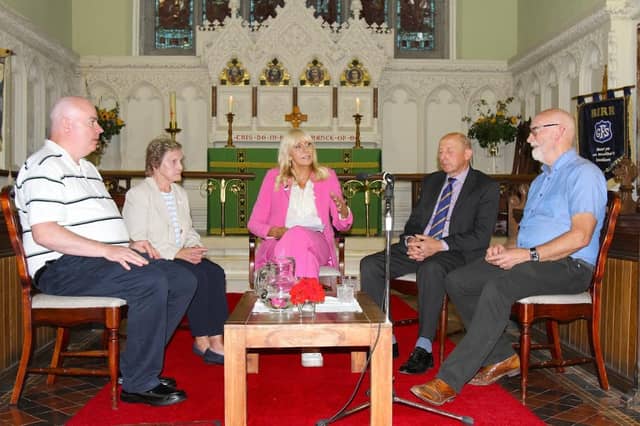
A WELL-ATTENDED service in Birr's St Brendan's Church of Ireland Church last week heard harrowing stories from four victims / survivors of The Troubles.
Kenny Donaldson, Director of the South East Fermanagh Foundation (SEFF) said SEFF supports innocent victims / survivors of The Troubles across Northern Ireland, the Republic of Ireland, Great Britain and beyond. He said it was very positive to have clergy from Roman Catholic, Protestant and Methodist Churches present at the service, including Rev Arthur Minion, Rev Nigel Gill, Fr Arnold Rosney and Rev Janet Whyte-Spunner.
He thanked Miriam O'Callaghan of RTE for agreeing to interview the four victims / survivors for the service. He pointed out that Miriam O'Callaghan is a very well known personality in society but their real focus this evening was the four people who were going to give personal testimony. “They have carried immense pain and hurt for many years, but in the process they have carried themselves with great dignity, never becoming embittered.”
He said the SEFF Quilts project is a labour of love which has been ongoing for the last 13 years. He said the ten quilts were created with great skill and they remember hundreds of victims of The Troubles. “The quilts are not a testament to death; they are a testament to life because they remember the hobbies and interests of each victim, hobbies and interests which each victim engaged in with great enthusiasm, passion and life. It is sometimes said that these victims were in the wrong place at the wrong time. But they weren't. They were exactly where they had a right to be; and it was in fact terrorism and the purveyors of violence who had no business being there.”
Kenny said it was good news to learn that The Troubles is scheduled to be introduced into the Leaving Certificate history curriculum in the Republic of Ireland starting from the 2027 academic year. Aspects of Northern Irish history up to 1993 were previously studied, but the specific, comprehensive history of The Troubles leading to the 1998 Good Friday Agreement is being formally integrated into the curriculum. He said it was also good to learn that under the Department of Education's draft Northern Ireland Curriculum 2028 proposals, the history of the Troubles is set to become a mandatory requirement for post-primary students for the first time in Northern Irish schools.
Kenny remembered Bill Hudson who was out birdwatching in Warrenpoint when 18 soldiers were killed in a bomb in 1979. The soldiers opened fire and Bill was accidentally hit and killed. He also remembered some of the many other victims who were innocent people caught in the crossfire.
He said the quilts are intended to make us reflect upon the fact that choosing the way of violence rather than the way of peace is a misstep.
He said hosting the exhibition in Birr had been a very positive thing and he warmly praised Rev Arthur Minion for his enthusiasm and for hosting the exhibition in St Brendan's Church.
The four survivors who related their experiences were Michael Donegan, Pamela Morrison, David Kelly and Richard Bell.
Pamela Morrison, from Fermanagh, told us that her three brothers were shot dead by the Provisional IRA during the 1980s. On February 1st, 1985, her brother Jimmy Graham was shot dead in his bus in a school yard. The killers boarded the bus and fired 24 shots. As the killers sped away they whooped in delight. Jimmy was the 3rd Graham brother to be killed. Ronnie Graham was shot dead in June 1981, and Cecil Graham in November 1981. Ronnie, a 39-year-old father of two, was shot while delivering coal and groceries to a shop. Cecil, 32, was visiting his wife and newborn baby at the home of her parents (Catholics who lived in a Catholic area) and was ambushed when he emerged. Jimmy, 39, a father of two, was due to drive primary schoolchildren to a swimming pool when the killers opened fire.
Pamela described the emotional consequences of these three murders as being like “torture.” She said that “the torture never ended. First Ronnie, then Cecil, then Jimmy. You never really got a chance to get yourself sorted out. The older you get, the worse it gets, the more you want them. Time never helps. No matter how long it is, that’s something you just can never forget. The pain is still there, something you just have to carry.” For more than three decades Pamela didn't speak publicly about the murders. It was too painful and too dangerous. With the help of SEFF she decided to open up. She also created some of the quilts.
On Sunday morning 22 October 1972, Richard Bell, his brother Robin and their father Sidney were driving to their farm in the Newtownbutler area of Fermanagh when they were ambushed by three members of the Provisional IRA. Thirty four bullets were fired into the car, killing Robin and wounding Sidney. Robin was 21 years of age. Richard believes the attack was carried out as a result of local intelligence being provided. Nobody was ever held accountable for the atrocity. “Robin's lower body was riddled with bullets,” he said, “and my father was hit by a bullet just behind his ear. My father never got over it. He died with a broken heart five years later. I was advised to pack up and leave the area but I felt this part of Fermanagh was my home and I decided to stay." He threw himself into his farm work to take his mind off what had happened. "Afterwards, none of our neighbours came to us and offered their condolences."
David Kelly was the son of Private Patrick Kelly. Private Kelly (10 May 1948–16 December 1983) was an Irish Army soldier in the Defence Forces who was killed by the Provisional IRA during the rescue of kidnapped supermarket executive Don Tidey at Derrada Wood, Ballinamore, County Leitrim. He was posthumously awarded the Military Star decoration. Private Kelly was a native of Moate, Co Westmeath. He was married and a father of four sons, ranging in ages from nine years to eleven weeks at the time of his death. David said his father had served in a number of UN deployments abroad and was also regularly deployed along the Irish border. David said the IRA could have surrendered but they chose to open fire instead, during which his father was fatally wounded. While Don Tidey was rescued the kidnappers were never caught and no one was ever subsequently convicted for the crimes.
David said the emotional fallout for his family was profound. “My mother was a shy, retiring person and she really struggled to cope with what had happened. I felt very depressed, angry, very stressed. We were never given any guidance or help in emotionally navigating something so awful.”
Samuel Donegan, born on the 20th of November, 1911, was a native of Ballintampen, Ballymacormack, Co. Longford. He joined An Garda Síochána on 4th September, 1934, and was promoted Sergeant in 1952 and Inspector in 1967. Inspector Donegan was a married man with six children, including Michael (who lives in Birr). Samuel served in Co. Mayo and Co. Sligo before being transferred to Cavan in 1967. On 8th June, 1972, he was one of a party of Garda and Army personnel conducting searches on the Cavan/Fermanagh border when he was killed by a booby-trap bomb on a country lane at Drumboghanagh, Newtownbutler, Co. Fermanagh. Nobody ever claimed responsibility for the killing, but gardaí and the RUC at the time were in no doubt it was a device planted by the Provisional IRA.
Michael said his father was a hardworking and fair-minded man. He recalled going on fishing trips with his father. Michael was in school in Cavan, sitting an exam, when the tragedy happened. He said two Guards came to the school to tell him the news and one of the Guards had tears in his eyes. They said his father had been injured in a bomb on the border. He passed away several hours later in hospital, around midnight. Michael said the loss and the hurt has remained with him ever since. “While you put on a brave face, and all of that, it's like the tip of the iceberg. The hurt and the pain is always within you, beneath the surface. That kind of bereavement is always working away in your nervous system, in your thoughts. You have no choice but to live with it and to keep going. I always have great empathy for others who experienced similar trauma. My father was 60 years of age. My mother was absolutely devastated afterwards. She was so broken that I thought she wouldn't survive. She did survive, though, living to the age of 95; always recalling her husband, always traumatised by what had happened."
Miriam O'Callaghan asked the four victims / survivors if faith had helped them cope with their tragedies. David, Richard and Pamela said their faith had been very important to them. Michael said he didn't have a traditional, churchgoing faith, but did receive consolation from his belief that there's a “divine and good spirit in humanity.”
Durig the two week exhibition of the Quilts in St Brendan’s both David and Michael spent a day acting as its overseers.