
Fascinating Roscrea river survey results published

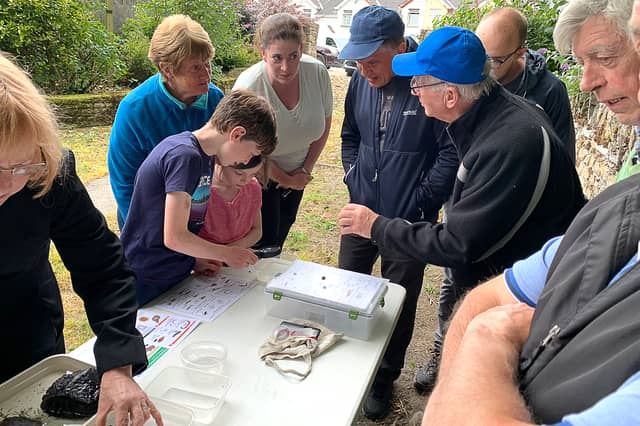

Some fascinating insights into the water quality of the river which flows through the heart of Roscrea have become available after a detailed survey of microscopic life and their environment by two water quality specialists.
The Moneen/Mall/Bunow river rises at Monaincha Bog outside Roscrea, flows through the town and joins the Little Brosna south west of Roscrea and into the River Shannon.
Enthusiastic members of Roscrea Tidy Towns, who have a passion for this river and nature in general, invited Tom Ban and Sean O’Farrell to do a training workshop on River Habitats.
The workshop took place at the Water Hole, Railway View, Roscrea on Wednesday July 27. The event was promoted and supported by the Cabragh Wetlands Trust, Thurles and funded by North Tipp Development Company.
In the introduction to the workshop we provided an overview of the importance of freshwater ecosystems in a global context as 97% of the water on the planet is saltwater, about 2% is as glacial ice, so only about 1% is available for humans, animals and plants that live on land.
Like land based ecosystems, river and water ecosystems depend on the sun to supply the energy to the system through the process of plant photosynthesis.
Algae and mosses on stones in rivers are important food sources for organisms that graze these plants. Those mini beasts are then eaten by larger organisms, fish or birds such as the dipper, kingfisher etc. The creatures in the river provide a hugely important service by recycling all plant materials, leaves, twigs, and deadwood.
The trees and bankside vegetation are very important for providing shade to keep the correct temperature for the creatures in the river and to also allow them to hide from predators. The bankside vegetation and field margin also acts as a very important buffer to filter out any potential pollution from reaching the river.
Rivers such as the Moneen/Bunow do not stay the same all the time but are in constant change, due to heavy rainfall events, strong currents, droughts, sediments being carried downstream, water colour changing, possible runoff from farmland of animal pooh, slurry or chemical fertiliser, herbicides and pesticides.
Other industries, including forestry, waste water treatment systems, septic tanks and private businesses and private houses can have a negative impact on the river. The EU Water Framework Directive (2000) set targets for member states to achieve good water quality standards for all rivers, lakes and estuaries by 2015 but member states have been failing so far and the new deadline is 2027.
In Ireland the Environmental Protection Agency is responsible for testing and monitoring the river and lake water quality. They carry out Biological (mini- beasts/macroinvertebrates), Chemical and hydromorphological studies of the waterbodies.
In assessing the Biological water quality status they categorise the river based on the presence or absence of different groups of organisms based on their varied sensitivities to pollution. The creatures may be very sensitive, or sensitive, tolerant, very tolerant or most tolerant.
Summary Report of Findings
Tom and I visited the Bunow river on Thursday 20 th of July, to observe the site in preparation for the main workshop on July 27. We were immediately impacted by the smell of a liquid flowing into the river from the direct opposite side to the ‘Water Hole’. This liquid had a creamy colour and as I say a foul smell.
When we visited at 6.30pm on the evening of the Water Habitat Training Workshop, we were again surprised, this time by the reddish colour of the water. It looked to me like blood. This colour dissipated after about 15 minutes to normal water colour.
We took some 3 minute ‘Kick samples’ and put the macroinvertebrates into white trays for observation, identification and analysis. After identifying the mini beasts we grouped and counted them. We introduced the attendees to the life cycles and strategies for survival of the different organisms and where each fitted in the River food web. We discussed the sensitivities of the different organisms to pollution and how this helps to classify the river water quality.
Reading the data
Based on how the EPA group the organisms related to pollution sensitivity, our results with many Mayfly (including one flattened species) and Cassed caddisfly, is leading to determining the Water Quality to be Good.
Observations from the Chemical analysis indicated the river's pH of 7 would be classed as good. The Dissolved O2 at 4ppm (parts per million) is moderate. While each organism has its own DO tolerance range, generally, DO levels below 3 milligrams per liter (mg/L) are of concern and waters with levels below 1 mg/L are considered hypoxic and usually devoid of life. The higher rate on the scale is 8ppm.
Both the Nitrogen and Phosphate (N+P) rates are satisfactory. The temperature seems satisfactory. The percentage saturation of Oxygen in the water seems on the low side. There is a correlation between water temperature and Dissolved Oxygen.
Conclusions
The first impression from the initial visit to the site was that the water quality could only be very poor due to the inflow of foul smelling creamy coloured liquid directly opposite the Water Hole. This was not happening when we visited one week later, but there was a reddish colour on the water on that day which dissipated after 15 minutes.
Our sampling of the macroinvertebrates on July 27 are, in our opinion, indicative of Good Water quality. Our chemical analysis did not show any results outside of normal at the time of sampling.
It was a real boost to our mission of highlighting the importance of river habitats, to be welcomed by 16 enthusiastic members of Roscrea community.
Our rivers, ponds and lakes need to have champions for these highly important natural resources and ecosystems.
We would be delighted to be invited to do a similar workshop for your community at a river near you. Please contact Sean on (087) 9227957 or Tom on (087) 9781465. These workshops are funded under the North Tipp Development Company Environmental theme.