
Memorial stone planned for unmarked grave of Offaly civil war victim


DONATIONS are being sought to fund a memorial stone at the unmarked grave in Birr of a National Army soldier killed in the Civil War.
As the 100th anniversary of the death of Private John Gunning approaches, historian Stephen Callaghan has announced that on March 1, a century after he was killed, a ledger stone will be placed at the man's place of rest in Clonoghill cemetery,
John Gunning was a former member of the Leinster Regiment who was discharged in 1922 and joined the National Army in 1923.
He was born to a single mother in 1891 in Ballitore, Co Kildare and joined the Leinster Regiment in 1911, serving during World War I.
“Despite any early setbacks in life he made something of himself and joined the army where he excelled at being a soldier,” said Mr Callaghan.
He was trained in Birr barracks and his first posting was with the first battalion of the Leinster Regiment in Faizabad, India before they returned to Europe in 1914.
“He fought his way through the Great War, serving in France, Belgium, Salonika and Egypt.”
The Leinster Regiment of the British army was disbanded in 1922 after the Anglo-Irish Treaty and John Gunning was discharged. He had been living at Military Road, Crinkle and married in 1920.
“After the war, he married Johanna Sullivan and in what was very likely an effort to support himself and his wife, as he did not get an army pension, he joined the newly formed National Army on 14 February 1923.”
He was with second infantry battalion of the army, under the command of the barracks in Athlone.
“Pretty much straight away he was thrown into the Civil War,” said Mr Callaghan.
Only two weeks after joining, on February 28, he was patrolling on bicycle at Crumlin, Moneygall with 11 other National Army soldiers when they came across an anti-Treaty force of 25 men in a house.
A gun battle took place when the men tried to escape and John Gunning was fatally wounded, dying on March 1. National Army Sergeant Patrick Byrne also died in the battle.
“While the National Army paid for Gunning's funeral, his grave was never marked, his widow too poor to afford a marker,” said Mr Callaghan.
Stephen Callaghan, who has written and worked extensively on burial grounds in Offaly, has been fascinated by the military history of Birr for many years and in 2008 he located the unmarked grave of John Gunning.
“Since finding John Gunning 15 years ago, his unmarked grave has been on my mind. Now coming to the centenary of his death, I think it is the most appropriate time to have it finally marked," he said.
“It struck me that he had died while serving with the precursor of the current Defence Forces. He died in the discharge of his duty and there is nothing there to recognise his sacrifice.” No picture of him has been found.
His widow remarried Hubert Mulhere in 1933. She had received a weekly pension of 17 shillings after John Gunning's death but Mr Callaghan says her pension application indicates she was of limited means and had been living with her parents and trying to earn some money through knitting.
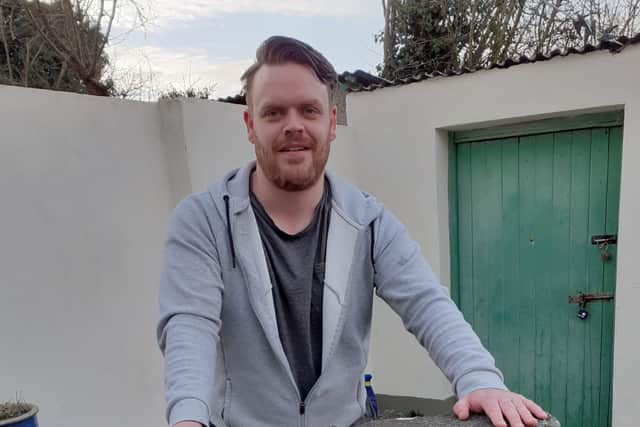
The historian has engaged a Dublin stonemason to cut and engrave the stone and is hoping to raise €700 to cover the cost.
Donations can be made by logging on to -
A retired army commandant, Paul Clarke, has said it is important that men like Private John Gunning are remembered appropriately.
“I think that it is incumbent on the Irish State and as a mature democratic nation to acknowledge the 200,000 Irish citizens, from all traditions who joined the British Army and served in the Great War 'in the defence of small nations',” he said.
“And of course, the 60,000 Irish citizens who did not return home and died on the battlefields of France and Belgium. In many cases because of extreme poverty this was not a choice for a lot of young men and a matter of their own and their family's survival. They should not be written out of history for doing the right thing.
“Private John Gunning was a proud Irishman who joined the Leinster Regiment to provide for his family in 1911.
“The fact that Volunteer Gunning survived the horrors of the Western Front only to die in his own country fighting for and against his own countrymen in a vicious civil war is a poignant reminder of the futility or war. May he rest in peace.”