
Mixed emotions for former Mother and Baby Home resident on return to Sean Ross Roscrea


Sean Ross Abbey in Roscrea was built in the 1750s. Back then it was known as Corville House, and was an elegant Georgian country house with two storeys over a basement. It was lived in by the Anglo-Irish Prittie family (who were also known as the Barons Dunalley). Count John O'Byrne purchased the estate from the Prittie family in the 19th Century and lived there until 1930. After the Count's exit the Sisters of the Sacred Hearts of Jesus and Mary moved in, in 1932. The Sisters immediately opened a Mother and Baby Home on the premises, which they ran until 1970.
The story of this very dark time has become extremely well known, but only since the noughties. Prior to that one heard very little, if anything, negative about the place. In fact, most of the time the public heard about St Anne's School, which is a very positive organisation and always left, and leaves, us with a good feeling. St Anne's School opened in February 1971 and provides specialist services to people with disabilities aged four to 18. It continues to be a shining light of positivity, providing a counterbalance to the murky and dark past of its neighbour.
By the noughties the Church's power and influence was significantly waning, and there was less fear of the institution. As people began to open up more and more about what happened during the '30s, '40s, '50s, etc a lot of darkness, so long hidden, came bubbling to the surface.
For decades a practice that should never have been allowed to take place, a practice which was deeply lacking in compassion, was carried out in Mother and Baby Homes like Sean Ross; namely making money from the adoption of babies born to unmarried girls. A lot of these babies were sold to childless parents from the United States.
The unmarried girls were often very vulnerable and while some of them mightn't have been able to cope with raising their children, they were never given the option. After the babies were adopted there was a shocking lack of contact with the birth mother (something which was focussed on in the 2013 film “Philomena”. In this film the true story of Michael A Hess and Philomena Lee is told. Michael A Hess was born Anthony Lee to Philomena Lee at Sean Ross in 1952).
The Angel's Plot is a peaceful but poignant green lawn surrounded by trees in the Abbey. Here lie the unmarked graves of an unknown number of mothers and babies. The fact the graves weren't marked is another shocking indictment of the system of the time.
In July 2020 it was revealed (through securing records held by the HSE, using the Freedom of Information Act) that a total of 1,024 'illegitimate' children died in Sean Ross Mother and Baby Home over a 37 year period. Almost half of them, 455, were officially listed as having died of heart failure. 128 children died from severe malnutrition.
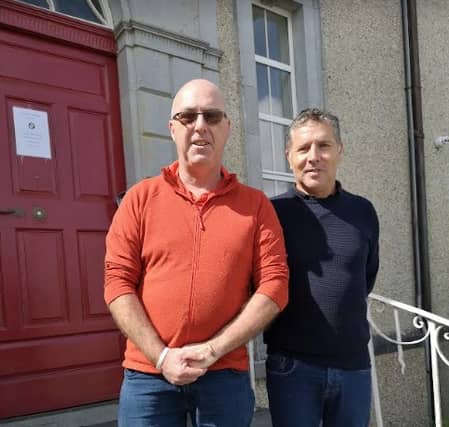
Last week one of the babies who survived contacted The Midland Tribune and wanted to tell his story. Paul Lynch is from Bandon, Cork and is in his early 50s. Until last year he didn't know he lived for a number of months in Sean Ross when he was a baby. When he found out, he was profoundly moved and felt he must visit the place where he was born. He contacted Michael Donovan, a Roscrea man who has helped a number of people who went through the Sean Ross system, and the two men visited the Abbey on Thursday last.
Paul had in his hands a 90 page governmental report published at the end of 2020. This report has drawn mixed feelings at best from survivors, often outright condemnation. The report submitted by the Commission of Investigation into Mother and Baby Homes concluded that primary responsibility for the treatment of unmarried women and girls and their children lay with their own families and with their children's fathers. Some believe that while there is some truth in this response (namely, that the fault lies with much of Irish society not just with individual religious orders), others believe that it is however something of a cop-out (the State and the Church were all powerful and deeply intertwined, they point out).
Paul told me that he is a twin (his brother is Gerard). “I was one of the last few children to leave Roscrea ,” he said. “The practice didn't go on for much longer after my time.
“A year ago I discovered that I had been in Sean Ross for a time. That was a shock. Up until then I didn't know I was in Sean Ross. I knew I had been in Bessborough for a while, but not about the Roscrea institution.”
Paul said some of the nuns were profoundly institutionalised and lacking in any true Christian grace. There were exceptions though. He recalled with great fondness a nun, Sister Norbert, who looked after himself and Gerard during their time in Sean Ross and Bessborough. “She was a very kind-hearted person. You can tell by the photos of her. She comes across as a genuine, kind-hearted person. She looked after us as if we were hers. She is dead now. I think she couldn't stomach the adoptions anymore after us and she moved to Cheswick in England.
Paul was born in St Luke's Hospital, Clonmel which took in “people who suffered from their nerves”, to use a very common euphemism.
“I was born on October 16th 1968 to Mary and Eddie Ely,” said Paul. “My mother gave birth to me in St Luke's. She was living in the Thurles area at the time. My father was working on a farm. Life was hard for them and they struggled financially.
“After Ger and I were born I believe that what should have happened is that we should have been fostered out for six to twelve months. The family, that is Mary and Eddie, should have been supported and then we should have moved back into their home. I think it was wrong that we weren't given back to our birth parents.”
Paul admits that there's a possibility that his birth parents mightn't have been able to look after him and Gerard, “but the system didn't even examine the possibility. As it turned out, I was fostered for 18 years.”
He said Sacred Heart nuns would sometimes visit them in their foster home. He added that he believed there were some minor supports provided for the birth parents, but nothing very significant. His foster family was based in Bandon and his foster father worked in a local firm as a painter and decorator.
“My foster Dad has now passed away,” Paul continued. “My foster mother is still alive. I loved my foster father. He was very good to us.
“The nuns failed to tell us when our birth mother passed away. I frown on the nuns' behaviour in this regard. I did get to meet my birth father.”
He spent 13 months in Sean Ross and 8 months in Bessborough, until he left in August 1970.
“I got my 90 page report from the Commission of Investigation into Mother and Baby Homes and I am not happy because they are saying I was conceived out of wedlock, that I was illegitimate. In fact I was able to get my parents' marriage certificiate which said they were married in March 1965, so I was not born out of wedlock.”
Paul told me that, emotionally speaking, he has come to terms with his past.
He pointed out that a big and serious omission in the government's report was the lack of mention of the vaccination programme carried out by the nuns. “The church, in cahoots with the government,” he remarked, “used us as guinea pigs in which the government could test new vaccines, without permission to do so. A nun told us that my brother and I got an allergic reaction to the vaccinations. My brother bled from his ears and I had boils on my legs and back.
“I would like to know how many more people like myself found themselves in the Mother and Baby homes, without any choice in the matter, and were given these experimental vaccines?” According to the Mother and Baby Homes Commission of Investigation, there were at least 13 vaccine trials carried out on more than 43,000 children. “These were experimental vaccines and the government was using us like guinea pigs,” said Paul. “We don't know the number of children in Sean Ross who were given these experimental vaccines. The vaccine companies and the scouts employed to find suitable babies got plenty of money. You know, eventually the truth always comes out. Corruption can only be hidden for so long before it comes out.” He said he felt an emotional chill when reading about Germany during the 1930s and 1940s as he could see that Ireland in that era wasn't a million miles removed from Fascism. “In Hitler's time the Nazis tried out experimental vaccines on identical twins. My brother and I looked fairly alike but we weren't identical twins.
“I'm 53 years of age now,” he continued. “For a number of years I had a lot of shame resulting from this early life experience. But now I know that in fact the shame is all theirs.
“I want to find out the truth. All of us who were babies in these homes want the full truth to come out.” He said his wife and his daughter are a great source of support and strength.
Michael Donovan is 56 and from Roscrea. He and Teresa Collins, from Portroe, both run a Facebook page called “We're still here”. The purpose of the page is to help find answers for people and provide support. “We help people looking for birth certs and baptism certs,”commented Michael. “The Sean Ross baptism certs are based in Clare.”
Michael worked as a gardener in Sean Ross during the 1980s. He said that he came across a lot of small bones in the Angel's Plot. He subsequently gave evidence to the Commission of Investigation.
Michael said there will be a special commemoration service in Sean Ross on September 25th during which the premises will be open to the public and there will be a wreath laying ceremony.