
OPINION (AN COLÚN): A poignant work of art focussing on the suffering of thousands in an Offaly workhouse

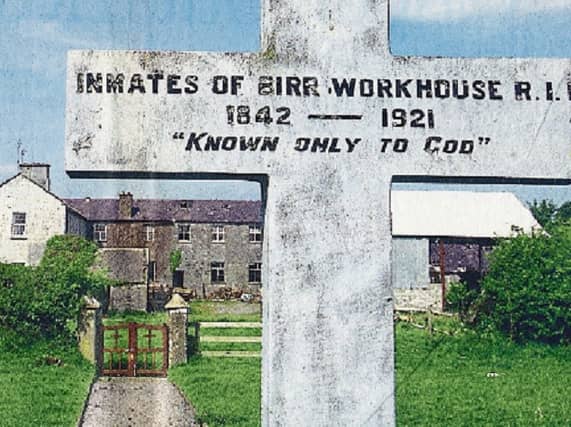

Birr Workhouse came into existence in May 1839. Under the name of Parsonstown Poor Law Union it was overseen by a Board of 29 Guardians and it covered a large area, from Borrisokane to Ferbane and from the Slieve Blooms to the Shannon. According to a census in 1831 the number of people living in this area was 71,138 (Birr itself was home to 8,744 souls).
The Workhouse was built on a seven acre site half a mile to the east of Birr. Its architect was George Wilkinson who designed a building with the ability to house 800 people.
The Workhouse was declared fit “for the reception of paupers” on March 14, 1842 and it received its first admissions on April 2.
Wilkinson was the architect for many workhouses and Birr follows his usual layout with an entrance and administrative block containing a porter's room, waiting room and the Guardians' board room.
The main accommodation block had the Master's quarters at the centre, with male and female wings to each side.
At the rear there was a range of single-storey utility rooms including the bakehouse and washhouse, connected through to the infirmary and “idiots' wards” via a central spine containing the chapel and dining hall.
The workhouse closed in 1921. It housed Birr Shoes from the 1930s to the 1960s. In more recent times it was home to Peerage Brass Factory.
Most of the workhouse buildings still survive today. Sadly in August 2017 it was badly damaged by fire when some youths set the place ablaze. Birr Historical Society commented at the time, “The society is greatly saddened to see the destruction by fire of a large section of the main block of Birr Workhouse yesterday. It is the end consequence of many years of neglect, of a wonderful building that had so much to offer the community. Well done to the many individuals and groups that battled in vain to save it over the years.”
Several months later, in February 2018, the President of Birr Historical Society, Brian Kennedy, warned that unless preservation work is carried out on Birr Workhouse and Birr Courthouse, both buildings will be lost to future generations.
Last week it was announced that €340,000 has been secured for the Courthouse and preservation works will begin in the next few weeks. It was a morale boost to hear this excellent news. Sadly we have heard nothing about the Workhouse for a very long time. A company called Castle Rook Ltd had been planning to turn the premises into a state of the art dementia facility and had said it would apply for planning in February 2020. Covid-19 seems to have delayed the project and while everyone wants to see the project succeed many are now wondering if it will ever come to pass.
On Saturday afternoon August 21 audiences were treated to a performance of The Meadow in the vicinity of the workhouse. The Meadow is a beautiful and poignant work of art focussing our minds on the large number of “paupers” buried in unmarked graves on the site, on the frequently grim spectacle of history, and on human systems which are hopelessly inadequate, cruel and inhumane.
Ireland thankfully is a much more civilised, humane and just place than the world which the impoverished lived in back in the 19th Century but there are still vast swathes of the contemporary world where people are living in deplorable conditions; places where human greed and corruption is permitted a fulsome expression.
Last night I picked up a book by a writer I love, François Mauriac. The book is called “The Son of Man” and it examines life's suffering, a world riven with addiction, a world which can be horrifically cruel and heartless, and why evil is permitted to happen. In symbolic opposition to the coldness and soullessness of our adult lives Mauriac offers the image of the Christ-child in the manger. “Even in our old age,” he says, “we have much in common with the little child in the crib; we recognise ourselves in that child and in a sense we are that child. One part of our being, a most hidden part, is the child who has not experienced evil; by this fact a part of our being is like unto God.” Mauriac's vision is a Christ-child filled with strength not with weakness, who, even when confronted by the sight of the slaughterhouses of the totalitarian regimes of the 20th Centiury, somehow rises above all of that horror and suffering. No matter how bad things get, the image of the Christ-child cannot be erased. It can be very hard though for us to keep this beautiful symbol present in our minds: “How difficult it is,” says Mauriac, “to keep our attention fixed on your (Christ's) childhood, not to be drawn towards the abyss of your tortured humanity, towards your passion and death. We are attracted to your passion by your resemblance to us in suffering. But it is not at the foot of the Cross that we are closest to you; it is perhaps while kneeling before your manger, before the God-Child who has just been born. I believe in you, God-Child, because you are a love that is still blind, still ignorant of innumerable crimes.” Imbued with this divine symbol, Mauriac feels himself disrobing before an ocean of love, intoxicated with God's peace.