
OPINION (AN COLÚN): A Saint's tale brilliantly told in Birr

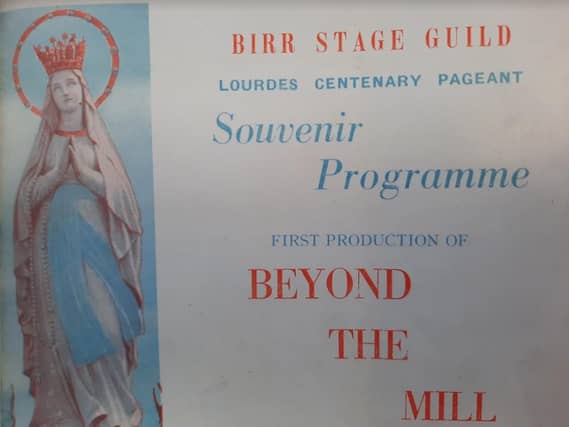

An English gentleman entered our Birr office a few months ago with a copy of a play my grandfather wrote in the 1950s called “Beyond the Mill”.
I was delighted to receive it, sat down and read the play for the first time.
It was brilliantly written. Granpa was a great writer. He was more than your typical newspaper editor (noble profession that it is). He was also a lover of culture and literature.
He had a deep respect for the classics of world literature. In my teenage years we often discussed books and he recommended books which resonated with him. I was going through a crazy, mixed up teenager period and some of these deeply resonated with me. I devoured them.
There was The Outsider by Colin Wilson which looked at people's quest for meaning in a world which often comes across as superficial, materialistic and meaningless.
There was William James' “Varieties of Religious Experience” which gave countless examples of people who connected with the mystical other and the bliss which that brought into their lives.
“Steppenwolf” by Herman Hesse was another favourite which looked at a deeply cultured but very glum man who embraces a world of jazz and sex. The novel finishes with an unbridled expression of the imagination, in a Joycean fashion.
Granpa loved the music of Wagner with its great surgings of bliss - I immediately understood the attraction.
As Editor of the Midland Tribune for decades, Granpa made his living from words. After he retired he ran a very popular column for years on the back page of the Tribune which focussed on some of the weekly offerings on RTE 1 and RTE2 (the only two channels on offer back then). He had a felicitous way with words, of phrasing sentences; but there was no pretention about it. It was a simple enjoyment of the craft. While he greatly appreciated regular news reporting, he loved feature writing, because it gave him the opportunity to go beyond, to be more expressive.
“Beyond the Mill” was first performed in The Marian Hall Birr on May 25th, 1958 and ran to June 8th 1958. In terms of felicity of writing style, Granpa was on top form here. It's also obvious that he spent many months researching the topic. A huge amount of work went into it.
The English gentleman had the Birr Stage Guild programme from the May / June '58 performances. The surnames of the performers featured many surnames which are still with us in the Birr area - McNamara, McDermott, Dolan, O'Brien, Kennedy, Hickey, Shortt, Harte, Grennan, Hogan, Kelly, O'Callaghan. The play tells the story of Saint Bernadette of Lourdes. On the front page of the programme there's the first verse of the song “Tap Your Sabots, Bernadette” - “We come behind you Bernadette, You lead the way across the hill This world of ours dare not forget Your rendezvous beyond the Mill.” (Sabots were a simple shoe made from wood and worn by French peasants).
As it was written in 1950s Ireland, Granpa had to be wary of the religious sensibilities of the time. He was also writing for a theatre in a small town, which was rural in outlook. He couldn't write anything too sceptical or denigratory. There could be no hint that the playwright was in any way philosophically at odds with Bernadette's story.
The Virgin Mary's apparitions in the play are excellently written, sometimes powerfully so. They must have looked great on the stage.
I was told by my father that he attended the performances as a 16 year old. Every night was packed out and many of the attendees were deeply reverential. Some of them were holding rosary beads and began blessing themselves and muttering prayers during the apparition scenes. This is the stage directions for one of those scenes. It describes Bernadette kneeling in front of Mary: “She kneels down and takes out her Rosary and makes a slow but beautiful sign of the cross. Light glows all around her. The vision becomes very bright. The Lady seems very happy and Bernadette is radiant. The music swells to a crescendo and dies down.”
Bernadette was only a 14 year old girl when she experienced her visions. Her reports were met with a great deal of scepticism and criticism. The church was initially very cautious but then embraced the phenomenon. There are several local people of importance in “Beyond the Mill” who express this mood of scepticism, of cynicism; and they play a prominent role in the play (being given a lot of 'air time', so to speak). We meet a few of them early on in the play. They are typical middle class gentlemen of importance in a rural area, who are good friends and like to meet regularly in a club to drink, smoke and play cards. They discuss Bernadette's family, the Soubirous: “The Soubirous, God help us!The only thing that lot could see clearly is the label on a brandy bottle. A useless lot. The father never did an honest day's work in his life and the mother's not much better.” The Mayor, a man called Lacade, comments, “The child's insane! This is going beyond a joke. It must stop. The whole business would be a laugh if it wasn't getting talked about so much. It will do our town terrible damage if it spreads much further.”