
OPINION (AN COLÚN): The railway that was stolen between Birr and Portumna

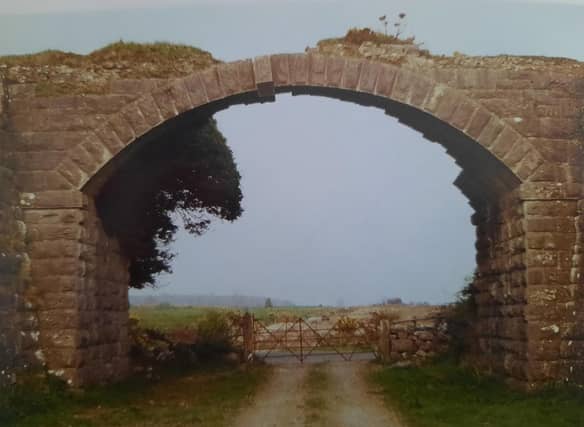

A Birr man who is a member of the Irish Railway Record Society drew my attention recently to the interesting story of the stolen railway between Portumna and Birr (or Parsonstown as it was known back then).
This rail line existed from 1868 to 1878 and is Ireland's biggest commercial railway failure.
An Act was passed in July 1861 authorising the building of the line. The Public Works Loan Commissioners and the Great Southern & Western Railway Company put up loans for the scheme.
Despite this the construction of the line was a long, drawn out affair and it didn't open until seven years later, in 1868. The first contractor went bankrupt; the second gave up; and the third completed the job.
The first train left Birr on Monday November 5th 1868. Locals critcised the passenger timetable for being inadequate. Coming from Portumna, passengers could connect for trains to Roscrea and Dublin. The train departed Portumna for Birr at 6am, and Birr for Portumna at 12.29pm. The journey took half-an-hour.
The line's financial performance was poor and when the lease expired in 1878 the Great Southern & Western Railway Company refused to renew it. The government was asked to take it over but it refused to do so. The service stopped operating in December 1878 and the GS&WR removed its rolling stock and withdrew its staff.
Some time passed and then the line began to mysteriously disappear. The line was well ballasted and this ballast began to disappear, starting a few miles from Birr. The ballast was ideal material for constructing farm roads and roadways into bogland.
After this the small pieces of iron began to disappear. Local historian Joe Coleman notes in his excellent essay on the subject, “No doubt the blacksmiths of the time were glad to receive them.”
The rails were next to go missing. “You could not mistake,” writes Joe, “the wrought iron 'bridge' style construction of these rails, associated with early railway building.”
The sleepers were massive planks of creosoted timber. These found all sorts of uses, including in farmbuildings and for firewood.
“The marauders came from near and far,” writes Joe, “and in a very short time nothing but the bed of the railway remained. The station buildings in Portumna are said to have disappeared in a single night. The timber, windows, doors, slates, etc, were very useful and quickly found some new homes. The kerbs of the platforms were prised loose with crowbars and made fine doorsteps for houses, cowsheds and stables.”
The Royal Irish Constabulary thwarted an attempt by locals to remove the girders of the six span bridge over the Little Brosna in Riverstown (this bridge remained intact until WWII).
Lord Rosse petitioned the government in London to revitalise the railway, but to no avail. Two local landowners, Colonel JF Hickie and Mr WT Trench organised a public meeting in 1889 to try and galvanise people, but again to no avail. Further efforts were made in 1903 and 1907. They too were the proverbial head banging against the brick wall.
Joe Coleman points out that even today some people become a bit evasive and coy when the subject of the infamous stolen railway is brought up in conversation. Even in the third decade of the 21st Century, he writes, “people are reluctant to talk about it. Some will say that the whole line disappeared in a single night, others will either claim that they never heard of it, or if they have, they will blame the people of East Galway for stealing it. However, without looking in any particular direction, there is much evidence to suggest that the railway didn't go too far away in the end.”
While it is often not obvious at ground level much of the line's alignment can still be made out from the air or by using Google Earth. Several bridges also still exist.
Finally, our region's former rail system features prominently in the historical novel “Hell hath no fury” by the famous Birr writer Malcolm Ross MacDonald. The novel is the nearest thing we'll get to a time machine in terms of bringing to life rail travel in the 19th Century. A crucial part of the plot of “Hell hath no fury” happens on one of the area's railway platforms, when Lady Lyndon-Fury snubs Daily O'Lindon as they are travelling by rail, on a soft day in 1885. Lady Lyndon-Fury's snub creates a negative series of events, because Daisy, seeking to get her own back, becomes immersed in a tit-for-tat that ends in the destruction of one family and a mixed outcome for another.
Local readers will thoroughly enjoy reading Malcolm's book because of its local setting. When it was published in 1990, it got some great reviews, including: “Beautifully written, this is Macdonald's best effort yet,” and “Set in late 19th-century Ireland, this delightful novel is full of the warmth and passion of the Irish.”