
Top Engineering medal award takes place in Birr Castle

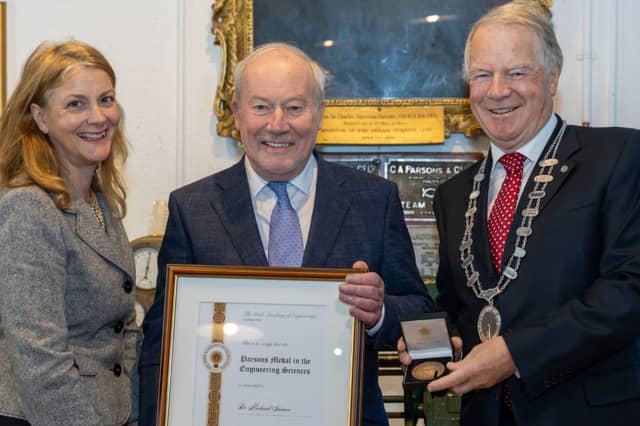

‘Mick Guinee’s motivation for the management buyout was to save jobs and nurture a skilled workforce in the Shannon region’
BIRR Castle once again hosted the awarding of the prestigious Parsons Medal on Tuesday 20 October last.
This Medal celebrates excellence and outstanding achievement in engineering and this year's recipient was Dr Michael Guinee, founder, former CEO, and Chairman of Ei Electronics in Shannon.
Dr Guinee received this honour from the Irish Academy of Engineering in recognition of his outstanding contribution to engineering in Ireland.
Named in honour of Charles Parsons of Birr Castle, the inventor of the marine steam turbine, the Parsons Medal is the Irish Academy of Engineering’s highest honour.
Members of the Irish Academy of Engineering and the Ei Electronics team attended for this special occasion, celebrating engineering excellence and the enduring legacy of Charles Parsons, and they were warmly welcomed by the staff of the Demesne and its manager Alicia Parsons.
Michael Guinee is a native of Mallow, County Cork. After graduating from UCC with a Bachelor of Engineering, Michael – or Mick, as he is better known – completed a master’s degree in Industrial Engineering in UCD. He worked for a short time with the ESB before moving to General Electric to work for ECCO, a GE company in Dundalk. However, being a Munster man at heart, when presented with the opportunity to move to Shannon in 1981, he took it, and two years later, he was appointed Managing Director of GE subsidiary Ei Company. (Ei stands for Emerald Isle).
In 1986, Mick was informed of GE’s plans to close the facility in Shannon. Even though it was a viable business, it was not part of the company's future strategic vision. Mick managed to delay GE’s public announcement about the closure so that he could negotiate a management buyout. Without the benefit of state support, Mick worked with a couple of people to conclude the buyout, and Ei Company became Ei Electronics in 1988.
Mick Guinee’s motivation for the management buyout was to save jobs and nurture a skilled workforce in the Shannon region. Recession in Ireland and the Mid-West region in the mid to late 1980s did not offer many prospects for the few hundred people employed in Ei at that time. GE was honourable – it paid everyone a generous redundancy – and Mick reemployed the workforce in the new Ei Electronics company the following week. 38 years later, Ei Electronics is one of Ireland’s largest and most successful indigenous manufacturing and exporting companies. Now employing over 1,250 people and exporting to over 30 countries worldwide, the company is a global leader in the design and manufacture of fire and carbon monoxide detection products for the residential sector.
Mick is a strong supporter of developing engineering skills in the Mid-West – he established the Ei Women in Engineering Scholarship in University of Limerick in 2019. Ei’s graduate programme recruits engineering and science graduates annually and supports UL’s cooperative education programme.
Mick also set up the Michael Guinee Charitable Foundation to support his philanthropic pursuits into the future.
Charles Parsons lived from 1854 to 1931. He grew up in Birr Castle and was the youngest son of the 3rd Earl of Rosse (who built the “Leviathan of Parsonstown”). Charles studied mathematics at Trinity College Dublin and St John's College, Cambridge. He became a mechanical engineer and became famous when he invented the modern multi-stage reaction steam turbine in 1884. Instead of trying to extract all energy from high-pressure steam in a single violent stage (which caused previous designs to disintegrate from centrifugal force), Charles used a series of rotating and stationary blade rings to let steam expand gradually. He attached his turbine to an electrical generator, which, producing 7.5 kW of electricity at 18,000 RPM which made cheap, large-scale electricity generation possible Parsons built the experimental, turbine-powered steamship Turbinia to revolutionize marine propulsion. His turbine-powered steamship Turbinia outran every warship of the era.