
Unusual event in funeral home in Offaly gets standing ovation

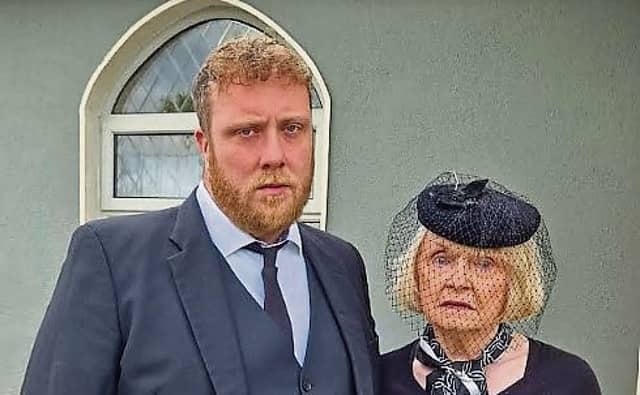

THERE was a very unusual event held at a funeral home in Birr on Thursday evening, in the sense that, it wasn't in fact a funeral.
Boyd's Funeral Home on the Tullamore Road was the rather odd venue for the performance of “The Dead House,” a play starring Martin Beanz Warde.
Before the show, Martin posted to social media to say "The Dead House will be reposing at Boyd's funeral home, Birr, County Offaly, as part of this year's Scripts festival.” He added: "I can't wait to perform this show in a fitting, although totally unusual space.”
The performance was well received by those in attendance, who gave Martin a well-deserved, standing ovation.
With the aim of creating a more immersive experience, the attendees were asked to sign a book of condolences on the way out!
“Everyone really took to the idea that they were witnessing the goings on at a funeral,” said Martin in his social media post. “Well done to Scripts for gathering such a stellar audience. Birr, you were deadly!”
Some of those who attended commended Martin for such a powerful show, commenting, on social media, “What a performance. Super. Well done. Can't wait for the wedding!" one person wrote.
Another said: "Fantastic night tonight. Loved the whole experience," while a third wrote: "Excellent performance tonight, Martin. Thank you. You deserved the standing ovation.”
Martin delivers a tour-de-force in The Dead House. He has written a very witty but sometimes poignant piece. The play lasts for an hour and is a one-man show. The energy and focus required to pull that off is very impressive.
Martin is a member of the Irish Traveller Community, holds a Sociology and Politics Degree and an MA in Journalism. The Dead House enjoyed a sold-out run at Dublin Theatre Festival, Galway Theatre Festival and Listowel Writer's Week.
In The Dead House Martin plays a gay Irish traveller, Patrick, who hasn't been home in ten years but returns from self-exile for his grandfather's funeral. “We are gathered at the dead house,” he tells us. “Such a morbid name, I mean, there is still another person alive in that place, my granny. My grandfather's cold and lifeless body is laid out so that we can all have a final moment to say goodbye. 'Goodbye Grandad,' as if he can even hear us.”
He talks about it being sometimes difficult being a gay man growing up in a Traveller culture which can be machismo. His relatives “looked down their noses at me when I went to university,” and spoke of him hanging out with “the hippies and the queers” in the university!
Some of the relatives at the funeral are in good form and laughing, despite it being a funeral. “I understand why they're laughing. Who wants to spend forever crying at a funeral?” The womenfolk are dressed all in black. His mother's black outfit makes her look like “a regal crow”. The women are busy offering sandwiches. One of his male relations talks about Patrick's “hippy” friends. Patrick tells him, “They are not hippies; they are artists.” This doesn't sink in with the male relative, who responds, “They are all drawing the dole no doubt?”
The funeral is in a small Council house and there's a wreath on the door. There's a picture of the Sacred Heart of Jesus, “reminding everyone of how religious we all are and I'm standing there like the big gay sinner that I am!” Scented candles have been lit. Patrick thinks about the difficulty of throwing away your loved one's small possessions after their death; something which is never publicly mentioned. There's a dog bowl in the garden with the name “Tiny” on it. “Strange name for a german shepherd,” he jokes. He meets his father in the garden shed, who's drinking a bottle of whiskey. The subject of Patrick's “homosexuality” comes up. “We don't say 'homosexual' anymore,” says Patrick, “We say LGBT.” “LGBT,” replies his Dad, mocking, “as if you need to spell out Gay!”
Patrick tells the audience: “He is not a bad father. He is your typical west of Ireland father. Sometimes fathers show love to their sons in ways that only they recognise. Sometimes that is enough.”
There's a traditional Traveller wagon in the garden. Patrick recalls his first kiss. It was at the age of 14 in the wagon, with Steven. Two weeks after that first kiss Steven committed suicide and was found “hanging from the rafters of the bike shed. There were no notes or warnings. There were no more summers.”
He is hugged warmly by his relatives, reminding him he is part of something bigger, he is part of a nest. Kissing his grandfather's forehead is “like kissing the forehead of a marble statue.”
They all proceed to the funeral mass in the church, then it's a 20 minute slow procession to the graveyard where his cousin Mary Kate sings Spancil Hill. The women cry but the men don't cry “because they have been taught to be brave, masculine and silent.”
The play ends with everyone heading to the pub.
As well as containing lots of black humour, The Dead House is a testament to the resilience of the human spirit and the importance of expressing one's voice and one's identity.