
US World War II pilot crash landed on Offaly bog after mistaking it for tarmac


It's 80 years in 2024 since US Air Force pilot Iris Dillon crash landed his war plane onto a bog in Offaly and was helped to safety by turf workers
2024 marks the 80th anniversary of an unusual crash landing involving Flight Officer Iris Dillon of the USA Air Force on an Offaly bog. The story of this man takes us from San Diego to the skies of World War II, to Colorado, with one significant stop at Clonsast bog near Bracknagh, Co. Offaly, between the towns of Edenderry and Portarlington.
The D-Day landings had just occurred a month beforehand, and it was just days before Anglo-American forces broke free of the Normandy beach heads to advance towards Paris, when Iris Dillon took off in his plane, named Shuu Shuu Baby, from Chalgrove airfield near Oxford in the UK. He flew for more than two hours after becoming lost over the Irish Sea, and when he sighted land he began to descend.
The 20-year-old pilot, who was on just his second mission, was unaware that he was about to fall onto Clonsast bog near the village of Bracknagh, Co Offaly. The incoming plane left local bog workers bemused, but Iris Dillon thought he was landing on a perfect piece of tarmac, only to catch up in the cleaned strip of bog and flip and partially bury his aircraft into the soft surface.
The pilot survived and called out “anybody there?” as the bog workers rushed to his aid. In a letter written by Iris Dillon to an Irish historian in the 1990s, the veteran recalled that day: “I flew over water for more than two hours and when I sighted land, I applied power to the engines and climbed until I was above the overcast”, he recounted.
“I elected to extend the landing gear to make the landing when I spotted what I thought was a suitable surface. The plane rolled about 200 yards, then the nose gear collapsed, and the plane flipped ending upside down.”
The grandfather of noted Edenderry historian and Maynooth University professor Ciaran Reilly, Paddy Farrell, was working on Clonsast that day. He recalled his grandfather’s memories of the plane crash: “My grandfather, Paddy Farrell, was working on the bog that day with several men and they saw the plane flying in very low and thought that it was going to land until they saw the propellers throwing up soil.”
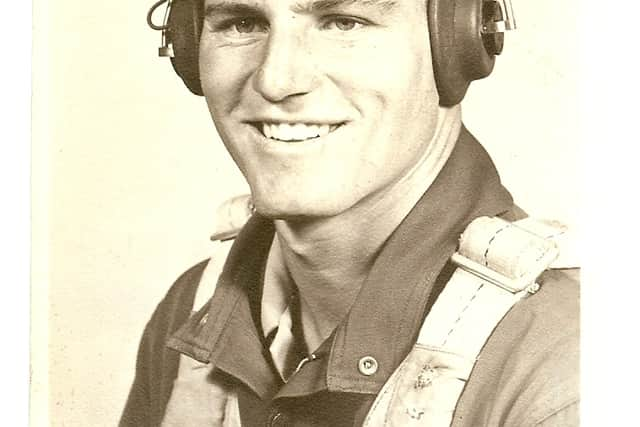
PICTURED: Irish Dillon during his time in the US Air Force
“I was unable to exit the plane until some of the workers cleared some of the bog away”, he said.
Paddy Farrell brought home a fragment of Iris Dillon’s aircraft’s windscreen and the Reilly family have retained this piece of World War II history now for 80 years. The plane, of which there were 10,000 manufactured, was nicknamed the “fork-tailed devil” by the German Luftwaffe, while the Japanese dubbed it “two planes, one pilot.” Iris Dillon’s particular aircraft was furnished with 26 mission markings, meaning it had seen considerable action before its demise in Co Offaly that day.
Iris Dillon was treated like any other American pilot who found themselves stranded in Ireland during that time, and after Local Defence Force members acted as an unarmed guard to Mr Dillon into Portarlington, the San Diego man was transported to the Curragh camp.
According to official records recovered by historian Declan O’Connor, Iris Dillon was provided with “some stimulant and food” before being interviewed and transferred to Baldonnell, where he was returned to Northern Ireland.
This was not the first time Offaly and the area around Edenderry had been caught up in World War II fighting. The town was reported to have been awoken from its sleep one night in 1941 as the Luftwaffe thundered overhead on its way to bomb Belfast. Another incident involved a single dog fight between RAF and Luftwaffe fighter jets in the sky directly above Edenderry while the Garda Sergeant of the day, a Sergeant Byrne, attempted to urge onlookers to go indoors.
Iris Dillon returned to active duty with the US Air Force and records suggest he was active again in the skies over France as soon as August 1944, just weeks after “being dazed” in an Offaly bog.
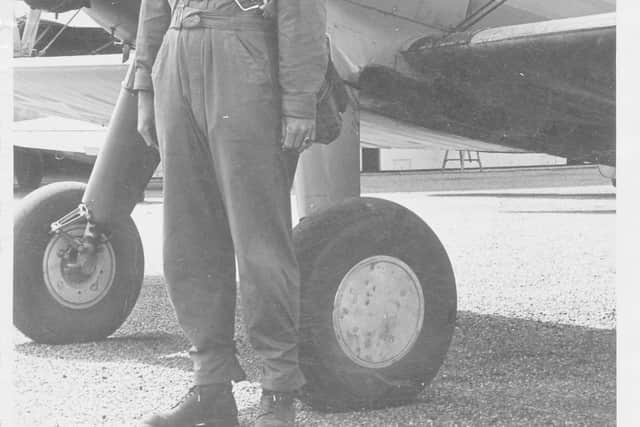
PICTURED: Iris Dillon beside a plane like the one he crash landed on Clonsast bog in 1944
Iris Dillon’s official obituary bears the story of Clonsast bog, where his daughter Len recalled her father telling them about “the day some Irishmen” rescued him on a peat bog. In that same obituary it is documented that Iris Dillon enjoyed the outdoors, “jogging ten miles a day” for much of his life, as well as fishing and camping excursions that he liked to take with his family. His daughter laments her father’s life: “One thing is for sure, we will miss him; his wit, subtle love, demonstrated guidance through actions and the momentum of family spirit.”
Iris Dillon never returned to Offaly or Ireland after his retirement, but with this obituary, and his fascinating life, this county has been written into his history, while his story and the memory of World War II will be forever etched into the ground of Clonsast bog.