
Battle of Donbas could prove decisive in Ukraine war


Russia is pounding the Donbas region of Ukraine with relentless artillery and air raids, making slow but steady progress in a bid to seize the industrial heartland of its neighbour.
With the conflict now in its fourth month, the battle for Donbas is a high-stakes campaign that could dictate the course of the entire war.

A Russian failure could lay the grounds for a Ukrainian counter-offensive – and possibly lead to political upheaval for the Kremlin.
Following botched early attempts in the invasion to capture Kyiv and the second-largest city of Kharkiv without proper planning and coordination, Russia turned its attention to the Donbas, a region of mines and factories where Moscow-backed separatists have been fighting Ukrainian forces since 2014.
Learning from its earlier mis-steps, Russia is treading more carefully there, relying on longer-range bombardments to soften Ukrainian defences.

Ukraine is losing between 100 and 200 soldiers a day, presidential adviser Mykhailo Podolyak told the BBC, as Russia has “thrown pretty much everything non-nuclear at the front”.
President Volodymyr Zelensky earlier put the daily death toll at up to 100.
Ukrainian defence minister Oleksii Reznikov described the combat situation as “extremely difficult”, and used a reference to an ancient deity of sacrifice as he said: “The Russian Moloch has plenty of means to devour human lives to satisfy its imperial ego.”
When the war was going badly for Russia, many thought President Vladimir Putin might claim victory after some gains in Donbas and then exit a conflict that has seriously bruised the economy and stretched its resources.

Russian forces control the entire Sea of Azov coast, including the strategic port of Mariupol, the entire Kherson region – a key gateway to Crimea – and a large chunk of the Zaporizhzhia region that could aid a further push deeper into Ukraine, and few expect that Mr Putin will stop there.
On Thursday, the Russian leader drew parallels between the Ukrainian conflict and the 18th century wars with Sweden waged by Peter the Great.
Now, as in those czarist times, “our lot is to take back and consolidate” historic Russian lands, Mr Putin said. Moscow has long regarded Ukraine as part of its sphere of influence.
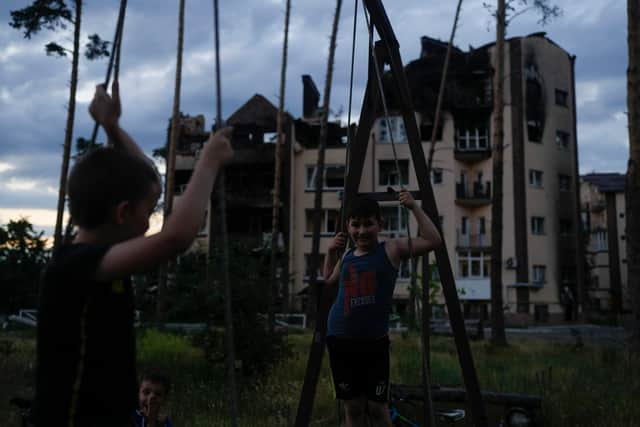
Many had expected it to try to encircle Ukrainian forces with a massive pincer movement from the north and south, but instead it has used a series of smaller moves to force a retreat and not overextend its supply lines.
Keir Giles of London’s Chatham House think-tank said Russia was “concentrating all of its artillery on a single section of the front line in order to grind its way forward by flattening everything in its path”.
Western officials still praise the ability of Ukrainian forces to defend their country, fighting back fiercely and similarly relying on artillery and retreating in some sections while launching frequent counter-attacks.
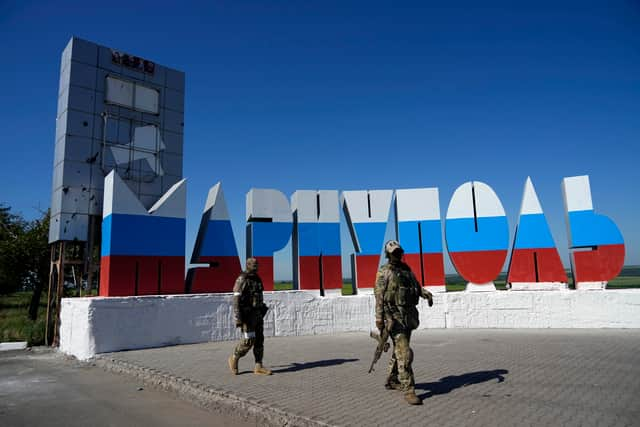
A senior Western official said the Russian campaign “continues to be deeply troubled at all levels”, noting that Moscow’s forces are taking “weeks to achieve even modest tactical goals such as taking individual villages”.
Last month, the Russians lost nearly an entire battalion in a botched attempt to cross the Siverskyi Donets River and set up a bridgehead. Hundreds were killed and dozens of armoured vehicles were destroyed.
“There is a sense of strategic improvisation or muddling through,” the official said, predicting that over the summer the Russian military could reach a “point where they can no longer effectively generate offensive combat power”.
Ukraine has begun to receive more heavy weapons from Western allies, who have provided dozens of howitzers and are now planning to start delivering multiple rocket launchers.
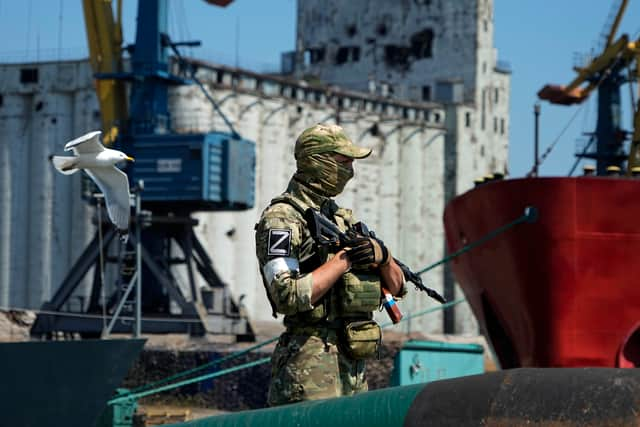
Foreign minister Sergei Lavrov also said that Russia could respond by seizing more land as a buffer zone from such weapons.
A top Russian general already has spoken of plans to cut off Ukraine from the Black Sea by seizing the Mykolaiv and Odesa regions all the way to the border with Romania, a move that would also allow Moscow to build a land corridor to Moldova’s separatist region of Transnistria that hosts a Russian military base.
Such ambitions all hinge on Moscow’s success in the east. A defeat in the Donbas would put Kyiv in a precarious position, with new recruits lacking the skills of battle-hardened soldiers now fighting in the east, and supplies of Western weapons insufficient to fend off a potentially deeper Russian push.
Ukrainian officials brushed off such fears, voicing confidence that its military can hold out to stem the Russian advances and even launch a counter-attack.
“Ukraine’s plan is clear: Kyiv is wearing the Russian army out, trying to win time for more deliveries of Western weapons, including air defence systems, in the hope of launching an efficient counter-offensive,” said analyst Mykola Sunhurovsky of the Razumkov Centre, a Kyiv-based think tank.