
Canterbury suburbs home to some of Britain’s earliest humans, study finds


The Canterbury suburbs were home to some of Britain’s earliest humans, new discoveries have revealed.
The research confirms that Homo heidelbergensis, an ancestor of Neanderthals, occupied southern Britain between 560,000 and 620,000 years ago, when it was still attached to Europe.
This makes it one of the earliest known Palaeolithic sites in northern Europe.

The findings come a century after stone tool artefacts were first uncovered at the site in Fordwich.
Located in an ancient riverbed, the site was originally discovered in the 1920s when local labourers unearthed artefacts known as hand axes (mostly now in the British Museum).
But by applying modern dating techniques to new excavations their age has finally been determined.

Researchers dated these stone tools using infrared-radiofluorescence (IR-RF) dating – a technique which determines the point at which feldspar sand grains were last exposed to sunlight, thereby establishing when they were buried.
Early humans are known to have been present in Britain from as early as 840,000, and potentially 950,000 years ago, but the early visits were fleeting, the study suggests.
Dr Tobias Lauer from the University of Tubingen in Germany, who led the dating of the new site, said: “This is one of the wonderful things about this site in Kent.

Dr Alastair Key from the University of Cambridge, who directed the excavation, adds: “The diversity of tools is fantastic.
“In the 1920s, the site produced some of the earliest hand axes ever discovered in Britain.
“Now, for the first time, we have found rare evidence of scraping and piercing implements at this very early age”.
Homo heidelbergensis was a hunter gatherer known to eat diverse animal and plant foods, meaning that many of the tools may have been used to process animal carcasses, potentially deer, horse, rhino and bison; as well as tubers and other plants.
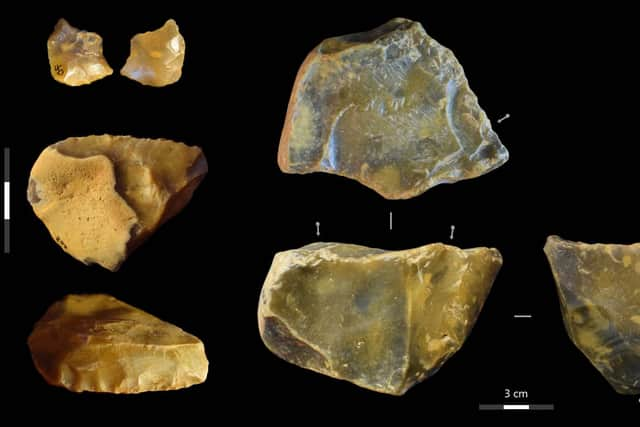
The presence of scraping and piercing implements, however, suggest other activities may have been undertaken.
Dr Tomos Proffitt from the Max Planck Institute of Evolutionary Anthropology, who analysed the artefacts, said: “Scrapers, during the Palaeolithic, are often associated with animal hide preparation.
“Finding these artefacts may therefore suggest that people during this time were preparing animal hides, possibly for clothing or shelters.
“The range of stone tools, not only from the original finds, but also from our new smaller excavations, suggest that hominins living in what was to become Britain, were thriving and not just surviving.”
The findings are published in the Royal Society Open Science journal.