
First Drive: On track in Toyota’s GR Supra Manual
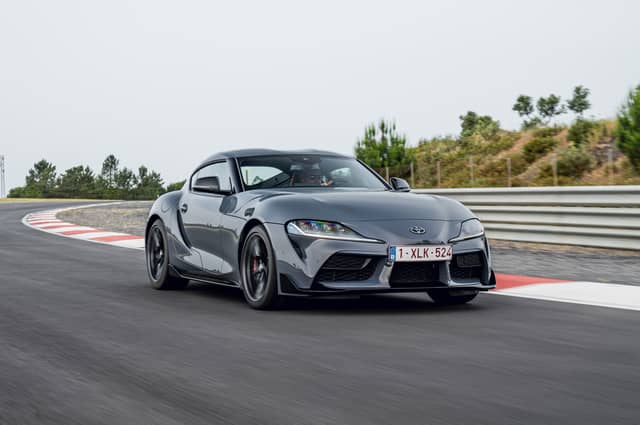

It’s not often that a manufacturer throws in a curveball mid-way through a car’s lifecycle. But that’s just what has happened with Toyota’s Supra. When the famous nameplate was revived onto the most recent car – which happened to share many components with BMW’s Z4 – it was offered only with the option of an automatic gearbox. However, due to overwhelming public demand, it has now equipped the Supra with a six-speed manual for a more involving driving experience.
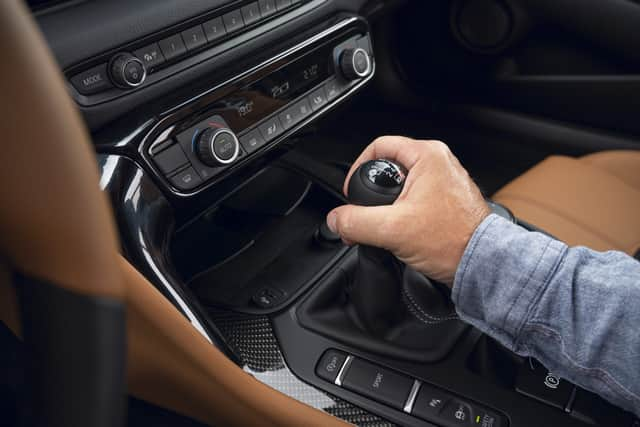
In fact, Toyota wanted to make sure that the placement of the gearstick itself was spot-on, along with the driver being able to easily operate the air conditioning panel – something that was difficult had the stick been placed in the same place as the one on the automatic car. The gearstick itself is one of the few places where weight has been added, too, with a 200g stick fitted to help with shift feel.
For instance, it has been made lighter. All manual-gearbox cars come with these measures, which replace the heavier electrically-adjustable seats for traditional – but lighter – manual versions. There are lightweight 19-inch alloy wheels, too, with all of the changes contributing to a 38.3kg saving over the automatic car.

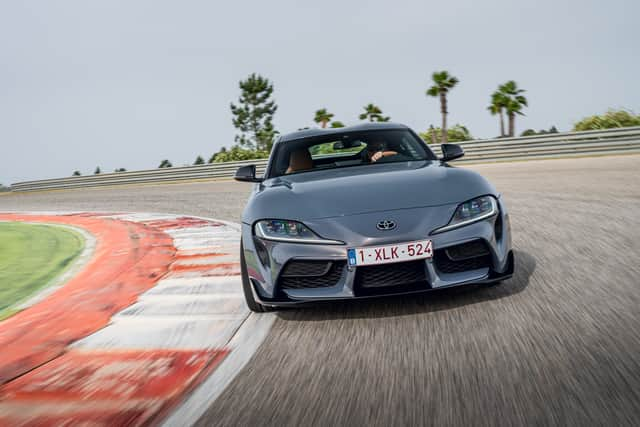
In order to see how these changes felt in the metal, we were given the opportunity to test out the Supra Manual for a short burst around the Monteblanco Circuit near Seville, Spain. It’s a testing track, with a series of complex corners and a long back straight which would work to test out how much more involvement the manual ‘box would bring to the Supra.


But the best part is the control the new gearbox gives you to fully exploit that 3.0-litre turbocharged straight-six. With 335bhp on tap it’s wonderfully powerful, while with the 38.3kg weight saving over the automatic version it feels even more urgent. On paper, the auto is the quicker car – zero to 60mph takes 4.1 seconds against the manual’s 4.3 – but it’s that ability to draw the last ounce of performance from every ratio that makes the difference here.
The revisions to the suspension do mean that the Supra deals even more competently with bends and cambers than before, with Monteblanco’s tricky back section and steep ascents doing little to unsettle the Supra. It can be driven in a more elaborate fashion – this is a rear-wheel-drive car with well over 300bhp, after all – but driven tidily the Supra makes short work of this circuit.
Toyota is already predicting that the 3.0-litre manual Supra will become the most popular car in the range. Though it’s not a night-and-day revision, this is more like a remastered album; it’s got everything that you loved from before, but it’s now even more engrossing than ever.